
Humans evolved more quickly than any other ape, according to a new 3D skull research.
Humans followed a different route.

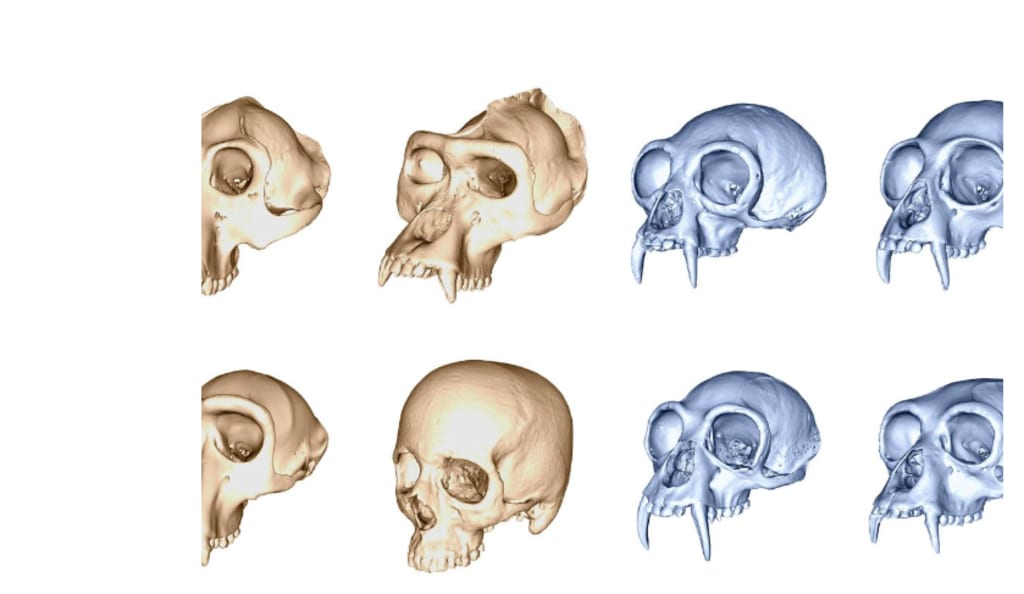
A lengthy evolutionary tale is concealed in every human face. Rapid change can be seen behind the flat cheekbones and curved cranium. According to a recent study from University College London (UCL), our skulls advanced quickly rather than merely evolving.
According to the study, humans evolved larger brains and flatter faces far more quickly than any other animal.
Skull evolution was fastest in humans.
The UCL team created computerised 3D reconstructions of the skulls of nine gibbon species and seven great ape species. They followed each person's evolution over millions of years.
The results were startling: human skulls changed twice as quickly as anticipated. According to Dr. Aida Gomez-Robles of UCL Anthropology, "humans have evolved the fastest of all the ape species."
The fact that humans developed so quickly probably indicates how important skull adaptations related to having large brains and small faces are to humans.
Stress on the evolution of the skull
These adaptations may be linked to the cognitive benefits of having a large brain, but social considerations may also have influenced our evolution, according to Dr. Gomez-Roblez.
While other apes retained longer, projecting characteristics, humans developed smaller faces and rounder heads. Rapid expansion of the braincase gave rise to the shape that we now identify as uniquely human.
Strong evolutionary pressure—possibly from both social behaviour and intelligence—is indicated by this acceleration.
New lifestyles and perspectives
Although gibbons diverged from our ancestry some 20 million years ago, their skulls are nearly the same across species. Its stability rather than sloth on the side of nature.
Gibbons share comparable eating habits, habitats, and monogamous behaviours. Their existence didn't require a significant alteration to their skulls. Scientists were able to utilise them as a reference group because of their slow rate of evolution.
Great apes, such as gorillas, chimpanzees, and humans, on the other hand, encountered a wider range of difficulties. Everybody adjusted in a different way. Massive crests associated with social dominance were created by gorillas. Perhaps to accommodate different lifestyles and ways of thinking, humans altered the shape of their faces and skulls.
The structure of change
Each skull was separated into four sections by researchers: the front, back, upper face, and lower face. After that, they measured the changes over time in each region.
The posterior neurocranium, or back of the skull, saw the fastest evolution. This area grew in humans to accommodate the developing brain. It extended upward into crests in gorillas, signifying strength and maturity.
The diversity of skulls was greater in male apes than in females. This discrepancy probably results from sexual competitiveness, as women were under less pressure to alter their physical appearance while men had to stand out.
Human skulls, both male and female, evolved more quickly than anticipated, although they did not exhibit the same degree of dimorphism as other great apes.
Humans followed a different route.
Not only did humans evolve more quickly, but they also underwent distinct changes. Our skulls evolved in a way that balanced brain size with face reduction, the researchers discovered.
The end outcome was a flatter face and rounder head, characteristics associated with higher levels of communication and intellect. Humans, in contrast to other apes, combined softer facial characteristics with brain enlargement, which may have facilitated social interaction.
This pattern wasn't exclusive to biology. Another factor was social selection. The evolution of the human skull may have been influenced by the capacity to communicate, identify faces, and express emotions.
Gorillas' skulls have evolved at the second-fastest rate after humans, yet their brains are smaller than those of other great apes, according to Dr. Gomez-Robles.
Since greater cranial crests on the top of their skulls are linked to better social standing, it is likely that social selection drove the alterations in their case. Perhaps some comparable Social selection that is specific to humans may have also taken place in humans.
A few skulls were frozen in time.
The majority of apes had minimal alteration. In particular, Gibbons demonstrates what scientists refer to as evolutionary stasis. Because stabilising selection prevented significant variation, their skulls stayed essentially unchanged during time.
Their skulls resemble each other almost exactly, despite having separate chromosomes and occasionally interbreeding. Even though great apes had more freedom to evolve, their cranial diversity was still relatively small in comparison to ours.
That pattern was broken by humans. Evolution was accelerated by the interaction of social complexity and brain expansion. Humans rebuilt what worked, while other species preserved it.
Human brains and skulls are connected
The findings revealed a significant division: the face and braincase developed under distinct stresses. The face represented social and environmental demands, whereas the brain region changed to accommodate growing cognition.
Nevertheless, both evolved simultaneously in humans. According to some scientists, the emergence of softer features, calmer temperaments, and stronger social ties is a sign of self-domestication.
Climate may have also been a factor. Human survival in varying temperatures and humidity levels may have been aided by variations in nasal and facial forms. Our skulls evolved to be adaptable, capable of balancing breathing, thinking, and belonging.
Human skulls of men and women
The evolution of the cranium was subtly influenced by sex. Great apes' males evolved greater diversity, particularly in species with rigid hierarchies. Male growth phases were probably prolonged by hormones, enabling more prominent bone formations.
Cranial alteration was limited in females since they achieved maturity earlier. From this disparity, humans evolved. Less physical rivalry and more cooperative living resulted from decreased sexual dimorphism.
What is revealed by human skulls
According to this study, humans are evolutionary anomalies. Our skulls underwent rapid, deliberate transformation. Both society and intelligence had a role to play.
Our minds were formed by connection, emotion, and communication just as much as by survival. Gibbons remained unwavering. Gorillas become fearless. The definition of a skull was altered by humans.
Not only did evolution make humans think, but it also made us identifiable. It wrote the tale of what it means to be human in bone and face.
About the Creator
Keep reading
More stories from Francis Dami and writers in Longevity and other communities.
Human brains show our mental states by emitting light and glowing in the dark.
As stimulated molecules release extra energy, photons are released by all living tissues. Researchers refer to the phenomenon as ultra-weak photon emission (UPE) because it is so faint—roughly a million times fainter than the human visual threshold.
By Francis Dami7 months ago in Longevity
Private Jet Pilots Salary in the World in 2026
Private jet pilots remain among the best-paid professionals in aviation in 2026, as the rapid growth of corporate and luxury air travel continues to expand opportunities worldwide. While airline pilots often receive the most public attention, pilots flying private jets for wealthy individuals, corporations, and charter companies frequently earn competitive salaries, flexible schedules, and exclusive career opportunities. Private aviation has grown significantly over the past decade, driven by high-net-worth individuals, multinational corporations, and governments that rely on private aircraft for efficiency and security. As a result, the demand for experienced private jet pilots has increased globally, contributing to higher salaries and improved benefits packages. Average Private Jet Pilot Salary in 2026 In 2026, private jet pilots around the world typically earn between $65,000 and $350,000 per year, depending on experience, aircraft type, and employer. Some highly experienced captains flying ultra-long-range business jets can earn even more. The aviation job market is also influenced by a global pilot shortage, which has encouraged many companies to offer higher pay and incentives to attract qualified pilots. According to industry data, the average private jet pilot salary globally is around $130,000 annually, though the figure can vary significantly depending on region and role. Salary by Experience Level Like most aviation careers, experience plays a major role in determining how much a private jet pilot earns. Entry-level pilots, usually working as first officers or co-pilots, earn around $50,000 to $85,000 annually. These pilots typically have limited flight hours and are still building experience with charter companies or smaller aircraft operators. Mid-career pilots, with several thousand hours of flight experience, usually earn between $85,000 and $150,000 per year. They may fly larger business jets or work for established corporate aviation departments. Senior captains, who often have more than 5,000 flight hours and extensive training, can earn $150,000 to $250,000 or more annually. These pilots typically command large luxury aircraft used for international travel by corporations and wealthy clients. In some elite positions—such as flying ultra-long-range jets like Gulfstreams or Bombardier Global aircraft—captains can earn over $300,000 per year, particularly when bonuses and allowances are included. Regional Salary Differences Private jet pilot salaries vary significantly by region due to economic conditions, demand, and the size of the private aviation market. United States The United States remains the largest private aviation market. Pilots there earn an average of about $131,000 annually, with experienced captains earning far more depending on aircraft type and employer. Europe In Western Europe, salaries typically range from €70,000 to €150,000 per year, while Eastern European markets tend to offer lower pay due to smaller private aviation sectors. Middle East Countries in the Middle East, especially the United Arab Emirates and Saudi Arabia, offer some of the most attractive compensation packages. Pilots can earn $100,000 to $180,000 annually, often with tax-free income and housing allowances. Asia-Pacific Rapid economic growth in countries such as China and Singapore has expanded the private aviation market in Asia. Experienced private jet pilots in this region can earn well above $200,000 per year depending on aircraft type and contract conditions. Factors That Influence Salary Several factors determine how much a private jet pilot earns. Aircraft type is one of the biggest influences. Pilots flying larger or long-range aircraft typically earn more because these jets require advanced training and greater responsibility. Experience and flight hours also play a major role. Pilots with thousands of hours logged and multiple aircraft certifications can negotiate significantly higher salaries. Employer type is another important factor. Corporate flight departments for large companies often offer higher salaries and more stable schedules compared with charter operators or freelance contracts. Additional Benefits In addition to base salary, private jet pilots frequently receive a range of benefits, including: Housing allowances Travel and meal allowances Health insurance Retirement plans Performance bonuses These benefits can significantly increase a pilot’s total compensation package. Outlook for the Future The outlook for private jet pilots remains strong in 2026. Growing global wealth, expanding corporate travel, and increased demand for private aviation continue to support the industry. As a result, skilled pilots are likely to remain in high demand. For aspiring aviators, becoming a private jet pilot requires years of training, thousands of flight hours, and specialized certifications. However, for those who reach the top levels of the profession, the financial rewards and career opportunities can be exceptional. In a rapidly evolving aviation landscape, private jet pilots continue to play a crucial role in connecting global business leaders, governments, and high-profile individuals across continents—while enjoying one of the most lucrative careers in the skies.
By Fiaz Ahmed 2 days ago in Longevity
Beginner Workout Routine at Home Without Equipment (Step-by-Step Full Body Guide)
Introduction Starting a fitness journey can feel overwhelming, especially for beginners who do not have access to a gym or expensive workout equipment. Many people want to improve their health and strength but are unsure where to begin or worry that working out at home may not be effective. The good news is that you do not need a gym membership or specialized machines to build a strong and healthy body. A well-structured beginner workout routine at home without equipment can help you develop strength, improve endurance, and establish a sustainable fitness habit.
By Core Well Fit4 days ago in Longevity




Comments
There are no comments for this story
Be the first to respond and start the conversation.