
How Weight-Loss Injections Are Making Obesity a Class Issue
The jabs transforming millions of lives are barely reaching those who need them most. As the rich get slimmer on private prescriptions, experts warn Britain is sleepwalking into a two-tier health catastrophe, and the poorest will pay the highest price.


Debbie lost almost three stone. She felt better than she had in years. Then the price of her medication went up from £199 a month to £301 and she had to stop. "I'm getting to the stage of desperation," she told STV News. "If I could get the same medication cheaper, I would." She has since been placed on an 18-month NHS waiting list for specialist weight management support. "I just hope the NHS can help soon. It's not just about losing weight, it's about getting my life back."
Debbie's story is becoming one of the defining healthcare narratives of our time. A new generation of weight-loss injection drugs like Mounjaro (tirzepatide) and Wegovy (semaglutide) has been hailed as the most significant advance in obesity medicine in decades. Clinical trials show patients losing between 15% and 22% of their body weight. The drugs reduce blood pressure, protect the heart, ease joints, and in some emerging studies, may even slow cancer growth. They do not just treat obesity's symptoms. For many patients, they end the condition itself.
But access to these drugs is being quietly decided not by clinical need, but by bank balance. And the consequences could reshape health inequality in Britain for a generation.
"The lack of fairness is apparent to patients."
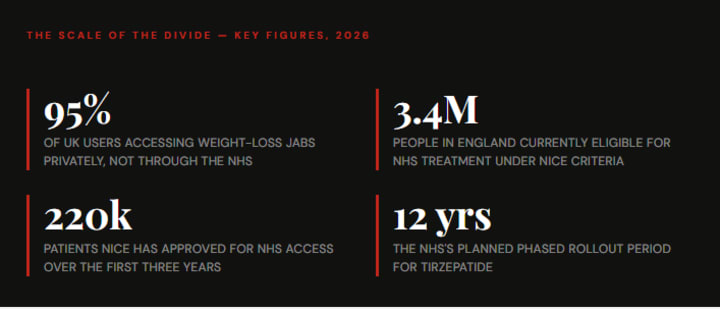
In December 2024, around 500,000 people in the UK were using semaglutide or tirzepatide. Of those, 95% were paying for it privately. By early 2025, a UCL survey estimated 1.6 million UK adults had used a weight-loss drug in the past year, the vast majority through private providers. A Mounjaro prescription typically costs around £200 a month, rising to over £300 at higher doses after Eli Lilly raised its UK prices by up to 170% in September 2025.
Meanwhile, the NHS is rationing access with strict eligibility thresholds. Under rules introduced in June 2025, patients can only receive tirzepatide via their GP if they have a BMI of 40 or above adjusted for ethnicity and at least four diagnosed co-morbidities, including conditions such as type 2 diabetes, high blood pressure, heart disease, and obstructive sleep apnea. Under that criterion, NICE has capped access at just 220,000 patients across the first three years of a 12-year rollout.
"There is a postcode lottery with weight management services. The lack of fairness is apparent to patients - some are able to get started and others are not."
Dorottya Norton, Specialist Weight Management Lead, Homerton Healthcare
Across London, senior doctors told the London Assembly Health Committee in September 2025 that the gap between what patients want and what the system can deliver had become untenable. "We need some degree of consistency across London so patients can get away from the postcode lottery," one clinician said. "It's becoming a difficult clinical environment. Many patients are also self-funding, so inequality is growing."
The cruel logic of the eligibility rules
There is a brutal paradox buried within the NHS's gating criteria. The qualifying conditions diabetes, high blood pressure, and sleep apnea must be formally diagnosed before a patient can access treatment. But researchers at King's College London have documented a stark pattern: these exact conditions are most likely to go undiagnosed in the communities that need them most.
🔬 Research Finding — King's College London, January 2026
Publishing in the British Journal of General Practice, researchers warned that current NHS eligibility criteria for tirzepatide risk creating a formal two-tier system. The conditions used to gatekeep access diabetes, high blood pressure, and sleep apnea, are frequently under-diagnosed in women, people from minority ethnic communities, those from low-income backgrounds, and patients with severe mental illness. In other words, the rules systematically exclude the people most at risk of advanced, untreated obesity.
There may be reason for cautious optimism on the cost front. Patents on semaglutide are due to expire in some markets in 2026, which could eventually open the door to cheaper generic versions. An oral form of semaglutide, a daily pill rather than a weekly injection, was launched in the US in January 2026 and is expected to reach the UK, potentially offering a more accessible and affordable alternative. The Scottish Government has also launched a trial offering free access to weight-loss drugs for up to 5,000 people in the country's most deprived areas.
What would fairness look like?
Researchers are united on the direction of change needed, even if the path there is contested. The King's College team has called for revised eligibility criteria that move away from requiring multiple pre-existing diagnosed conditions towards recognizing obesity itself as the primary condition warranting treatment. They also call for culturally adapted wraparound support dietary, psychological, and lifestyle services without which the drugs are less effective and less sustainable.
Community pharmacies, which are more concentrated in deprived areas than GP surgeries, have been proposed as a delivery vehicle for wider access. The government's 2026/27 GP contract has introduced £25 million in ring-fenced funding and two new obesity indicators in the Quality and Outcomes Framework, requiring practices to identify and support patients with obesity more consistently. It is a step. But experts say it is a small one against the scale of what is needed.
"Unless we adjust how eligibility is defined and how services are delivered, the planned rollout risks creating a two-tier system - where ability to self-fund determines access to treatment."
Dr Laurence Dobbie, King's College London - British Journal of General Practice, 2025
The science of these drugs is no longer in question. Decades of skepticism about whether obesity could be treated medically rather than managed through willpower have been dismantled by trial after trial. The drugs work. The question is whether a society that allowed the conditions of poverty to drive up obesity rates will now allow the cure to be rationed by wealth.
For Debbie, on her 18-month waiting list, the answer cannot come soon enough.
About the Creator
Alex
I've built my career around people-focused roles in the software industry, where clear communication, hands-on support, and quality assurance are always top priorities.
The Connection Between ADHD and Genetics.
Commentary An Impulsive Gene? My youngest son jumps from one task to another. Ask him to clean his room, he eventually quits because he becomes fixated on something. He can’t sit still for long. On the other hand, when he’s doing something he likes, he is fixated on it, sometimes barely taking in his surroundings or listening to others.
By Dean Traylora day ago in Longevity
Calling vs Income
There is a tension that never quite goes away once it has been seen clearly, and it sits at the intersection of calling and survival. Some forms of work feel unquestionably meaningful, even necessary, yet remain economically fragile or entirely unsupported. Other forms of work provide stability, predictability, and income, while feeling hollow or misaligned with who a person actually is. Once this divide becomes visible, it is difficult to unsee, and even harder to navigate honestly without resentment creeping in.
By Peter Thwing - Host of the FST Podcast2 days ago in Longevity


Comments
There are no comments for this story
Be the first to respond and start the conversation.