
Halal Cosmetics Market Trends & Summary
A Rapidly Expanding Global Beauty Category Driven by Ethical Consumption, Rising Muslim Population, and Strong Certification Standards

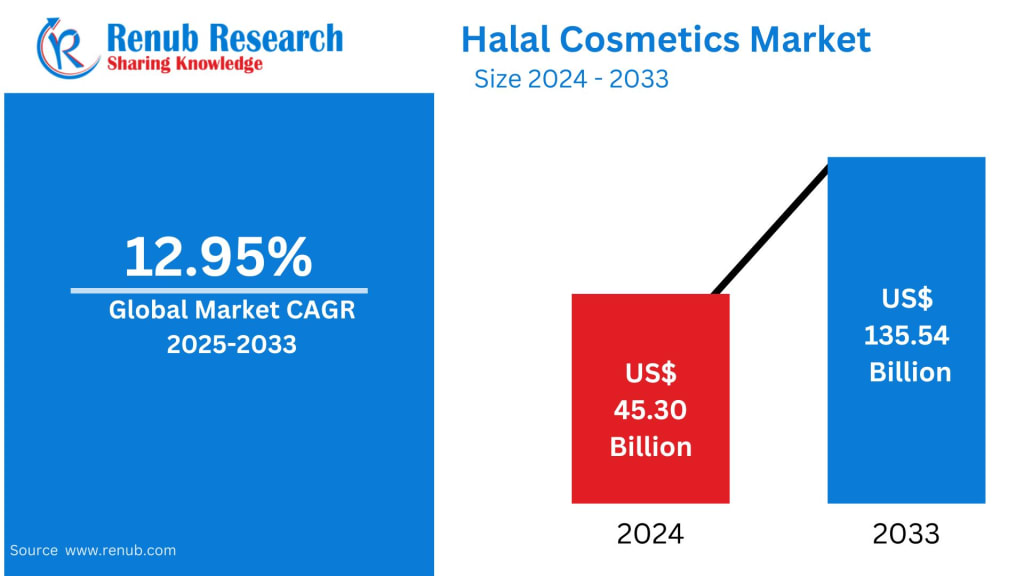
The global Halal Cosmetics market is on track to reach US$ 135.54 billion by 2033, rising from US$ 45.30 billion in 2024, according to Renub Research. With an impressive CAGR of 12.95% from 2025–2033, this sector is one of the fastest-growing segments in the global beauty and personal care industry. The sharp rise in demand is fueled by increasing Muslim populations worldwide, heightened consumer consciousness about ethical and clean ingredients, emerging halal certification standards, and the digitization of retail distribution.
As beauty evolves beyond aesthetics, consumers are prioritizing purity, transparency, and sustainability—values deeply aligned with halal principles. As a result, halal cosmetics are now attracting non-Muslim audiences as well, further widening market appeal and accelerating global market penetration.
This article explores the current landscape, growth drivers, challenges, regional insights, and future potential of the halal cosmetics industry based on Renub Research's Halal Cosmetics Market & Forecast 2025–2033.
Industry Overview: What Makes Cosmetics “Halal”?
Halal cosmetics are defined by their compliance with Islamic law (Shariah) and exclude:
Alcohol and intoxicants
Ingredients derived from pigs, reptiles, insects, or blood
Unethically sourced animal derivatives
Contaminated or unclean production materials
Formulations must adhere to recognized halal standards such as MS 2200-1:2008 for cosmetics and personal care and MS 2200-2:2013, which regulates the use of bone, skin, and hair.
Beyond religious observance, halal cosmetics appeal to the growing cohort seeking safe, natural, cruelty-free, and eco-friendly products. These values resonate globally, including in countries with relatively small Muslim populations.
Large markets such as Malaysia, India, China, and the United States are enabling the cross-border sale of halal-certified beauty goods, further expanding industry reach and reinforcing consumer trust.
Growth Drivers Fueling the Halal Cosmetics Market
1. Shift Toward Ethical Consumption & Transparency
Today’s consumers—Muslim and non-Muslim alike—are scrutinizing ingredient labels more than ever. Halal cosmetics stand out as they guarantee:
Ingredient purity and safety
Ethical sourcing methods
Animal welfare compliance
Eco-friendly production processes
This aligns with rising consumer demand for:
Clean-label products
Cruelty-free formulas
Vegan or plant-based beauty
Chemical-free and hypoallergenic skincare
As public awareness of health and sustainability intensifies, halal cosmetics benefit from being perceived as inherently safer and more responsibly produced.
2. Stronger Certification Frameworks
The global standardization of halal certification has transformed the sector. Clear, enforceable rules provide:
Greater consumer trust
Reduced cross-contamination risks in manufacturing
Easier international trade across Europe, APAC, GCC, and North America
Governments and certification bodies are introducing stricter guidelines, which enhance product integrity and encourage new brands to enter the halal beauty sector with high-quality offerings.
3. Growing Religious Observance & Rising Muslim Demographics
With over 1.9 billion Muslims worldwide, halal beauty is evolving into a necessity rather than a niche category. Rising adherence to religious values enhances demand for halal-certified personal care.
Additionally, increasing disposable incomes among Muslim-majority nations further stimulate premiumization trends in cosmetics, from skincare to fragrances and color makeup.
4. Digital Commerce & Social Media Influence
Online platforms, influencers, and beauty creators across Indonesia, Malaysia, the Middle East, India, and Europe have played a significant role in:
Educating customers about halal standards
Promoting transparency in formulations
Inspiring product trials and reviews
Expanding global brand visibility
E-commerce platforms such as Amazon, Shopee, Lazada, and regional beauty retailers now carry extensive halal-certified inventories, accelerating cross-border market growth.
Challenges Hindering the Halal Cosmetics Market
1. Intensifying Competition with Conventional Beauty Brands
Many mainstream beauty giants are adopting:
Sustainable ingredients
Cruelty-free certifications
Vegan formulations
This narrows the distinction between halal and non-halal brands for everyday consumers seeking ethical beauty. As a result, halal cosmetics brands must highlight:
Religious authenticity
Ingredient purity
Compliance certifications
Specialized halal-friendly alternatives
2. Lack of Global Standardization of Certification
Halal guidelines vary widely across countries. Definitions of “halal” may differ, causing confusion among manufacturers and consumers. This inconsistency creates barriers for international brand expansion.
Unified certification protocols would help streamline production and enhance consumer confidence.
Market Segment Trends
Personal Care Products Hold the Largest Market Share
Muslim women, young Gen Z consumers, and ethically aware buyers increasingly prefer halal personal care offerings such as lotions, shampoos, cleansers, and body-care products. Their rising adoption is driving the category's dominance.
Skincare Leads Revenue Generation
Skincare continues to outpace other segments due to:
High consumer investment in daily skincare routines
Demand for gentle, natural, halal-certified ingredients
Popularity of serums, moisturizers, and anti-aging products
Skincare's leadership also reflects broader global beauty trends where skin health takes precedence over makeup.
Supermarkets & Hypermarkets Dominate Distribution
Large retail chains greatly boost product visibility. Their credibility also increases consumer confidence in halal certifications.
Online retailers are growing rapidly, but supermarkets remain the most trusted and widely used distribution channel globally.
Regional Insights: Global Halal Cosmetics Market Overview
Renub Research divides the market across 24 countries spanning North America, Europe, Asia, MEA, and the Rest of the World. Below are highlights of four important markets:
United States
The U.S. halal cosmetics market is expanding rapidly due to:
Increasing demand for natural and cruelty-free products
A sizeable Muslim population
Inclusion of halal cosmetics in major retail chains
Strong growth of e-commerce beauty shopping
Challenges include inconsistent certification standards and competition from ethical non-halal brands. However, rising awareness ensures steady long-term expansion.
Germany
Germany’s market is being shaped by:
Strong demand from Muslim consumers
Rising interest in vegan, clean, and sustainable beauty
Robust specialty store and online retail presence
The key hurdle remains the lack of standardized certification across Europe. Still, growing consumer awareness is strengthening the category.
Indonesia
As one of the world’s largest Muslim-majority nations, Indonesia is a powerhouse for halal cosmetics. Growth is driven by:
Strong cultural adherence to halal principles
Expanding middle class and purchasing power
Nationwide demand for chemical-free, cruelty-free beauty
Government support for halal standardization
Domestic and international brands are expanding aggressively into this lucrative market.
Qatar
In Qatar, rising demand is fueled by:
Preference for alcohol-free and ethically sourced cosmetics
Growing awareness of halal-certified beauty
Strong retail presence through supermarkets and luxury stores
Higher product pricing and certification inconsistencies remain challenges, but demand continues to grow as consumers increasingly choose ethical beauty alternatives.
Halal Cosmetics Market Segmentation (Renub Research)
By Product Type
Color Cosmetics
Personal Care Products
Fragrances
By Applications
Hair
Skin
Face
Beauty Care
By Distribution Channels
Hypermarkets & Supermarkets
Online Stores
Convenience Stores
Specialty Stores
Others
Countries Covered
24 nations, including the U.S., Canada, Germany, United Kingdom, India, Indonesia, China, Malaysia, Saudi Arabia, UAE, Qatar, Nigeria, Turkey, Egypt, and more.
Key Companies Profiled
Estee Lauder
L’Oréal
S&J International Enterprises
Kao Corporation
Clara International Beauty Group
INIKA
AMARA Cosmetics
WARDAH Cosmetics
Sampure Minerals
Halal Cosmetics Company
Each company includes:
Overview
Recent Developments
Revenue Insights
Final Thoughts
The halal cosmetics market is moving from niche to mainstream, driven by shifting consumer values, rising global incomes, and the increasing visibility of ethical beauty. As certification standards strengthen and companies innovate with natural, clean formulations, halal beauty is positioned to become one of the most influential forces shaping the future of global cosmetics.
With a forecast of US$ 135.54 billion by 2033, the runway for growth is long—and brands that prioritize transparency, inclusivity, and ethical sourcing are best poised to lead this expanding market.
About the Creator
Keep reading
More stories from Aaina Oberoi and writers in Longevity and other communities.
Nano Robotics Industry Overview: A Future Shaped by Molecular Machines
The nano robotics industry is one of the most transformative technological frontiers of the 21st century. Built around the development of robots between 1 and 100 nanometers, nano robotics aims to perform tasks at the molecular and cellular level—an ability that could reshape healthcare, environmental monitoring, manufacturing, and more. Although commercial adoption remains in its early stages, global investments and research momentum indicate a rapidly accelerating market with far-reaching implications.
By Aaina Oberoiabout a month ago in Longevity
Day 4 of Quitting
If this is how sobriety feels, maybe it’s better to go through life a little buzzed… this, along with other hits like, I want to kill myself, I wish I was dead, and I’m going to throw myself off a bridge have been the only thoughts on rotation these past few days. I promise myself that if, in a month, I still feel like this (‘this’ meaning despondent, full of rage, and simultaneously numb) I can go back to smoking. Until mid-February though? Nicotine is off the table.
By sleepy drafts6 days ago in Longevity


Comments
There are no comments for this story
Be the first to respond and start the conversation.