
Grieving for a Body That You Can't Ever Return to
Revelations after being diagnosed with Ehlers-Danlos Syndrome

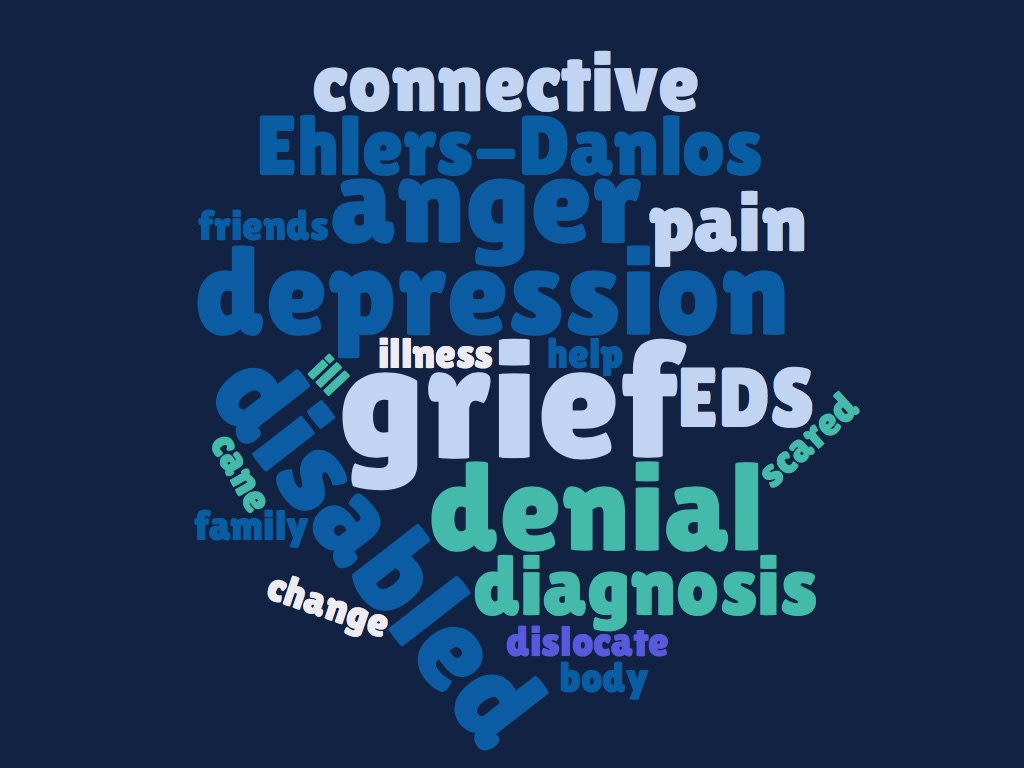
Three years ago I was diagnosed with a rare connective tissue disorder called Ehlers-Danlos Syndrome (EDS). I'd gone from dancing three or four times a week to much less exercise and my body didn't agree. I began having a lot of pain and my shoulders and fingers were dislocating a lot, so I finally got a referral to a rheumatologist and they confirmed it was EDS. From there I kept getting more and more symptoms and less and less mobility.
Last year (two years into my diagnosis) I realised I had not accepted my new disability. I hadn't used that word to describe myself, I hadn't put any images of me using my walking stick online and I hadn't talked to a lot of my friends about it. Accepting I couldn't dance again was hard. I can't shower with hot water, I struggle opening packages and I can't do a food shop without a two-hour nap after. I was putting together an editorial to raise awareness for EDS for Conker Magazine and whilst writing it, I came to a realisation that I was grieving. I was grieving a body I would never have again.
Since my EDS got worse I've seen a lot of changes to my body and strength. Exercise is hard because of fatigue, dislocations, and pain so I have put on a considerable amount of weight that I can't burn off. I have stretch marks all over my body from putting on weight and a stretchy skin symptom from EDS. I have very little strength in my muscles as I'm losing muscle tone and more and more joints are starting to dislocate. I get brain fog (memory loss) when I'm tired, when it's hot or when my pain levels are high. I'm missing my 20-year-old body when I could do sport, I found general tasks easier to complete and my mind and memory were sharp.
Once I worked out I was going through some type of grief I started looking into it. I had never heard of grieving something that wasn't a death but it seemed to resonate with the situation and me. The five stages of grief are denial, anger, bargaining, depression, and acceptance. Spoiler, they aren't lying!
Denial, check! I refused to use the word disabled or tell any of my friends I had started using a walking stick. They were all away at university and so it was pretty easy to hide it. Any family that didn't live with me or see me regularly didn't know about the diagnosis or progression either. I was happier to pretend it wasn't happening.
Anger, check! After falling down the stairs and dislocating my shoulder 15 minutes before I was about to leave for a big gig I'd secured for work I sat on the floor and sobbed out of anger and frustration. Why did it have to happen then? Why couldn't I get through this one great opportunity without anything going wrong? I wanted a new body, or my old body back, either would suffice. I wanted to be 'normal' again.
Bargaining, check! I'd say I connect with this step the least but I do recognise it a little. Although I knew I could never fix it or get a cure, I would push my luck. I would wear braces on my knees and wrists so I could work all day, even though the logical solution would be to cut down hours or rest. I would push myself until I couldn't move instead of pacing myself. Once I started getting problems with my stomach and bowels I didn't know what to do. I went to extremes in my head, thinking a stoma bag would be better than what I was going through. Where my skin stretches more, my boobs weren't as perky as they once were, even though I was still only in my early 20s. I said I would get a boob job if I had the money, even though that wouldn't fix the collagen in my skin. I wanted any solutions that meant I would have a normal body again, a normal life.
Depression, check! Although not clinically diagnosed, I have definitely been through some very dark and low moments relating to my health and body. There have been days I can't get out of bed, or maybe I don't want to, and days where I just sit there in a daze. When I watch people doing things that I can't join in with or needing to exercise for a release and not being able to. I used to come along to my friend's numerous bowling trips and just say I'd sit and chat. Bowling balls would dislocate my fingers and shoulders no matter how light but every time I would feel so much worse for actually attending. It just reminded me of all the fun things I could no longer do and all the things I would eventually be excluded from because of something I had no control over. There are days where I wish I didn't EDS; that it never existed. Coming to terms with the fact that this is my life now is very big and I haven't learnt to like it yet.
Acceptance, I'm working on it. It's been a huge focus for me this year and a lot of things have been pushed aside to make room for this change of mindset. In reality, I don't have any choice but to accept it. EDS has no cure, no medication and no surgery to fix the symptoms. It's not an infection that can be cleared up or a broken bone that can be put in a cast. Your body produces faulty collagen on a molecular level so supplements won't help and neither will vitamins. I can accept I have EDS forever however; I can't comprehend feeling this much pain, every day, for years and years. I can't fathom that I'll never pick something up again without fear of dislocation or that I'll probably never have a hot shower again. A lot of bras dislocate my ribs and some shoes dislocate my toes. I am not a risk taker and pretty much every activity has a risk of pain now. It makes me feel limited and controlled and I need to work on that but it'll come in time. I never knew that this was a common feeling in the disabled community. Nobody ever talks about it and I thought I was going mad. I couldn't work out why I couldn't just get over it and get on with it until I figured out grieving for something that's still living was a possibility. I was grieving for an old self but I still existed.
Despite everything, I'm currently managing to work and live as much as I can. I'm enjoying being able to create art as a photographer for as long as my body allows. The future for me is pretty uncertain from what I've read and experienced. I have no idea if I'll get to the point that I'll need a wheelchair, or if my EDS will stay at the level it is, so it's quite difficult to look forward with conviction. I hope to be able to continue my work and reach more people with my art. I hope to have a family, as terrifying as pregnancy and EDS is. I hope that my pain eases in places and I get better at managing everything. Realising I was grieving, and dealing with that emotion is the first step to getting through this rough patch and so hopefully, I will find a balance I'm happy with.
About the Creator
Rebecca Gannon
Strong little lady with a chronic illness and a big heart
Keep reading
More stories from Rebecca Gannon and writers in Longevity and other communities.
Mental Health Shouldn't be a Taboo Subject
I think it's mad that people are slated for talking about what is purely another health condition that you have no control over. Just because you can't see it, doesn't mean it's not real. You don't tell a person with a broken leg to just get up and walk normally or that sitting in nature will fix the broken bone.
By Rebecca Gannon9 years ago in Longevity
Best Artwork Styles for Contemporary Living Spaces
Contemporary living spaces are defined by simplicity, clean lines, and intentional design choices. Unlike traditional interiors that rely heavily on ornamentation, contemporary homes often embrace openness, neutral palettes, and functional layouts. Because of this minimal foundation, artwork plays an essential role in adding personality, warmth, and visual depth.
By CEO A&S Developersabout 19 hours ago in Longevity


Comments
There are no comments for this story
Be the first to respond and start the conversation.