
Global Dialysis Market Size and Forecast 2025–2033
Rising Prevalence of Kidney Disorders and Rapid Expansion of Home Dialysis Solutions Drive Steady Market Growth

Dialysis Market Overview
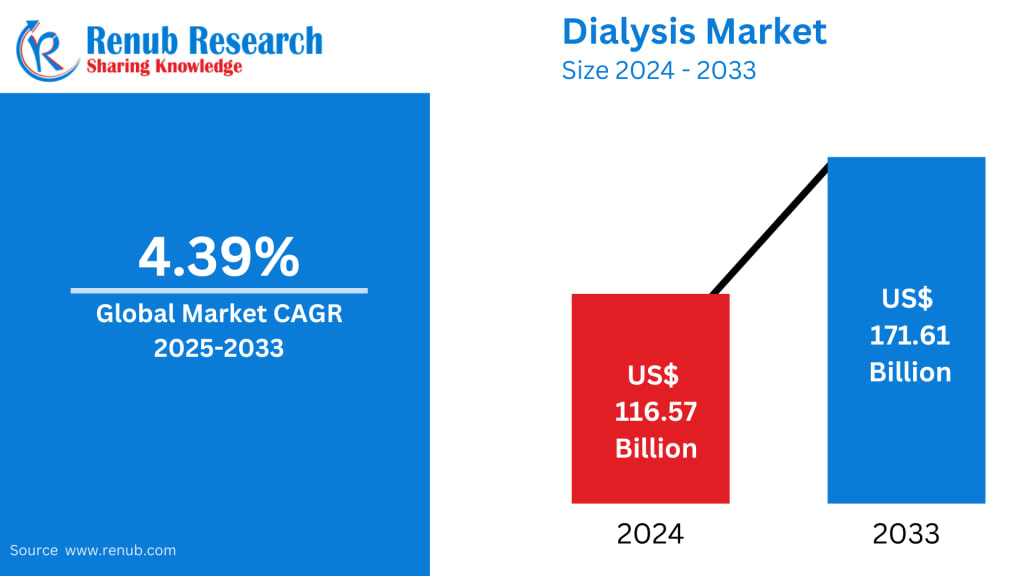
The global dialysis market is entering a phase of transformative growth, powered by increasing disease burden, a rapidly aging population, and technological advancements reshaping treatment accessibility. According to Renub Research, the Dialysis Market is expected to reach US$ 171.61 billion by 2033, rising from US$ 116.57 billion in 2024, at a CAGR of 4.39% between 2025 and 2033.
Dialysis remains a life-sustaining procedure for patients whose kidneys can no longer filter toxins, waste, and excess fluids. The two primary types of dialysis—hemodialysis and peritoneal dialysis—restore balance and help maintain essential physiological functions until a patient receives a kidney transplant, or in many cases, for a lifetime.
Hemodialysis purifies blood through an external machine, while peritoneal dialysis uses the body's natural peritoneal membrane to perform filtration. Though the procedure does not cure kidney failure, it significantly extends life expectancy and supports quality of life for millions of individuals worldwide.
The market’s upward trajectory stems from several influential factors: rising global rates of chronic kidney disease (CKD) and end-stage renal disease (ESRD), growing diabetes and hypertension prevalence, expanding home-based care solutions, and supportive government reimbursement structures. With the percentage of people aged 65+ expected to grow from 10% in 2024 to over 16% by 2050, renal disorders are poised to increase substantially. Projections suggest CKD prevalence in the G3–G5 stages could surpass 10% in multiple regions by 2050 if current trends continue.
As healthcare systems worldwide face mounting strain, innovative dialysis technologies, increasing awareness, and private sector expansion are helping reshape patient access while ensuring long-term market momentum.
Major Growth Drivers for the Global Dialysis Market
1. Growing Need for Advanced Peritoneal Dialysis Methods
The demand for modernized peritoneal dialysis (PD) therapies is rising sharply. Automated Peritoneal Dialysis (APD) and Continuous Ambulatory Peritoneal Dialysis (CAPD) have become particularly influential, especially in developed nations.
In the United States alone, 86% of new PD patients today prefer nocturnal APD, where machines automatically carry out exchanges during sleep. APD offers convenience, minimal lifestyle disruption, and improved toxin removal. CAPD, meanwhile, gives patients manual control and the ability to administer treatment independently throughout the day.
The ongoing shift toward home-based care—accelerated by patient preference for flexibility, reduction in center visits, and infection-control considerations—has strengthened the PD segment. As companies invest in supportive technologies such as remote monitoring, PD adoption is expected to rise even faster across Asia-Pacific, Europe, and Latin America.
2. Expansion of Private Dialysis Facilities and Clinics
The growth of private dialysis centers is significantly influencing the market landscape. These facilities provide flexible scheduling, better staff-to-patient ratios, innovative treatment technologies, and enhanced personalized care.
In India, for example, over 700 dialysis centers with more than 4,000 machines operate primarily under private ownership. Such expansion improves treatment accessibility, especially in urban settings, while alleviating pressure on crowded public hospitals.
Private sector participation also fuels healthy competition, accelerating investments in modern equipment, digital platforms, and patient-centric services. This competition drives quality improvements, inspires innovation, and strengthens treatment outcomes across regions.
3. Lifestyle Changes Leading to Increased Renal Disorders
Chronic kidney disease and ESRD represent some of the heaviest burdens on global healthcare. Lifestyle factors—including sedentary habits, poor dietary patterns, obesity, and long-term diabetes—are intensifying disease prevalence worldwide.
In the United States, over 786,000 people were living with ESRD in 2021, with 71% requiring dialysis, according to the National Institute of Diabetes and Digestive and Kidney Diseases (NIDDKD). Globally, Fresenius Medical Care reported 4.8 million cases of chronic renal failure in 2022, with expected annual growth of 3–6%.
Regulatory bodies are also granting approvals for new dialysis consumables, wearable solutions, and miniaturized equipment. For instance, in May 2021, the U.S. Patent Office approved Victor Gura’s design for a wearable artificial kidney, a significant leap toward greater mobility and independence for dialysis patients.
Such trends underscore the increasing urgency for consistent dialysis supply, robust patient support systems, and continued technological progress.
Challenges Impacting Market Growth
1. High Treatment Costs
Dialysis remains an expensive therapy, often costing thousands of dollars per month. Nations without strong insurance frameworks or government reimbursement programs face the steepest access inequities.
High costs stem from:
continuous use of consumables,
skilled medical staffing,
advanced machines and technology,
long-term facility upkeep,
repeated treatment requirements.
This financial burden limits patient reach in several emerging economies and remains a major obstacle for long-term market democratization.
2. Patient Compliance and Quality of Life Concerns
Dialysis demands strict treatment schedules—several times a week for hemodialysis or daily routines for peritoneal dialysis. Many patients struggle with:
physical fatigue,
psychological stress,
dietary restrictions,
limited mobility,
risk of infections,
social and emotional burdens.
These factors affect both adherence and treatment outcomes. Improving convenience through home-dialysis, wearable devices, shorter session times, and patient education programs is becoming essential to address quality-of-life challenges.
Dialysis Market: Regional Overview
North America
North America leads the global dialysis market due to high healthcare spending, widespread CKD prevalence, and strong private and public dialysis networks.
United States
The U.S. remains the world’s largest dialysis market, supported by:
a large aging population,
high diabetes and hypertension incidence,
strong adoption of home-based dialysis technologies,
robust presence of private dialysis giants.
Though treatment costs remain a barrier, technological innovation and insurance coverage continue to support overall market growth.
Canada
Canada benefits from a publicly funded healthcare system, modern dialysis infrastructure, and strong emphasis on peritoneal dialysis utilization.
Europe
Europe maintains a mature dialysis ecosystem. Germany, the U.K., Italy, and France lead in treatment centers, reimbursement frameworks, and adoption of advanced dialysis technologies.
Germany
Germany’s dialysis market thrives on:
advanced infrastructure,
skilled specialists,
well-structured reimbursement policies,
rising CKD incidence.
Peritoneal dialysis adoption is accelerating, though challenges such as rising treatment costs persist.
Asia-Pacific
Asia-Pacific is the fastest-growing regional market due to large patient populations, improving medical access, and rising private sector investments.
India
India’s dialysis market is expanding rapidly due to:
increasing CKD prevalence,
government programs such as the Pradhan Mantri National Dialysis Programme,
rapid growth of private dialysis chains,
greater adoption of PD and home dialysis.
While affordability challenges remain, domestic innovation and public-private partnerships are improving access.
China, Japan, South Korea, and Southeast Asia
These nations are experiencing growing demand due to aging populations, improved diagnostic rates, and government support.
Middle East & Africa
Saudi Arabia leads the region with strong healthcare investments, modern dialysis centers, and rising adoption of home and peritoneal dialysis solutions.
The UAE and South Africa are also witnessing steady gains, though some African nations still face infrastructure deficits.
Dialysis Market Segmentation
By Type
Peritoneal Dialysis
Hemodialysis
By Product & Services
Services
Equipment
Consumables
Drugs
By End User
Home Dialysis
In-Center Dialysis
By Region
North America: United States, Canada
Europe: France, Germany, Italy, Spain, U.K., Belgium, Netherlands, Turkey
Asia-Pacific: China, Japan, India, South Korea, Thailand, Malaysia, Indonesia, Australia, New Zealand
Latin America: Brazil, Mexico, Argentina
Middle East & Africa: Saudi Arabia, UAE, South Africa
Competitive Landscape: Key Companies
Asahi Kasei Corporation
B. Braun Melsungen AG
Baxter International Inc.
Becton Dickinson and Company
DaVita Inc.
Fresenius Medical Care AG & Co. KGaA
JMS Co. Ltd.
Medtronic Plc.
These organizations are investing heavily in home-dialysis platforms, smart monitoring systems, next-generation machines, and long-term service contracts to strengthen global market positioning.
Final Thoughts
The global dialysis market is transforming rapidly as healthcare systems brace for rising kidney disease rates, expanding elderly populations, and lifestyle-related health challenges. With advancing technologies, growing private sector participation, and increasing home-dialysis adoption, the sector is becoming more patient-centric and accessible than ever before.
Yet challenges persist—especially regarding treatment cost, patient compliance, and regional disparities. As innovations such as wearable artificial kidneys and portable hemodialysis systems edge closer to reality, the next decade may revolutionize how patients receive renal care. With strong market fundamentals and rising demand, the dialysis industry is well-positioned for sustained long-term growth through 2033.
About the Creator
Diya Dey
Market Analyst
Day 4 of Quitting
If this is how sobriety feels, maybe it’s better to go through life a little buzzed… this, along with other hits like, I want to kill myself, I wish I was dead, and I’m going to throw myself off a bridge have been the only thoughts on rotation these past few days. I promise myself that if, in a month, I still feel like this (‘this’ meaning despondent, full of rage, and simultaneously numb) I can go back to smoking. Until mid-February though? Nicotine is off the table.
By sleepy drafts7 days ago in Longevity
The Return of the Aircraft Carrier Truman Is Being Seen as a Snub to the Navy in the War of the Future
The return of the U.S. aircraft carrier USS Harry S. Truman to active deployment has sparked debate far beyond naval circles. While some see it as a show of enduring American naval power, others interpret the move as a symbolic snub—particularly in the context of how modern warfare is rapidly evolving. In an era dominated by drones, cyber warfare, hypersonic missiles, and artificial intelligence, the decision to once again lean heavily on a traditional aircraft carrier has raised uncomfortable questions about whether the Navy is preparing for the wars of tomorrow or clinging to the strategies of yesterday. A Floating Symbol of 20th-Century Power For decades, aircraft carriers have been the ultimate symbol of U.S. military dominance. These massive floating airbases project power thousands of miles from American shores and allow the U.S. to strike almost anywhere in the world. The Truman, like other Nimitz-class carriers, represents this legacy—housing nearly 5,000 sailors, dozens of fighter jets, and unmatched logistical capability. However, critics argue that what once made carriers indispensable now makes them vulnerable. Their sheer size, cost, and visibility turn them into high-value targets in a battlefield increasingly defined by precision strikes and long-range weapons. The “War of the Future” Looks Very Different Modern conflict is no longer limited to sea, land, and air. Cyber attacks can cripple infrastructure without a single shot fired. Drones can swarm targets at a fraction of the cost of traditional aircraft. Hypersonic missiles can reach targets faster than current defenses can respond. In this context, sending a massive carrier strike group into contested waters can appear less like a strategic necessity and more like a risky gamble. Critics argue that the return of the Truman reflects an outdated mindset—one that prioritizes visible force projection over adaptability and technological evolution. A Snub to Naval Innovation? Many analysts and serving officers believe the Navy’s future lies in distributed lethality—smaller, more agile platforms networked together, harder to detect and cheaper to replace. Unmanned surface vessels, autonomous submarines, and land-based missile systems are increasingly viewed as the backbone of next-generation naval warfare. Against this backdrop, recommitting to a traditional carrier is seen by some as sidelining innovation. It sends a message that, despite years of discussion about transformation, the Navy still defaults to familiar tools when tensions rise. This perception has led to frustration among those advocating for faster modernization. They argue that resources devoted to maintaining and protecting carriers like the Truman could instead accelerate investment in emerging technologies that are more relevant to future conflicts. The Strategic Signal to Allies and Rivals Supporters of the decision counter that the Truman’s return is not about nostalgia—it’s about deterrence. Aircraft carriers remain powerful political tools. Their presence reassures allies, signals commitment, and demonstrates readiness in a way few other assets can. Yet even here, the message is mixed. To technologically advanced rivals, the deployment may signal predictability rather than strength. Adversaries have spent years developing strategies specifically designed to neutralize carriers, including anti-ship ballistic missiles and advanced surveillance systems. Cost Versus Capability The financial reality cannot be ignored. A single carrier strike group costs billions of dollars to build, maintain, and operate. In contrast, drone fleets and missile systems can be produced and deployed at a much lower cost, often with greater strategic flexibility. Critics argue that continuing to rely on carriers drains resources from areas where the Navy needs to grow most urgently. In a future conflict defined by speed, dispersion, and digital dominance, the cost-benefit equation of aircraft carriers looks increasingly questionable. Why the Carrier Still Matters—For Now Despite the criticism, aircraft carriers are not obsolete—yet. They remain unmatched in their ability to sustain prolonged air operations without relying on foreign bases. In regions where access is limited or politically sensitive, carriers still provide options no other platform can. The real issue, many experts say, is not the existence of carriers like the Truman, but over-reliance on them. Using them as one component of a broader, more flexible strategy may still make sense. Treating them as the centerpiece of future war planning may not. A Turning Point for Naval Strategy The return of the USS Harry S. Truman highlights a deeper tension within modern military thinking. It represents a crossroads between tradition and transformation, between proven power and emerging threats. Whether history views this moment as a wise assertion of strength or a missed opportunity for innovation will depend on what comes next. If the Navy pairs legacy platforms with bold technological change, the carrier’s return may be justified. If not, it risks becoming a powerful symbol—not of dominance, but of reluctance to adapt in a rapidly changing world.
By Fiazahmedbrohi a day ago in Longevity




Comments
There are no comments for this story
Be the first to respond and start the conversation.