
Global Anti-venom Market Size and Forecast 2025–2033
Rising Snakebite Incidences and Biomedical Innovation Drive a Life-Saving Global Industry

Introduction
The global anti-venom market is emerging as a vital segment within the biopharmaceutical and emergency healthcare landscape, addressing one of the most neglected yet deadly public health challenges worldwide. Snakebites, scorpion stings, and other venomous encounters continue to claim tens of thousands of lives each year, particularly in rural and tropical regions with limited access to timely medical care.
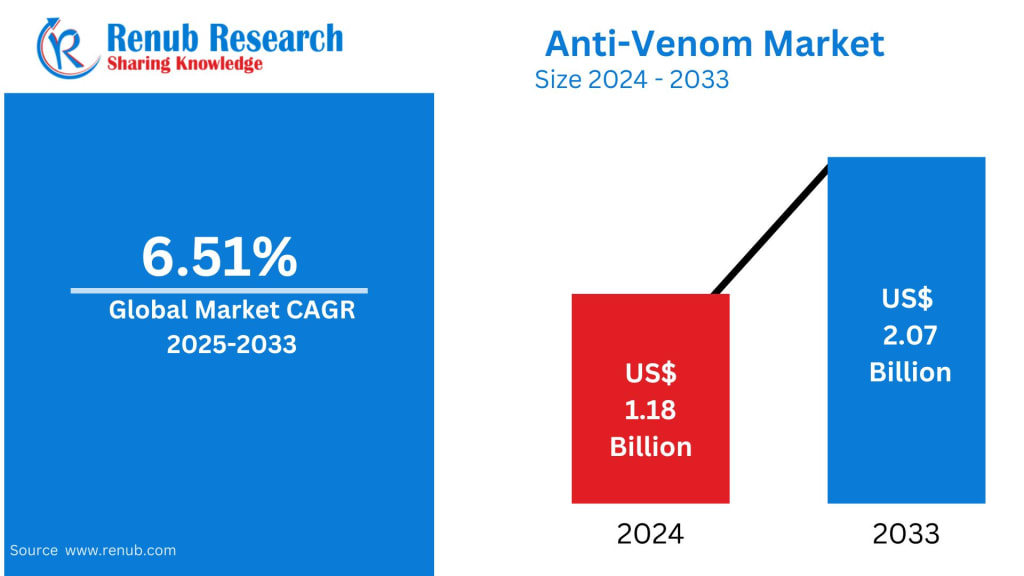
According to Renub Research, the global anti-venom market was valued at approximately US$ 1.18 billion in 2024 and is projected to grow at a compound annual growth rate (CAGR) of 6.51% from 2025 to 2033, reaching around US$ 2.07 billion by 2033. This growth is driven by rising snakebite incidences, technological advancements in antivenom production, increased government intervention, and expanding global health initiatives aimed at reducing venom-related mortality.
As healthcare systems strengthen emergency response infrastructure and manufacturers focus on safer, more effective biologics, anti-venom is gaining recognition as a critical component of global public health preparedness.
Understanding Anti-venom and Its Medical Importance
Anti-venom, also known as antivenin, is a biological therapeutic derived from the serum of immunized animals—most commonly horses or sheep—that produce antibodies against specific venoms. When administered promptly after a venomous bite or sting, anti-venom neutralizes toxins circulating in the bloodstream, preventing severe complications such as organ failure, paralysis, hemorrhage, and death.
The importance of anti-venom extends beyond emergency medicine. It represents a life-saving intervention in regions where venomous animals are part of daily life, particularly in agricultural communities across Asia, Africa, Latin America, and parts of Australia. Increased public awareness, better diagnostics, and improved cold-chain storage are enhancing the reach and effectiveness of anti-venom therapies globally.
Global Anti-venom Market Overview
The rising burden of snakebites—recognized by the World Health Organization (WHO) as a neglected tropical disease—has significantly elevated the demand for anti-venom products. Population growth in rural areas, climate change altering animal habitats, and increased human-wildlife interactions are further intensifying exposure risks.
Healthcare investments by governments and international organizations are improving access to essential medicines, while research institutions and pharmaceutical companies are advancing antivenom formulations to improve efficacy and reduce adverse reactions. Collectively, these factors are creating a favorable growth environment for the global anti-venom market.
Key Growth Drivers
Rising Incidence of Venomous Bites
Snakebites and scorpion stings remain common in developing countries, particularly among agricultural workers. The urgent need for effective and rapid treatment continues to fuel market demand.
Advancements in Anti-venom Technology
Modern purification techniques, recombinant antibody research, and improved immunoglobulin processing are making anti-venoms safer, more potent, and more region-specific.
Government and NGO Initiatives
Public health programs focusing on snakebite management, rural healthcare access, and emergency preparedness are expanding anti-venom availability worldwide.
Expansion of Global Distribution Networks
Improved logistics, cold-chain infrastructure, and partnerships with international health organizations are increasing market penetration in underserved regions.
Top Manufacturers in the Global Anti-venom Market
Bharat Serums and Vaccines Limited (India)
Established in 1971, Bharat Serums and Vaccines Limited (BSV) is a leading biopharmaceutical company specializing in critical care injectables, vaccines, and anti-sera. With exports to over 100 countries, BSV plays a crucial role in addressing snakebite mortality across emerging markets through continuous R&D and international-grade manufacturing.
Boehringer Ingelheim International GmbH (Germany)
Founded in 1885, Boehringer Ingelheim is a global pharmaceutical powerhouse with expertise in biologics and animal health. Its strong research capabilities and regulatory excellence contribute to the development and distribution of high-quality venom-related therapeutics.
Boston Scientific Corporation (USA)
While primarily known for medical devices, Boston Scientific’s advanced healthcare technologies support emergency medicine and critical care environments where anti-venom administration is essential.
CSL Limited (Australia)
CSL is a global biotechnology leader with deep expertise in plasma-derived therapies and immunology. Its advanced biologics platform supports the production of high-quality immunoglobulins relevant to antivenom applications.
Merck & Co., Inc. (USA)
Merck’s broad biopharmaceutical portfolio, global manufacturing network, and commitment to infectious disease solutions strengthen its role in life-saving therapeutics, including anti-venom-related research and supply.
Product Launches and Strategic Collaborations
VINS Bioproducts Limited (September 2024)
VINS Bioproducts strengthened its global footprint by expanding production of snake and scorpion anti-sera, supported by two advanced manufacturing facilities and a 150-acre equine farm. Its products now reach more than 70 countries.
Bharat Serums and Vaccines Ltd. (August 2022)
BSV partnered with the Indian Institute of Science (IISc) to develop next-generation snakebite antivenom, aimed at improving treatment outcomes and reducing mortality in India.
Recent Market Developments
MicroPharm Limited (June 2024)
MicroPharm acquired Sanofi Pasteur’s antivenom portfolio, including Viperfav®, Bothrofav®, and Fav-Afrique®. This acquisition aims to reintroduce region-specific antivenoms to Africa and the Middle East, addressing long-standing unmet needs.
Ophirex, Inc. (March 2022)
Ophirex received U.S. FDA Fast Track designation for varespladib-methyl, a promising small-molecule treatment for snakebite, signaling future innovation beyond traditional serum-based therapies.
SWOT Analysis Snapshot
Merck KGaA – Strengths
Merck KGaA benefits from advanced biologics expertise, robust R&D infrastructure, and global partnerships. Its strong regulatory compliance and antibody production capabilities position it well for next-generation antivenom innovation.
Pfizer Inc. – Strengths
Pfizer’s extensive pharmaceutical experience, large-scale biologics manufacturing, and global logistics network allow rapid deployment of high-quality antivenom products, particularly in emergency and humanitarian settings.
Sustainability Goals Shaping the Market
Butantan Institute (Brazil)
The Butantan Institute integrates sustainability into biomedical innovation by adopting energy-efficient production, responsible waste management, and equitable healthcare access. Its ethical research practices and environmental stewardship strengthen long-term resilience in antivenom production.
South African Vaccine Producers (Pty) Ltd.
SAVP emphasizes eco-friendly manufacturing, renewable energy adoption, and local capacity building. By combining environmental responsibility with public health impact, SAVP supports sustainable healthcare development across Africa.
Market Segmentation Overview
The global anti-venom market is segmented based on:
Type of Venom: Snake, scorpion, spider, and others
Source: Equine-derived, ovine-derived
End-Users: Hospitals, clinics, emergency care centers
Geography: Asia-Pacific, Africa, Latin America, North America, Europe
Emerging markets dominate demand, while developed regions focus on innovation, safety improvements, and stockpile management.
Company Landscape and Strategic Analysis
Detailed analysis for leading companies—including Bharat Serums and Vaccines Limited, CSL Limited, Merck & Co., Pfizer Inc., VINS Bioproducts, MicroPharm, Butantan Institute, and others—covers:
Company history and mission
Business models and operations
Executive leadership and workforce
Mergers, partnerships, and investments
Sustainability initiatives
Product portfolios and pipelines
SWOT and revenue analysis
This comprehensive competitive landscape highlights how collaboration, innovation, and sustainability are shaping the future of the anti-venom market.
Final Thoughts
The global anti-venom market stands at the intersection of urgent public health need and scientific innovation. With Renub Research forecasting growth from US$ 1.18 billion in 2024 to US$ 2.07 billion by 2033, the sector is poised for sustained expansion.
As governments, manufacturers, and global health organizations work together to improve access, affordability, and effectiveness, anti-venom will remain a cornerstone of emergency medical care. The future of this market lies not only in technological advancement but also in equitable distribution, sustainability, and global cooperation—ensuring that life-saving treatment reaches those who need it most.
About the Creator
Marthan Sir
Educator with 30+ years of teaching experience | Passionate about sharing knowledge, life lessons & insights | Writing to inspire, inform, and empower readers.
Keep reading
More stories from Marthan Sir and writers in Longevity and other communities.
Europe Cardiac Surgical Device Market Size and Forecast 2025–2033
Europe Cardiac Surgical Device Market Outlook The Europe Cardiac Surgical Device Market is projected to grow steadily over the next decade, reaching US$ 816.88 million by 2033, up from US$ 609.37 million in 2024, registering a compound annual growth rate (CAGR) of 3.31% from 2025 to 2033, according to Renub Research.
By Marthan Sir22 days ago in Longevity
Day 4 of Quitting
If this is how sobriety feels, maybe it’s better to go through life a little buzzed… this, along with other hits like, I want to kill myself, I wish I was dead, and I’m going to throw myself off a bridge have been the only thoughts on rotation these past few days. I promise myself that if, in a month, I still feel like this (‘this’ meaning despondent, full of rage, and simultaneously numb) I can go back to smoking. Until mid-February though? Nicotine is off the table.
By sleepy drafts6 days ago in Longevity
7 Ways I Trained My Mind to Stop Overthinking
I used to live inside my head. Not in a creative, daydreamy way. In an exhausting, suffocating, never-ending loop of what-ifs and worst-case scenarios. Every conversation replayed. Every decision questioned. Every possibility analyzed until I couldn't move forward at all.
By Fazal Hadi7 days ago in Longevity


Comments
There are no comments for this story
Be the first to respond and start the conversation.