
7 Ways I Trained My Mind to Stop Overthinking
How I escaped the prison of my own thoughts and finally found peace

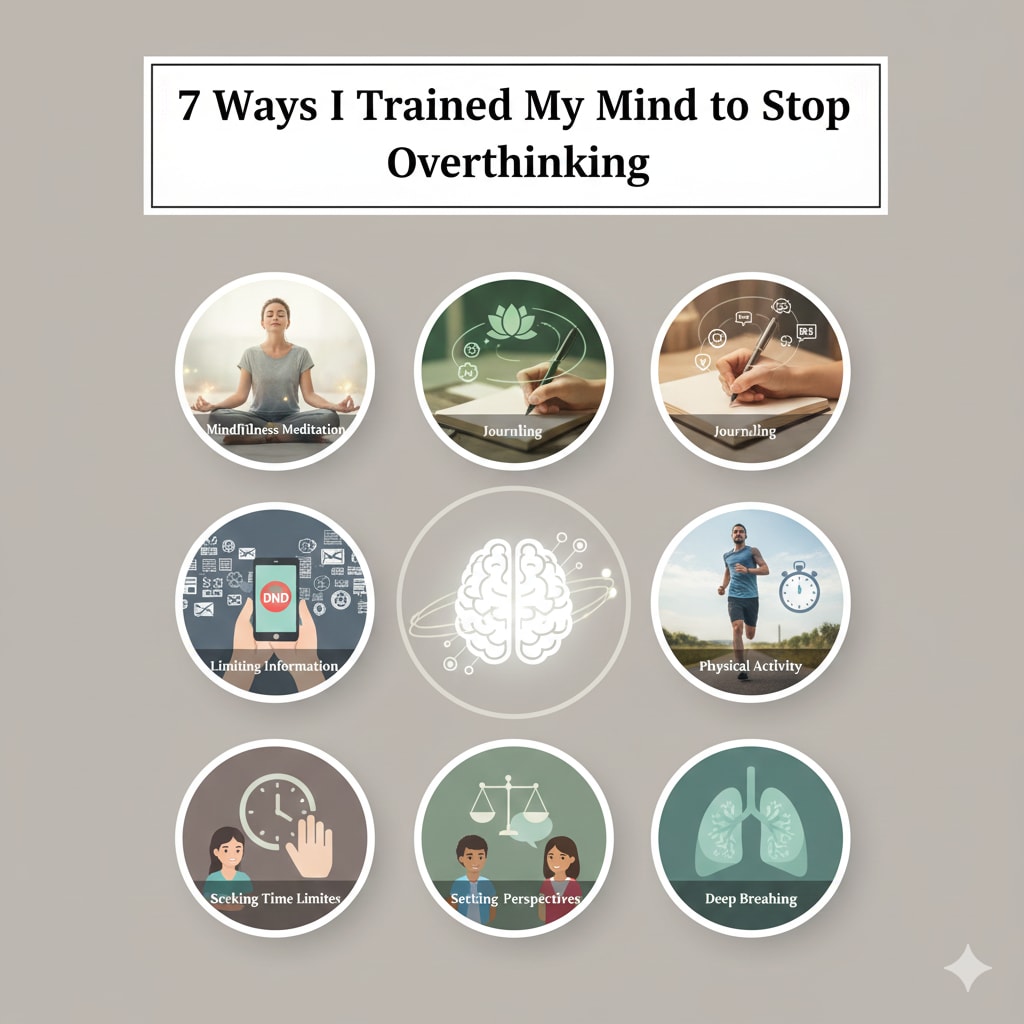
I used to live inside my head.
Not in a creative, daydreamy way. In an exhausting, suffocating, never-ending loop of what-ifs and worst-case scenarios. Every conversation replayed. Every decision questioned. Every possibility analyzed until I couldn't move forward at all.
Overthinking wasn't just a habit—it was a prison. And I was both the prisoner and the guard.
It cost me sleep. It cost me opportunities. It cost me relationships. And one day, sitting at my kitchen table at 3 AM, spiraling through the same thoughts for the hundredth time, I realized something had to change.
I couldn't live like this anymore.
So I started studying my own mind. I experimented. I failed. I tried again. And slowly, I discovered seven strategies that helped me break free from the endless cycle of overthinking.
Here's what saved me.
1. I Named the Voice in My Head
The first breakthrough came when I stopped identifying with every thought that popped into my mind.
I gave my overthinking voice a name—Gerald. And whenever I caught myself spiraling, I'd say, "Oh, there's Gerald again, worrying about things that haven't happened yet."
It sounds silly, but it worked. Creating distance between myself and my thoughts helped me realize I wasn't my thoughts—I was the person observing them.
Gerald could panic all he wanted. But I didn't have to listen.
2. I Set a "Worry Window"
One of my biggest problems was that overthinking took over my entire day. I'd be at work, with friends, trying to sleep—and my mind would hijack every moment with anxiety.
So I created a "worry window"—15 minutes every evening where I was allowed to overthink as much as I wanted. I'd write down every fear, every concern, every spiraling thought. And then, when the timer went off, I closed the notebook.
If a worry popped up during the day, I'd tell myself, "I'll think about that during my worry window."
It trained my brain to realize that not every thought deserves immediate attention. Most of them could wait. And by the time the worry window arrived, half of them didn't even matter anymore.
3. I Asked Myself: "Is This Useful?"
This simple question became my anchor.
Whenever I caught myself overthinking, I'd pause and ask: "Is this thought actually helping me solve a problem, or is it just making me anxious?"
If it was useful—if it led to action or clarity—I'd keep thinking. But if it was just spinning wheels in the mud, creating stress without solutions, I'd let it go.
Not every thought deserves your energy. Some thoughts are just noise.
And learning to recognize the difference changed everything.
4. I Replaced "What If" with "What Is"
Overthinking lives in the future. It feeds on uncertainty. It thrives on imagining everything that could go wrong.
So I started bringing myself back to the present by asking: "What is actually happening right now?"
Not what might happen. Not what could happen. What is.
Usually, in the present moment, I was safe. I was okay. The catastrophe I was imagining hadn't happened yet—and most of the time, it never would.
This shift from "what if" to "what is" became my lifeline back to reality.
5. I Moved My Body
I discovered something powerful: you cannot overthink while you're moving.
When my mind started spiraling, I'd go for a walk. Do jumping jacks. Dance to one song. Anything that got me out of my head and into my body.
Physical movement interrupts the mental loop. It shifts your energy. It reminds you that you're not just a brain floating in space—you're a whole person, and sometimes your body knows how to calm down faster than your mind does.
6. I Practiced the 5-Second Rule
Overthinking thrives on hesitation. The longer I sat with a decision, the more my mind would spiral into every possible outcome.
So I started using the 5-second rule: when I knew what I needed to do, I gave myself five seconds to act before my brain could talk me out of it.
Five. Four. Three. Two. One. Go.
Send the text. Make the call. Take the step. Whatever it was, I did it before overthinking could paralyze me.
Action is the antidote to overthinking. And the faster you move, the less time your mind has to sabotage you.
7. I Gave Myself Permission to Be Wrong
This was the hardest one. And the most important.
I realized that a huge part of my overthinking came from a fear of making the wrong choice. So I'd analyze and re-analyze, trying to guarantee a perfect outcome.
But here's the truth I finally accepted: there is no perfect choice. There's only the choice you make, and what you do with it afterward.
I gave myself permission to be wrong. To mess up. To choose imperfectly and learn as I went.
And the moment I released the need to be right all the time, the pressure to overthink everything disappeared.
The Freedom on the Other Side
I'm not going to lie and say I never overthink anymore. Old habits show up sometimes, especially during stressful seasons.
But now, I have tools. I have strategies. I have a way out of the maze.
And most importantly, I have peace. The kind of peace that comes from knowing you don't have to figure everything out before you move forward. The kind of peace that whispers, "You'll handle it when it comes."
A Message for the Overthinkers
If you're reading this with a mind that won't shut off, a heart that's heavy with worry, and a constant loop of thoughts you can't escape—I see you. I've been you.
And I want you to know: you are not broken. Your mind is just trying to protect you in the only way it knows how.
But you can train it. You can teach it new patterns. You can break free from the endless spiral.
It won't happen overnight. But it will happen. One small shift at a time.
So start today. Pick one strategy. Try it. Be patient with yourself.
Because the person you are on the other side of overthinking—calm, clear, and confident—is worth the work.
And they're waiting for you.
----------------------------------
Thank you for reading...
Regards: Fazal Hadi
About the Creator
Fazal Hadi
Hello, I’m Fazal Hadi, a motivational storyteller who writes honest, human stories that inspire growth, hope, and inner strength.
Keep reading
More stories from Fazal Hadi and writers in Longevity and other communities.
6 Thoughts That Were Quietly Ruining My Progress
I thought I was doing everything right. I woke up early. I set goals. I worked hard. I stayed disciplined. But somehow, no matter how much effort I poured in, I felt like I was running in place. Progress felt impossible. Success felt distant. And every day, I grew more frustrated with myself.
By Fazal Hadi2 months ago in Longevity
Caffeine and Anxiety: How Much Is Too Much for Students?
Coffee before class. Energy drink before assignments. Another coffee for night study. Sound familiar? For many students, caffeine feels like survival. But what if your daily cup is quietly making your anxiety worse?
By Being Inquisitive5 days ago in Longevity
Why You Wake Up Tired Even After 8 Hours of Sleep
You slept for 8 hours. Your alarm rings. And somehow… you still feel exhausted. If you’re constantly waking up tired, you’re not lazy. And you’re definitely not alone. Many students struggle with feeling tired after 8 hours of sleep, and the problem usually isn’t the number of hours — it’s the quality of sleep.
By Being Inquisitive4 days ago in Longevity


Comments
There are no comments for this story
Be the first to respond and start the conversation.