
Forever Young or Doomed to Decay? The Perils of Beating Death
When science meets immortality, what could possibly go wrong?

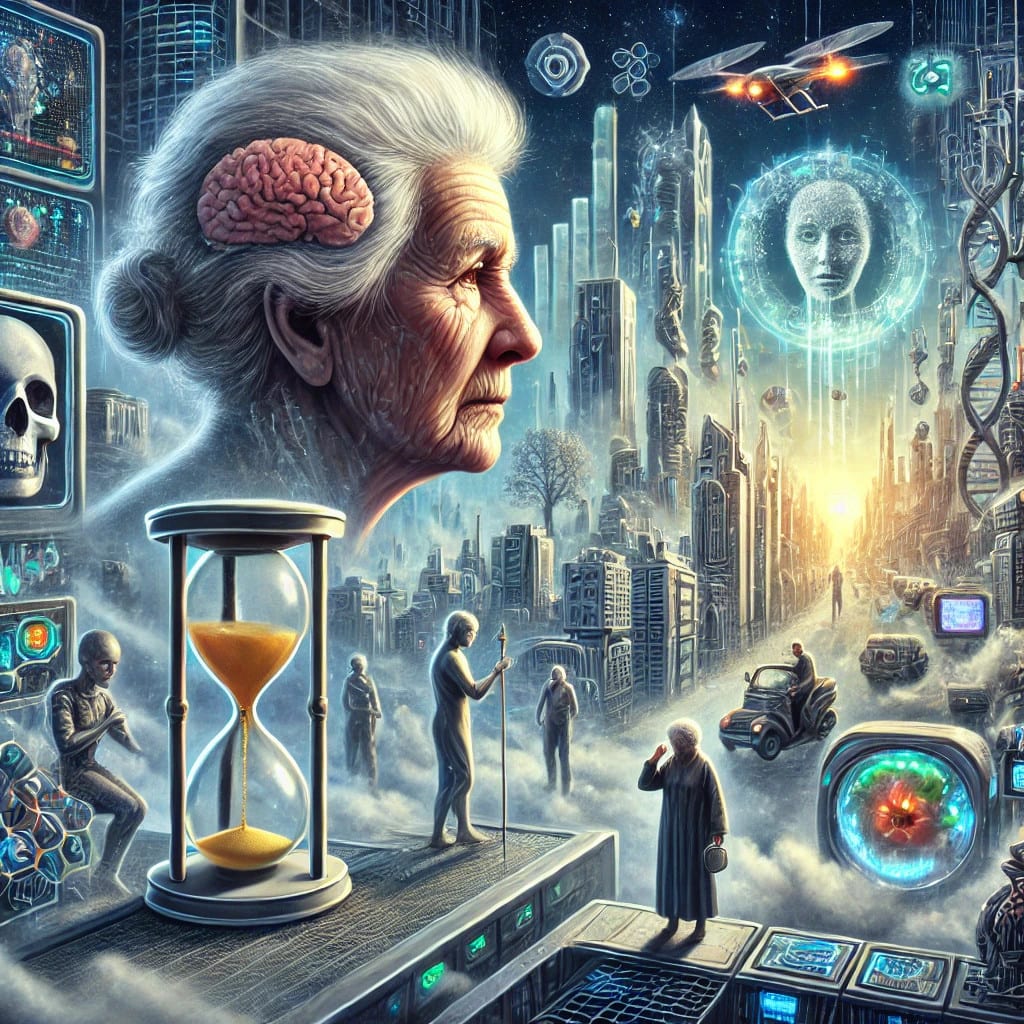
The Promise and the Paradox
Imagine waking up one morning to breaking news: a biotech firm has discovered a treatment that halts aging indefinitely. No more wrinkles, no more diseases of old age, no more ticking clock. Humanity, at long last, has conquered death—or so it seems.
But here’s the catch: what happens to society when no one dies? Would this invention usher in an era of infinite possibilities or open the floodgates to unimaginable chaos? History shows that every technological leap comes with consequences, some foreseen, others catastrophic. So before we rush to sign up for eternal youth, let’s explore what happens when humans defy mortality.
The Science Behind Living Forever
For centuries, alchemists and scientists have searched for the elixir of life. Today, cutting-edge research in genetics, nanotechnology, and cellular rejuvenation is bringing that dream closer to reality. Scientists are developing gene-editing techniques like CRISPR to eliminate age-related deterioration. Companies like Altos Labs and Calico, backed by billionaires, aim to reprogram cells to maintain their youthful state indefinitely.
But longevity research isn't just about genetics. Scientists are exploring nanobots that could repair damaged tissues from the inside, stem cell therapies that regenerate organs, and AI-driven diagnostics to predict and prevent diseases before they even start. These breakthroughs suggest that we might soon have the ability to extend human life far beyond its natural limits.
However, manipulating biology on this scale is uncharted territory. What if halting aging disrupts essential cellular processes? What if curing death has unintended side effects, like an increased risk of cancer or a decline in cognitive function over time? The science of immortality is thrilling, but it's also riddled with uncertainties.
The Biological Trade-Offs
Living forever sounds appealing, but biological constraints might pose unexpected challenges. Cells that refuse to age might also refuse to die when they become damaged, increasing cancer risks. The body’s immune system, designed for a finite lifespan, might struggle to adapt to indefinite existence. And what about neuroplasticity? The brain may not be capable of maintaining mental agility over centuries, potentially leading to cognitive stagnation.
Furthermore, the biology of aging has evolved in such a way that it may contribute to long-term health by naturally clearing out damaged cells. Without aging, the body’s natural processes could be thrown into disarray, creating vulnerabilities that we may not yet understand. It’s not just about halting aging; it’s about ensuring that our bodies can remain functional, resilient, and adaptive as we live for centuries.
The Psychological Burden of Immortality
At first glance, an infinite lifespan seems like a gift. But would our minds be able to handle it? Psychologists argue that mortality gives life meaning. The urgency to achieve, love, and experience stems from knowing our time is limited. Without death, would we lose our drive? Could immortality strip life of its profound sense of urgency and make it feel like an endless waiting game?
Studies on longevity suggest that aging affects more than just the body—it shapes our emotions and relationships. People naturally evolve as they age, learning from loss and adapting to change. If we stopped aging at, say, 30, would we ever develop the wisdom that comes with growing old? Would relationships become stagnant? Would long-term commitments still hold meaning?
Additionally, consider the psychological toll of living indefinitely. Imagine witnessing loved ones pass away, experiencing centuries of heartbreak, and seeing the world change beyond recognition. Immortality could bring mental health challenges that we can’t yet predict. Some might welcome the extra time, but for others, the weight of eternity could be unbearable, leading to depression, existential crises, or even a desire to end it all.
Memory Overload and Identity Crisis
One of the most profound questions immortality raises is how our memories would evolve. Would our minds accumulate endless memories, or would they begin to purge the oldest ones to make room for new experiences? If memories faded over time, what happens to personal identity? Are we truly the same person if we no longer remember our past? These questions challenge the very notion of selfhood.
Would we still maintain our sense of identity, or would we become strangers to ourselves? Over time, the accumulation of countless memories could lead to confusion, emotional detachment, or a profound sense of loss. The concept of personal growth, of becoming the person we are meant to be, might be stunted if we lose touch with who we were in the past.
Overpopulation and Resource Scarcity
Earth’s resources are already stretched thin, and a population that no longer ages or dies would exacerbate the crisis. Imagine cities overflowing with people, job markets stagnating because no one retires, and housing prices skyrocketing because every home remains occupied indefinitely. The strain on resources could become unbearable, especially as food, water, and energy supplies become scarcer.
If birth rates remained the same, the planet would become unsustainable within a few generations. Governments might have to enforce strict reproduction limits or develop radical solutions like space colonization to accommodate the ever-growing human race. Off-world colonization could become a plausible solution, but the cost and technological barriers would present significant challenges. Would this shift humanity from Earth to the stars, or would it exacerbate the inequality between those who can afford to escape and those left behind?
Wealth Inequality and Power Dynamics
Moreover, wealth inequality would explode. The ultra-rich, who could afford early access to life-extending technology, would hold power indefinitely, creating an economic and political system where leadership never changes. Would democracy survive when rulers never age? Or would society evolve into an eternal oligarchy, with the same individuals controlling the world forever?
The influence of the wealthy would expand even further in an immortal world, as those with financial resources could buy access to immortality, monopolizing political and social power. The average citizen would be left with fewer opportunities to affect change, leading to increased disillusionment and perhaps even social unrest.
Potential Solutions to Overpopulation
Some propose off-world colonization as a solution, but space travel remains prohibitively expensive. Others suggest controlled population cycling, where individuals voluntarily retire from existence after a predetermined period. Would people accept such a fate, or would society descend into rebellion and unrest? This solution could allow for a more sustainable population, but it would raise ethical questions about the value of life and personal autonomy.
Perhaps some societies would embrace controlled death, seeing it as a form of self-sacrifice for the greater good. Others might reject it entirely, leading to profound divisions in society. Would people be willing to give up the concept of immortality in exchange for a more balanced and sustainable world?
The Economic Impact of Immortality
With people living indefinitely, traditional economic structures would crumble. Retirement funds would become obsolete, as no one would retire. The workforce would be flooded with experienced individuals, making it difficult for younger generations to find jobs. Would companies be forced to mandate periodic career shifts to prevent stagnation? The concept of career progression and job security would change dramatically in a world where people could work indefinitely.
Additionally, consumer spending patterns would change. Would an immortal population continue to consume at the same rate, or would long-term planning lead to frugality? These shifts could drastically reshape the global economy, forcing new models of trade, taxation, and resource distribution. Governments and companies would need to adapt to a world where retirement and death are no longer factors in the economic equation.
Social and Cultural Shifts in an Ageless Society
How would immortality impact family dynamics? Generations would blur, with great-great-grandparents existing alongside their descendants for centuries. Would the concept of family bonds weaken, or would new structures emerge to accommodate longer lives? The traditional role of elders in many societies might change, as they could live alongside their descendants without the generational gap that currently exists.
Education would need to evolve. Would people continuously retrain in different fields, or would knowledge accumulation slow due to cognitive limits? With centuries of time to accumulate expertise, individuals could become polymaths, mastering multiple fields over their extended lives. This could lead to a renaissance of knowledge and creativity—or, on the other hand, stagnation as people become overwhelmed by the sheer volume of information.
Criminality and the Justice System
How would justice function in a world where criminals no longer age? Life sentences would take on a horrifying permanence. Would capital punishment return, or would alternative sentences be created? The notion of rehabilitation would need to be redefined. If someone serves 500 years in prison, are they still the same person as when they were convicted?
In a society where crime and punishment have no end, justice might need to evolve into something entirely new. Could people who commit horrific crimes ever truly be rehabilitated, or would they become eternal threats to society? Would the very concept of punishment shift from retribution to long-term protection, as offenders are locked away indefinitely?
The Ethics of Playing God
Extending human life raises deep ethical and philosophical questions. Do we have the right to override nature’s design? Would a world without death be a utopia or a nightmare? Would religions adapt to a world where the afterlife is postponed indefinitely, or would belief systems crumble?
One possible compromise is controlled longevity—extending life but allowing for natural death when individuals choose. This model, already explored in fiction, offers a balance between prolonged existence and personal agency. However, it raises the question: would humanity ever be content with anything less than complete immortality, or would this compromise become the next battleground for philosophical debate?
The Black Market of Eternal Life
Not everyone would have legal access to life-extending treatments. This gap would create a lucrative black market, where underground clinics offer unregulated procedures with unknown risks. Organ trafficking, experimental drugs, and unethical human trials could become widespread, pushing desperate individuals into dangerous situations. The very pursuit of immortality could lead to a new wave of exploitation and inequality.
Conclusion: Be Careful What You Wish For
The dream of immortality is as old as civilization itself, but the reality may be more complex than we imagine. Living forever might solve some problems while creating others far worse. Instead of rushing toward eternal life, perhaps we should focus on improving the quality of the years we already have.
After all, a life well-lived—whether it lasts 80 years or 800—is worth more than an eternity without purpose.
What do you think? Would you take the chance to live forever, or is mortality a gift in disguise? Share your thoughts in the comments!
About the Creator
Alain SUPPINI
I’m Alain — a French critical care anesthesiologist who writes to keep memory alive. Between past and present, medicine and words, I search for what endures.
Keep reading
More stories from Alain SUPPINI and writers in Longevity and other communities.
Mastering French Without Losing Your Sanity: A Realistic Guide for Beginners
Learning French can feel like solving a Rubik’s Cube blindfolded. The tricky pronunciation, the never-ending grammar rules, and the surprising exceptions make it seem impossible. But don’t worry—equipping yourself with key expressions and effective strategies can turn frustration into fluency. Let’s simplify French and make learning enjoyable.
By Alain SUPPINIExclusive • 11 months ago
Day 4 of Quitting
If this is how sobriety feels, maybe it’s better to go through life a little buzzed… this, along with other hits like, I want to kill myself, I wish I was dead, and I’m going to throw myself off a bridge have been the only thoughts on rotation these past few days. I promise myself that if, in a month, I still feel like this (‘this’ meaning despondent, full of rage, and simultaneously numb) I can go back to smoking. Until mid-February though? Nicotine is off the table.
By sleepy drafts8 days ago in Longevity


Comments
There are no comments for this story
Be the first to respond and start the conversation.