

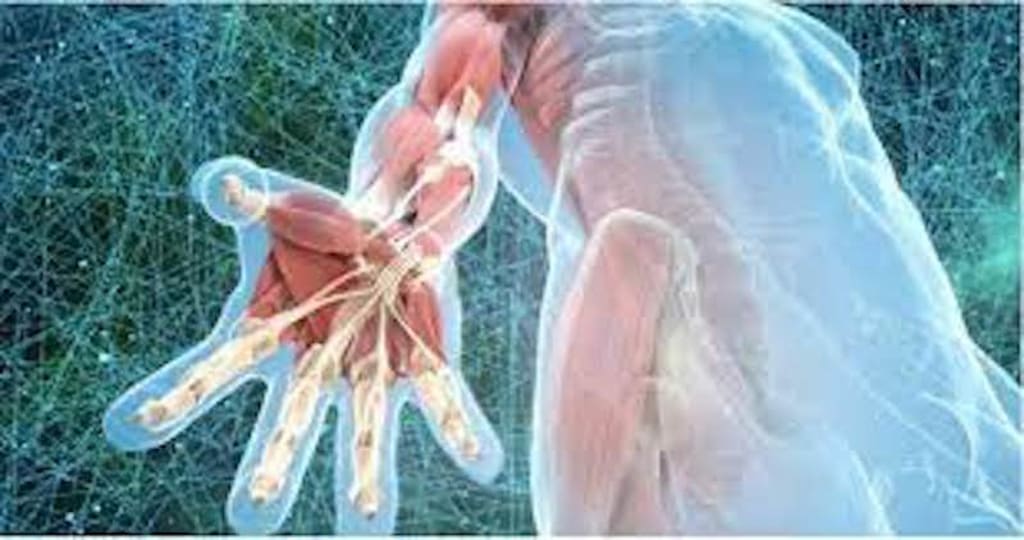
Ever heard of fascia? It happens to be the buzzword in healthcare these days, but it's the newest and least understood system in the body. Research only began about twenty-years ago, and the science is so state-of-the-art that the nomenclature (how they identify it) is still hotly debated.
Check this definition out: The fascial system consists of the three-dimensional continuum of soft, collagen containing, loose and dense fibrous connective tissues that permeate the body. It incorporates elements such as adipose tissue, adventitiae and neurovascular sheaths, aponeuroses, deep and superficial fasciae, epineurium, joint capsules, ligaments, membranes, meninges, myofascial expansions, periostea, retinacula, septa, tendons, visceral fasciae, and all the intramuscular and intermuscular connective tissues including endo-/peri-/epimysium. (fascialcongress.org)
Confused? Let me help. Fascia is a complex network of bags, sheets, and strings made mostly of collagen that diverts and transmits forces in the body, and it is crucial to your function and form. It surrounds and holds every organ, blood vessel, bone, nerve fiber, and muscle in place. In fact, if you removed everything in your body that wasn't fascia, you'd still look like you, only a fascial you, without eyeballs.
The interesting part is that scientists used to think of it as an inert tissue. Nothing could be further from the truth. I remember watching a presentation at an International Fascial Congress a few years ago where an orthopedic surgeon bemoaned the mistake he made for years, cutting it out and throwing it away. It wasn't his fault. Everybody misunderstood fascia back then. The same doctor showed video footage of fascia taken microscopically during an operation where the tissue responded to both mechanical and chemical stimuli, demonstrating its role in healing and communication.
So, why does fascia matter? For a lot of reasons, actually. Think of it as your fibre-optic cables, masterminding and coordinating various responses throughout the body.
Studies have proven that muscles do not transmit their full force directly to the skeleton via tendons, but rather distribute a portion of their contractile or tensile force to other structures via fascial sheets. These fascial sheets affect regions of the body several joints away. A pathological change within fascia can cause inflammation that will not only worsen low back pain, for example, but spread the pain to various receptive fields.
Fascia can also change its nature from being a flexible, supportive tissue to becoming more fibrous and scar-like when injury occurs which is both beneficial and detrimental. It's your first responder, providing stability and support as the nerve conductivity through fascia is much faster than the CNS (Central Nervous System), but it can become "sticky", affecting your mobility and musculoskeletal balance afterwards, if not treated properly.
You might be surprised to know that fascia also has a role to play in weight loss. Cellulite is nothing more than encapsulated fat. Fascia forms that capsule when waste products are released from the immune system, and the body starts to form white versus brown fat (a whole other discussion). As toxins build up, the fascial system protects you by "wrapping" these fat cells to store excessive waste. Don't worry! Fascia is highly responsive, and made up of a large percentage of water (70%), so you can signal the body to metabolize these toxins.
What is the take-away? For me, fascia is fascinating, and something everyone needs to be aware of. I ran a healthcare clinic for many years that specialized in fascial treatments, and we were able to help a woman walk again after the chronic pain centre had given up on her due to a debilitating knee injury. We were also able to help a gentleman stop taking reflux medication (after 15 years!) by releasing the fascia in his abdomen. For another young woman, who was losing her hair due to excessive dieting, we were able to work with a nutritionist to help restore her to good health. We released fascial adhesions in her low back and legs, so she not only felt better, but also was able to achieve weight loss in a healthy way.
My hope is that by learning a bit about fascia, you will be better able to advocate for yourself, if you have chronic pain or any other issues that could be affected by this system. If not, it's still pretty cool to know that there may not be two-degrees of separation between you and Spiderman.
About the Creator
Mary Lynn
storyteller | yogamom | lady boss | musician | grad student | website soon, hearts & tips appreciated
Day 4 of Quitting
If this is how sobriety feels, maybe it’s better to go through life a little buzzed… this, along with other hits like, I want to kill myself, I wish I was dead, and I’m going to throw myself off a bridge have been the only thoughts on rotation these past few days. I promise myself that if, in a month, I still feel like this (‘this’ meaning despondent, full of rage, and simultaneously numb) I can go back to smoking. Until mid-February though? Nicotine is off the table.
By sleepy drafts9 days ago in Longevity
Saudi Arabia Generic Drugs Market Size and Forecast 2025–2033
Saudi Arabia Generic Drugs Market Outlook The Saudi Arabia Generic Drugs Market is anticipated to grow to US$ 8.11 billion by 2033 from US$ 4.05 billion in 2024, expanding at a CAGR of 8.02% during 2025–2033. This growth is attributed to rising healthcare needs, proactive government efforts to curb pharmaceutical expenditure, and increasing awareness of cost-effective medication alternatives. Expanding domestic pharmaceutical manufacturing and regulatory support for generics are further strengthening the market’s long-term outlook.
By Marthan Sira day ago in Longevity




Comments
There are no comments for this story
Be the first to respond and start the conversation.