
Einstein Predicted It, and Mars Has Just Confirmed It: Why Time Flows Differently on the Red Planet and How Space Missions Must Adapt
“Mars’ unique gravitational and orbital conditions are forcing scientists to rethink mission timing, communication, and astronaut schedules.”

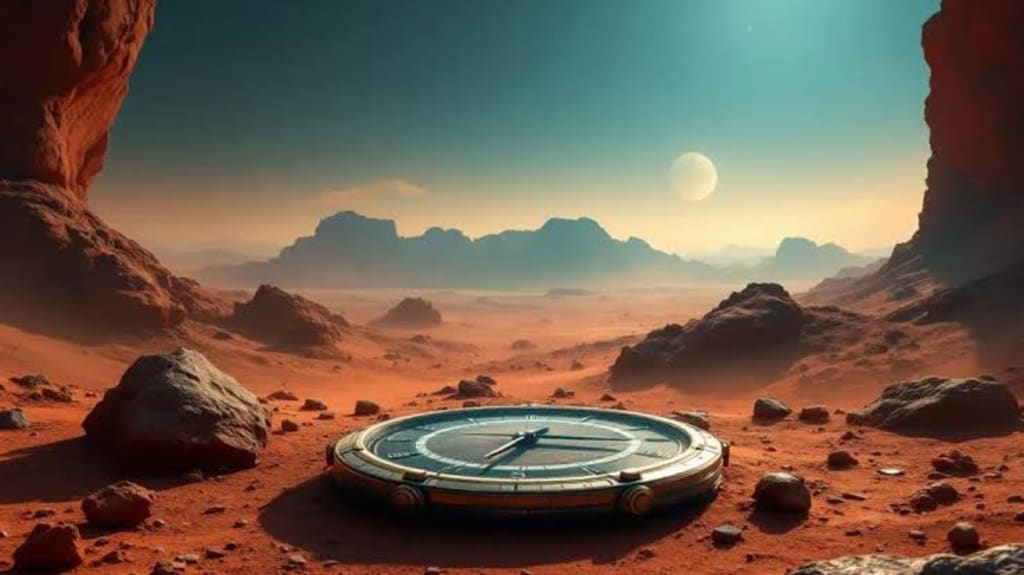
When Albert Einstein introduced his theory of relativity more than a century ago, it radically changed humanity’s understanding of time. He proposed that time is not absolute—it slows down or speeds up depending on gravity and motion. For decades, this idea felt abstract, confined to equations and thought experiments. Today, however, Mars has turned Einstein’s prediction into a practical challenge. Scientists have confirmed that time on the Red Planet flows at a slightly different rate than on Earth, and this difference is forcing future space missions to rethink how they operate.
Time Is Not the Same Everywhere
Einstein’s general theory of relativity states that gravity affects time. The stronger the gravitational pull, the slower time passes. Earth, being larger and denser than Mars, has stronger gravity. As a result, clocks on Mars tick slightly faster than clocks on Earth. The difference is tiny—measured in microseconds—but in the precise world of space exploration, even such small variations matter.
Mars also has a different orbital speed and rotational rhythm. A day on Mars, known as a “sol,” is about 24 hours and 39 minutes long. This mismatch alone creates challenges for mission planners on Earth who must synchronize commands, data transmissions, and rover activities across two planets operating on different clocks.
How Scientists Confirmed It
Modern Mars missions rely on ultra-precise atomic clocks and advanced navigation systems. Spacecraft orbiting Mars and rovers on its surface constantly exchange signals with Earth. Over time, scientists noticed consistent timing discrepancies that could not be explained by engineering errors or signal delays alone. These differences matched exactly what Einstein’s equations predicted: time on Mars flows faster due to its weaker gravitational field.
This confirmation is not just theoretical validation—it has real operational consequences. Navigation, communication, and scientific measurements all depend on accurate timekeeping. If mission controllers ignore relativistic time differences, errors can accumulate, potentially causing spacecraft to drift off course or miss critical mission windows.
Why Time Differences Matter for Space Missions
Space missions rely on extreme precision. When a rover drills into Martian soil or a lander touches down on the surface, timing errors of even milliseconds can lead to serious problems. Over months and years, microsecond-level discrepancies can grow into navigation errors spanning meters—or worse.
Mars missions already operate with communication delays ranging from 4 to 24 minutes, depending on the planets’ positions. Adding relativistic time differences into the mix makes coordination even more complex. Engineers must account for how fast clocks tick on Mars compared to Earth to ensure commands arrive at the correct moment and data is interpreted accurately.
Adapting to Martian Time
To solve this problem, scientists are developing Mars-specific timekeeping systems. Instead of relying solely on Earth-based clocks, future missions may use dedicated “Mars time” standards. These systems would automatically adjust for gravitational and relativistic differences, allowing spacecraft, orbiters, and surface equipment to operate in sync with the planet they are exploring.
NASA engineers already experience a preview of this challenge during rover missions. When a new rover lands on Mars, mission teams often live on “Mars time,” shifting their work schedules by about 39 minutes each day to match the Martian sol. While this practice helps with daily operations, it is exhausting for humans and impractical for long-term missions—especially those involving astronauts.
Implications for Human Exploration
As space agencies plan crewed missions to Mars, time dilation becomes more than a technical issue—it becomes a human one. Astronauts living on Mars will age imperceptibly faster than people on Earth due to weaker gravity. While the difference is far too small to affect health, it highlights how deeply relativity will shape life beyond our planet.
More importantly, mission planners must design communication systems, navigation tools, and even legal and scheduling frameworks that account for different time flows. A future Mars colony may need its own official time standard, separate from Earth’s.
A Reminder of Einstein’s Lasting Legacy
Einstein’s theories were once considered purely academic. Today, they guide GPS satellites orbiting Earth and now help navigate missions millions of kilometers away on Mars. The confirmation that time flows differently on the Red Planet is another reminder that the universe follows rules that defy everyday intuition.
As humanity prepares to explore deeper into space, Einstein’s insights are no longer just ideas—they are essential tools. Mars has confirmed what physics predicted long ago: time itself changes across the cosmos, and if we want to become a multi-planet species, we must learn to live by more than one clock.
About the Creator
Fiaz Ahmed Brohi
I am a passionate writer with a love for exploring and creating content on trending topics. Always curious, always sharing stories that engage and inspire.
Keep reading
More stories from Fiaz Ahmed Brohi and writers in Longevity and other communities.
Greenland's People Must Decide Its Future, Says Nandy
In a recent statement, UK minister Lisa Nandy emphasized that the people of Greenland must have the primary say in determining their future, underscoring the principle of self-determination in the face of growing international interest in the Arctic region. As geopolitical tensions intensify and the Arctic’s strategic and resource potential becomes increasingly valuable, the minister’s remarks highlight the delicate balance between foreign interests and local autonomy. Greenland’s Strategic Importance Greenland, the world’s largest island, has become a focal point in global geopolitics. Its location between the North Atlantic and Arctic Oceans offers strategic military and shipping advantages. Melting ice due to climate change is opening previously inaccessible sea routes and exposing natural resources, including rare earth minerals and potentially vast oil and gas reserves. These developments have drawn attention from countries like the United States, China, and European powers, each seeking to secure their interests in the Arctic. The island is an autonomous territory within the Kingdom of Denmark, with its own government handling most domestic matters, though defense and foreign policy remain under Danish control. Greenland’s growing autonomy has fueled discussions about whether the island should pursue greater independence or maintain its current relationship with Denmark. Nandy’s Statement and Its Significance In her address, Nandy stressed that any decision regarding Greenland’s future should be led by its people, not dictated by external powers. “Greenlanders must have the right to chart their own course,” she said, emphasizing the importance of respecting local voices amid international debates about the Arctic. Her comments came in the wake of increased international attention, particularly from the United States. Former President Donald Trump had previously proposed purchasing Greenland, a plan that was widely criticized and rejected by Danish and Greenlandic officials. However, the idea highlighted the geopolitical importance of the region and the potential for foreign powers to influence its future. Economic and Environmental Considerations Greenland’s future is not solely a political question. Economic development and environmental protection are deeply intertwined. The island’s economy relies heavily on fishing, tourism, and public sector employment. However, the melting ice and new accessibility to minerals and hydrocarbons present both opportunities and risks. While resource extraction could provide significant revenue and accelerate Greenland’s path toward economic self-sufficiency, it also carries environmental costs that could threaten the fragile Arctic ecosystem. Nandy’s emphasis on local decision-making implies that Greenlanders should weigh the trade-offs carefully, balancing economic ambitions with environmental stewardship. Global Implications The Arctic is increasingly becoming a theater of strategic competition. Russia has expanded its military presence along its Arctic coast, while China has labeled itself a “near-Arctic state” and is pursuing partnerships in the region. NATO has also shown interest in monitoring and securing Arctic sea routes. In this context, Greenland’s political choices carry broader international significance. By affirming the principle that Greenland’s people must decide their own path, Nandy signals that external actors should respect self-determination while engaging diplomatically. Her comments implicitly caution against attempts to pressure Greenland politically or economically, emphasizing that sustainable development and stability depend on local leadership and consent. Local Voices and Autonomy Greenlanders themselves have voiced a mix of opinions about the future. Some favor greater independence from Denmark, hoping to leverage natural resources to build an economically self-sufficient state. Others prioritize maintaining ties with Denmark, which provides financial support and international security guarantees. The debate is further complicated by the need to balance traditional livelihoods, such as fishing and hunting, with the economic promise of resource extraction. Experts note that ensuring meaningful participation of Greenland’s people in these discussions is essential. Policies imposed externally risk undermining social cohesion and could provoke resistance or unrest. Nandy’s comments highlight the importance of empowering local governance structures and supporting informed decision-making. Conclusion Greenland’s future is a complex tapestry of geopolitics, economics, and environmental stewardship. As international attention intensifies, the principle of self-determination remains crucial. The UK’s Lisa Nandy underscored that Greenlanders must be the ultimate decision-makers regarding their political and economic path. Whether Greenland moves toward full independence, strengthens its autonomy within Denmark, or negotiates partnerships with global powers, the key takeaway is clear: the island’s people must lead the conversation and shape their destiny. External interest, while inevitable, must be guided by respect for local governance, environmental sustainability, and the democratic will of Greenland’s residents. As the Arctic continues to transform due to climate change and strategic competition, Greenland stands at a crossroads. The decisions made in the coming years will not only define the island’s political and economic future but also serve as a benchmark for how global powers respect the sovereignty and agency of small, strategically important territories.
By Fiaz Ahmed Brohi2 months ago in Longevity
Early March 2026: 4 Goals Accomplished
It's early March and I've now accomplished my 4th writing goal for the year of 2026. Before diving into the behind-the-scenes of it... why not tell you up front what that accomplishment was? I was published in a 2nd publication for this year. Published in Helix Literary Magazine out of Central Connecticut State University. You can read it for free right now!
By Stephen Kramer Avitabile7 days ago in Writers




Comments
There are no comments for this story
Be the first to respond and start the conversation.