
Does Your Place of Worship Know How to Minister to Those with Chronic Illness?
Ministry Missing for Those Who are Chronically Ill


I have been attending a place of worship since I was in seven years old when my father gained custody of me and my sister. Physically, I was a healthy child. I remember sitting in pews seeing people with boils and crutches, and others who were dealing with illness. I have always been observant to those around me, a "people watcher." As I look back, to evaluate if I have ever been in a place of worship that loved on hurting people who were/are chronically ill, I really can't say that beyond a rare one-a-year healing prayer service or prayer list that I observed much emphasis on supporting those who were dealing with any type of chronic illness, whether visible or invisible.
When I first became ill ten years ago at age 35, I would have thought if anything the "church" would reach out to me and others who were hurting due to chronic illness, but unfortunately, that hasn't been my experience. After one single prayer meeting, there have been few calls to check up on me to offer additional prayer. Although I see ministries for those with addiction, divorce, financial issues, anxiety, etc., I find an absence of support groups for those living with chronic illness. And rarely is illness services when the topic is on life's struggles. This is something I don't understand and often ask, "Why?" If I would take an educated guess, illness is something many want to avoid themselves, it is a topic misunderstood and one that makes them uncomfortable. The easy way out—don't talk about it; avoid the topic altogether.
To have a support group in a house of worship for the chronically ill, you would need two things: someone who understands chronic illness to lead it and the approval of those in charge of ministry. Truly, who better to lead a chronic illness group than someone who has experienced it—yet honestly, most of us are too exhausted to take on the level of responsibility it would require managing a support group. Many houses of worship may have a Counseling Center, but unless those who are in charge of adult ministry classes agree that this is a need, it is not going to evolve. Of all the places of worship I have visited within the last two year, I know of one church in my area that has a chronic illness "small group" which in reality isn't small at all. The fact that the group is large should send a message to the church; there is a great need for those living with chronic illness to gain support from the church and others who experience illness.
Not only have I been attending a house of worship, but I have worked at one for 11 years, giving me the opportunity to see how things work from the inside out. Most houses of worship have mission statements and goals for outreach—whether it be to plant churches or houses of worship, do worship together in small groups settings, minister to a diverse set of individuals, reaching the homeless and economically challenged, ministering to the elderly, as well as the hurting (as long as it is addressing divorce, financial challenges, loss of job, loss of loved one, etc.). But where in the house of worship do they minister to the those who live with chronic illness? I haven't seen much of this beyond placing them on a prayer list and often wondering who receives the prayer list and how many are actually praying for those on the list. Those with chronic illness, not only need you to pray for them but to pray with them. Seeing that prayer list, I wonder if those black-inked embedded requests simply sit there until either someone gets better or passes on. In my case, I hope to get better, but the reality is with an "invisible" chronic illness, it may be a life-long struggle. And for us who have the invisible form, we don't look sick, so how can we be sick?
Even after all these years and all I have seen within the houses of worship workings, I am really taken back at how little houses of worship mentor those dealing with chronic illness. Aren't those who believe in a higher power called to come around you? Love you? Pray for you? Anoint you? Step in when you have little faith and hope? Help you through your struggle?
The more I search the "church" as a whole, the more outraged and disappointed I become, the more real it is to me that those who are in long-term pain are not being mentored by the houses of worship. I heard a pastor say once, "Meet the needs first and then they will see the love and power of their God." Doesn't that include us, the ones that struggle daily with our health?
I had one pastor say to me recently during a phone conversation, "Well aren't you the few percentage of people with chronic illness? Isn't there only a small percentage of those who deal with chronic illness." My blood boiled and I about jumped out of my car seat, as I had pulled over on my way home from work to take the call. No! There is a huge number of individuals who are dealing with chronic illness and a great majority of them may not be attending religious worship services because (1) either they feel too bad to get out or (2) they are not getting spiritually fed.
A 2012 article on CDC.gov stated, "As of 2012, about half of all adults—117 million people in the United States—had one or more chronic health conditions. One in four adults had two or more chronic health conditions." During our phone conversation, my response to this head of ministry was probably not as effective as it could have been, nor was my tone out of frustration, "Chronic illness is a totally different beast in itself! Have you seen how many hospitals and doctor offices there are surrounding the metroplexes and why do you think there were so many? Because there are so many sick people with long-term conditions: ALS, Lupus, Lyme, Fibromyalgia, Multiple Sclerosis, paralysis, Ehlers Danlos Syndrome, gastroparesis, back pain, cancers, diabetes, and the list goes on and on." One only has to open a medical book to see how many illnesses people face today. No, we the chronically ill, are not the minority, and truthfully, we may be slowly growing to become the majority. You may not see us because we may not get out much due to pain (we are shacked up in bed), we fake feeling well, or we lack being a sociable part of society. Possibly, if houses of worship place more priority on mentoring us and we felt loved and cared for, many of us may actually show up on Saturday or Sunday for service and for a dose of hope. Many of us need it, want it and desire it.
Those running the churches, temples, mosques, etc. need to be more open to the fact that there is a need to minister to the sick. I encourage them to open their ears, their eyes and then their hearts and come to understand this growing issue and realize how many chronically ill people truly need to be mentored and spiritually fed. We need more support groups, outreaches, and more hands-on ministry.
I, myself, manage a religious-based support group in my area for Lyme disease and as a member of multiple support groups for the chronically ill on Facebook, I realize how easy it is for many to lose faith and hope and, ultimately, our religious belief system in the midst of chronic illness. For what "god" would allow such a thing, so much pain and hurt? And I would give you my perspective on that question, but that is a whole other article in itself. Although I haven't lost my religious belief system and faith, I can see how easy it may be to fall into that mindset when you constantly hurt. I will admit, I have found myself angry and feeling betrayed by my higher power on many occasion. When the house of worship does not reach out, it communicates and reinforces we are invisible to them and others and our issues are not important or at least not important enough for which to create a ministry. It confirms we are misunderstood and there is a lack of understanding of what we go through daily physically, spiritually, emotional, and psychologically.
"There are around 60% of people who deal with chronic illness every day. 40% of those have multiple illnesses" according to Chronic Conditions in America—July 2017. As one living with chronic illness who needs to see houses of worship step up,my advice, deal with your fear of illness—we have had to and do on a daily basis! Stop avoiding the issue, educate yourself and minister to us, because our sect isn't getting smaller, it growing to epidemic proportions. It isn't going away, and if the houses of worship do not jump in and address the issue of a lack of ministry to the chronically ill, then a lot of people are going to be lost and remain invisible.
About the Creator
No one
I live with Lyme disease and founded the North Texas Lyme Support Group in the Dallas Fort-Worth Area in 2010. I write about invisible chronic illness related to Lyme disease for educational purposes.
Day 4 of Quitting
If this is how sobriety feels, maybe it’s better to go through life a little buzzed… this, along with other hits like, I want to kill myself, I wish I was dead, and I’m going to throw myself off a bridge have been the only thoughts on rotation these past few days. I promise myself that if, in a month, I still feel like this (‘this’ meaning despondent, full of rage, and simultaneously numb) I can go back to smoking. Until mid-February though? Nicotine is off the table.
By sleepy drafts12 days ago in Longevity
IBD Treatment Market Forecast and Size 2025–2033
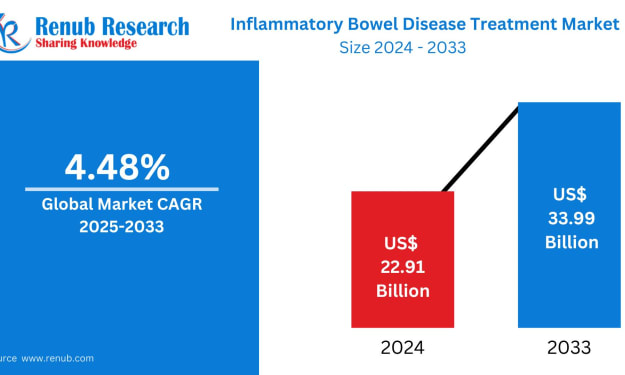
Global IBD Treatment Market: Size, Growth, and the Forces Shaping the Next Decade The inflammatory bowel disease (IBD) treatment market is on a steady upward trajectory as innovation, awareness, and healthcare access converge across regions. Based on Renub Research estimates, the global IBD treatment market is expected to increase from approximately USD 22.91 billion in 2024 to about USD 33.99 billion by 2033, expanding at a CAGR of 4.48% between 2025 and 2033. This growth reflects the rising prevalence of IBD worldwide, the ongoing shift toward biologics and targeted therapies, and a broader push for early diagnosis and long-term disease management.
By Marthan Sir5 days ago in Longevity



Comments
There are no comments for this story
Be the first to respond and start the conversation.