
Distributed Control Systems Market Outlook
How Digital Automation Is Redefining Industrial Operations in a Smart Manufacturing Era

Introduction: From Centralized Control to Distributed Intelligence
Modern industry is no longer defined by isolated machines and manual supervision. Today’s factories, power plants, refineries, and utilities operate as interconnected digital ecosystems—where data, automation, and intelligent decision-making flow seamlessly across processes. At the center of this transformation stands the Distributed Control System (DCS).
A DCS is not simply an automation platform; it is the digital backbone of complex industrial environments. By distributing control functions across multiple networked controllers, sensors, and operator stations, DCS platforms deliver higher reliability, real-time responsiveness, and safer operations than traditional centralized control systems. Whether in oil & gas refineries, chemical plants, water treatment facilities, or power generation units, DCS technology enables industries to operate with precision, stability, and resilience.
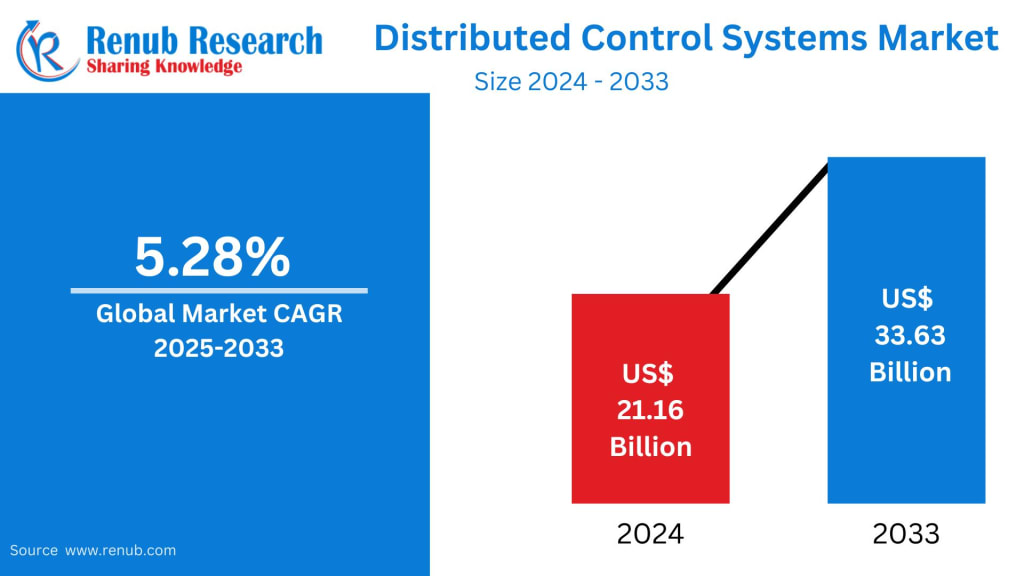
According to Renub Research, the international Distributed Control Systems market was valued at approximately US$ 21.16 billion in 2024. With industries worldwide accelerating automation and digital transformation, the market is projected to grow at a CAGR of 5.28% from 2025 to 2033, reaching an estimated US$ 33.63 billion by 2033. This steady expansion reflects the growing importance of intelligent process control in a world shaped by Industry 4.0.
Understanding Distributed Control Systems
A Distributed Control System is an automated control platform designed to manage complex industrial processes across multiple locations. Unlike centralized systems, which rely on a single control unit, DCS distributes control across interconnected modules. Each module handles a specific process function while remaining integrated within the broader network.
This architecture offers several critical advantages:
Reliability: If one control unit fails, others continue operating, minimizing downtime.
Scalability: Systems can be expanded easily as production lines grow.
Real-Time Monitoring: Operators gain immediate insight into performance metrics and anomalies.
Process Optimization: Advanced analytics improve yield, safety, and energy efficiency.
In sectors such as power generation, chemical processing, water treatment, oil & gas, and large-scale manufacturing, DCS is essential for maintaining consistent product quality, regulatory compliance, and safe operations.
Market Drivers: Why DCS Adoption Is Accelerating
1. Industrial Automation and Smart Manufacturing
The global shift toward smart factories is a primary growth engine for the DCS market. Manufacturers are integrating robotics, IoT devices, and AI-driven analytics into production lines. DCS platforms provide the centralized visibility and distributed execution needed to manage these advanced systems efficiently.
2. Industry 4.0 and Digital Transformation
As industries transition into Industry 4.0, data-driven decision-making becomes critical. DCS solutions now integrate cloud computing, machine learning, and digital twin technologies, enabling predictive maintenance, asset optimization, and remote operations.
3. Energy Efficiency and Sustainability
Rising energy costs and environmental regulations are pushing companies to optimize resource usage. DCS platforms help monitor energy consumption in real time, reduce waste, and improve operational efficiency—making them indispensable tools in sustainability-driven industrial strategies.
4. Growth in Process Industries
Sectors such as chemicals, pharmaceuticals, oil & gas, power generation, and water treatment continue to expand, particularly in emerging economies. These industries require precise, automated process control—fueling consistent demand for DCS systems.
Market Outlook: Renub Research Forecast
Renub Research highlights the strong long-term potential of the market:
2024 Market Size: US$ 21.16 Billion
Forecast CAGR (2025–2033): 5.28%
2033 Market Value: US$ 33.63 Billion
This growth trajectory reflects rising investments in infrastructure modernization, renewable energy projects, digital manufacturing, and cybersecurity-enhanced automation platforms.
While developed economies focus on upgrading legacy systems, emerging markets in Asia-Pacific, the Middle East, and Latin America are driving fresh installations in power, water, and manufacturing sectors.
Competitive Landscape: Leading Industry Players
The Distributed Control Systems market is dominated by established global technology providers with deep expertise in automation, energy management, and industrial software.
Azbil Corporation (Japan)
Founded in 1906, Azbil operates across building automation, advanced automation, and life automation. Its DCS solutions enhance operational efficiency in industrial facilities while supporting energy-saving and facility management services. Although most of its revenue comes from Japan, its global footprint continues to expand.
Honeywell International Inc. (USA)
Honeywell is a global technology leader offering advanced process technologies, sensing and control systems, and industrial automation solutions. Serving industries such as aerospace, petrochemicals, refining, and manufacturing, Honeywell combines automation with cybersecurity, analytics, and digital platforms to deliver robust DCS architectures.
Valmet Oyj (Finland)
Valmet is a specialist in process technologies and automation systems for pulp, paper, and energy industries. Its DCS solutions optimize production efficiency, energy utilization, and raw material usage. With operations spanning Asia-Pacific, Europe, the Americas, and Africa, Valmet plays a key role in sustainable industrial automation.
Mitsubishi Heavy Industries (Japan)
MHI delivers automation and control systems across energy, infrastructure, logistics, and aerospace sectors. Its DCS offerings support power systems, environmental engineering, and industrial machinery, backed by a strong global manufacturing and engineering network.
Omron Corporation (Japan)
Omron provides advanced automation components, robotics, motion systems, and control technologies. Its DCS-related solutions are widely used in manufacturing, healthcare, and transportation infrastructure, emphasizing safety, IoT integration, and data-driven operations.
Strategic Analysis: How Leading Players Compete
Schneider Electric SE – Strength and Opportunity
Strength:
Schneider Electric’s biggest competitive advantage lies in its EcoStruxure™ platform, which integrates real-time analytics, energy management, IoT, and automation into a unified digital architecture. Its open-system design, cybersecurity focus, and sustainability-driven innovation position it as a global leader in smart industrial control.
Opportunity:
The accelerating adoption of smart factories and Industry 4.0 presents major growth potential. Schneider can expand AI-driven predictive maintenance, cloud-based DCS solutions, and remote monitoring tools—particularly in fast-growing markets across Asia-Pacific and the Middle East.
Hitachi, Ltd. – Strength and Opportunity
Strength:
Hitachi combines information technology (IT), operational technology (OT), and analytics through its Lumada platform. This enables advanced optimization, asset management, and energy efficiency across power, chemicals, water, and manufacturing industries.
Opportunity:
The global transition toward renewable energy and digital infrastructure creates new demand for intelligent DCS platforms. By aligning its automation solutions with green energy, smart grids, and sustainable infrastructure projects, Hitachi can expand its footprint in next-generation industrial automation.
Sustainability in the DCS Market
Sustainability is no longer optional—it is central to industrial competitiveness. Distributed Control Systems play a pivotal role in optimizing energy use, reducing emissions, and supporting responsible manufacturing.
General Electric Company: A Sustainability Case Study
General Electric (GE) has embedded ESG principles into its operations, focusing on decarbonization, renewable energy, and advanced efficiency technologies. GE aims to achieve carbon neutrality in its operations by 2030 and net-zero emissions across its value chain by 2050.
Through wind turbines, grid modernization, and fuel-efficient aviation engines, GE uses automation and digital control to reduce emissions and enhance system performance. Its alignment with global sustainability frameworks such as TCFD and SASB reinforces transparency and governance, positioning GE as a leader in sustainable industrial innovation.
Recent Industry Developments
The DCS market continues to evolve rapidly with AI, cybersecurity, and digital twin technologies reshaping industrial operations:
May 2025 – Siemens & Microsoft: Siemens launched its Industrial Foundation Model, accelerating digital twin adoption and AI-driven shop-floor decision-making.
May 2025 – Emerson: Emerson introduced the DeltaV Edge Environment, enabling secure, one-way data transfer for advanced analytics while maintaining strict system isolation for cybersecurity.
January 2025 – Siemens: The Siemens Industrial Copilot, a generative AI assistant, was unveiled to support operators with real-time guidance on complex industrial tasks.
October 2024 – ABB: ABB released Freelance 2024 DCS, featuring enhanced connectivity, faster data transmission, PROFINET integration, NAMUR Open Architecture compatibility, and advanced cybersecurity for future-ready operations.
These developments illustrate the market’s transition toward intelligent, secure, and highly connected control systems.
Market Structure and Company Analysis Framework
Industry analysts increasingly evaluate DCS providers across multiple strategic dimensions:
Market & Forecast Analysis: Historical performance and future growth outlook.
Market Share & Competitive Positioning: Vendor dominance across industries and regions.
Company Profiles: Business models, leadership, workforce, and governance structures.
Product Analysis: System architecture, quality standards, innovation pipelines, and benchmarking.
Sustainability Assessment: Renewable energy adoption, energy-efficient infrastructure, waste management, and water conservation.
Strategic Tools: SWOT analysis, mergers & acquisitions, partnerships, and investment trends.
This structured approach is applied to leading players including ABB, Siemens, Schneider Electric, Honeywell, Emerson, Yokogawa, Hitachi, Rockwell Automation, and others—reflecting the increasingly strategic nature of the DCS industry.
Future Trends Shaping the DCS Market
1. AI-Driven Automation
Artificial intelligence will increasingly handle anomaly detection, predictive maintenance, and real-time optimization, reducing human intervention and improving uptime.
2. Cloud and Edge Computing
Hybrid architectures will allow critical processes to run on-site while analytics and visualization move to the cloud—balancing performance with scalability.
3. Cybersecurity as a Core Feature
As industrial networks become more connected, cybersecurity will be embedded directly into DCS architectures rather than treated as an add-on.
4. Renewable Energy and Smart Grids
DCS platforms will play a crucial role in managing decentralized energy systems, battery storage, and grid balancing.
Final Thoughts: A Market Built for the Intelligent Industrial Age
The Distributed Control Systems market is no longer confined to process control—it is the digital nerve center of modern industry. From enabling smart factories and renewable energy integration to ensuring safety, efficiency, and sustainability, DCS platforms are redefining how the world’s most complex operations function.
With the market projected by Renub Research to grow from US$ 21.16 billion in 2024 to US$ 33.63 billion by 2033, the trajectory is clear: industries that invest in intelligent automation today will shape the competitive landscape of tomorrow.
As AI, cloud technologies, and cybersecurity become standard features of control systems, DCS will continue to evolve from an operational tool into a strategic asset—empowering industries to build resilient, efficient, and sustainable operations in the digital era.
About the Creator
Janine Root
Janine Root is a skilled content writer with a passion for creating engaging, informative, and SEO-optimized content. She excels in crafting compelling narratives that resonate with audiences and drive results.
Keep reading
More stories from Janine Root and writers in Longevity and other communities.
North America Gas Chromatography Market Size and Forecast 2025–2033
Introduction: Precision at the Heart of Modern Industry Gas chromatography (GC) has long stood as one of the most reliable analytical techniques in modern science. From detecting trace contaminants in food and water to ensuring pharmaceutical purity and monitoring industrial emissions, GC systems operate behind the scenes of countless safety, compliance, and research processes. As North America intensifies its focus on regulatory oversight, advanced research, and sustainability, the relevance of gas chromatography continues to expand.
By Janine Root 3 days ago in Longevity
Day 4 of Quitting
If this is how sobriety feels, maybe it’s better to go through life a little buzzed… this, along with other hits like, I want to kill myself, I wish I was dead, and I’m going to throw myself off a bridge have been the only thoughts on rotation these past few days. I promise myself that if, in a month, I still feel like this (‘this’ meaning despondent, full of rage, and simultaneously numb) I can go back to smoking. Until mid-February though? Nicotine is off the table.
By sleepy drafts5 days ago in Longevity
Many Schools Don’t Think Students Can Read Full Novels Anymore — And That’s a Tragedy
In classrooms across the world, a quiet but troubling shift is taking place. Many schools are scaling back or completely abandoning the teaching of full-length novels, replacing them with excerpts, summaries, or short-form texts. The reasoning often sounds practical: students lack the attention span, reading stamina, or motivation to finish long books. But this growing assumption carries a deeper cost. The decline of novel reading in schools is not just an educational adjustment — it is a cultural and intellectual tragedy. The Shrinking Role of the Novel For generations, novels have been central to education. They taught students empathy, critical thinking, moral reasoning, and the patience required to follow complex ideas over time. From classic literature to modern fiction, full novels allowed young readers to live inside other lives and perspectives. Today, however, many educators report that students struggle to complete even a few chapters. Digital distractions, social media, and fast-paced content have reshaped how young people consume information. In response, schools increasingly favor bite-sized reading materials that align with standardized testing and reduced classroom time. While this may appear efficient, it risks sacrificing depth for convenience. Why Reading Full Novels Still Matters Reading a novel is fundamentally different from reading short texts. A novel demands sustained attention, emotional investment, and intellectual endurance. These are not outdated skills — they are essential ones. When students read a full novel, they learn how to track themes across hundreds of pages, understand character development, and recognize cause-and-effect relationships in complex narratives. These abilities translate directly into real-world skills such as problem-solving, patience, and long-term focus. More importantly, novels cultivate empathy. Living inside a character’s thoughts over time helps students understand perspectives vastly different from their own. In an increasingly polarized world, this emotional literacy is invaluable. Lowering Expectations, Lowering Outcomes One of the most concerning aspects of abandoning novels is the message it sends to students: we don’t think you’re capable. When schools assume students cannot handle long-form reading, expectations are quietly lowered. History shows that when expectations drop, outcomes often follow. Students rise to challenges when given the tools and encouragement to do so. If reading stamina is weak, the solution should not be avoidance but gradual rebuilding — just as physical strength improves with practice. Removing novels from curricula denies students the chance to develop this crucial skill. The Role of Technology and Attention It is undeniable that digital culture has reshaped attention spans. Constant notifications, short videos, and algorithm-driven content train the brain to crave immediacy. But schools should act as a counterbalance to this trend, not surrender to it. Education has always required effort that goes against the grain of comfort. Learning mathematics is difficult. Writing essays is demanding. Reading novels is no different. Shielding students from difficulty does not prepare them for adulthood — it weakens their resilience. Engagement, Not Elimination The problem is not novels themselves, but how they are taught. Too often, novels are presented as rigid academic tasks rather than living stories. Educators who connect books to students’ lives, encourage discussion, and allow space for interpretation often see higher engagement. Modern novels, diverse voices, and relevant themes can reignite interest. Pairing reading with creative projects, debates, or multimedia exploration can make novels feel alive rather than burdensome. The answer is innovation in teaching, not retreat from literature. Equity and Cultural Loss There is also an equity issue at stake. Students from book-rich homes may continue reading novels independently, while those without access rely entirely on schools for literary exposure. Removing novels from classrooms widens the cultural gap, depriving many students of the shared experience of literature. Novels are not just educational tools — they are cultural touchstones. They shape language, values, and identity. Losing them from schools means losing a common intellectual heritage. What We Stand to Lose If students grow up believing they cannot read novels, the consequences extend far beyond school. Long-form reading strengthens concentration, memory, and analytical thinking — skills essential for higher education, professional life, and informed citizenship. A society that abandons deep reading risks becoming more reactive, less reflective, and more vulnerable to misinformation. The ability to sit with complexity, ambiguity, and nuance begins with reading books that do not offer instant gratification. Conclusion The belief that students can no longer read full novels is not just pessimistic — it is dangerous. It reflects a failure of imagination and resolve rather than a failure of students themselves. Young people are capable of far more than we often assume, especially when challenged with purpose and support. Abandoning novels may seem like a practical response to modern realities, but it comes at a steep cost. Preserving long-form reading in schools is not about nostalgia; it is about protecting the intellectual and emotional development of future generations. If schools give up on novels, we give up on depth, empathy, and sustained thought. That is not progress. That is a tragedy.
By Fiazahmedbrohi 6 days ago in Longevity



Comments
There are no comments for this story
Be the first to respond and start the conversation.