
Discovering the Unexpected Serenity of Walking Meditations
A whopping seven years into my meditation practice, I finally tried a walking meditation.

“I found that one of the hardest things about mindfulness practice was to let go of effort. For years, I treated meditation as one more item on my daily to-do list — mindfulness…check. This task orientation turned meditation into a chore that I could do incorrectly.”
— Seth J. Gillihan, PhD, Mindful Cognitive Behavioral Therapy: A Simple Path to Healing, Hope, and Peace
Took me long enough to try a walking meditation, didn’t it?
I have a bad habit of going, “I’ll do it what most people say is the right way! The BEST WAY! Because I work hard to get good at stuff!”
I unfortunately do this with many facets of life, whether it’s writing, making kombucha, working with resin, or countless other things. I do some research, go with what I perceive in the moment to be the best, and stubbornly stick to it, even if it perhaps isn’t the best thing for a beginner. Even if I should actually be open-minded to other approaches.
I’m slowly learning not to be so stubborn about what seems like the “best way.” I do more research before making opinions. I hold more space for other opinions and approaches now. It’s a slow process of change, but I’m getting there.
And walking meditations are something that I, in my stubbornness, thought was inferior to a quiet seated meditation. But I was falling into a pitfall of thinking there’s only one right way to do things.
Meditation is a slow practice for many of us to learn.
It took me a solid two to three years of attempting to meditate before I made much headway on truly quieting my thoughts. This was partly because I was so untrained in turning my attention inward. In my earliest meditation classes, I’d be sitting on a yoga block in a beautifully quiet studio, trying to calm down my thoughts.
It was an ideal situation for meditation. I would do meditation classes in similar set-ups in future studios and my various apartments — finding quiet, dark spaces. But then it was actually in one of my worst apartments, where I had neighbors who played dubstep loudly for 14 hours a day, where I had some of my deepest periods of focus. I had to work so hard to tune out the noise that once I finally succeeded, I was quite focused.
It sounds like that’s the worst possible situation to meditate it, but paradoxically, the greater challenge to tune out distractions around me actually helped me pay more attention to the sensations in my body.
I tried a walking meditation for the first time and found it surprisingly easy to focus on bodily sensations while in motion.
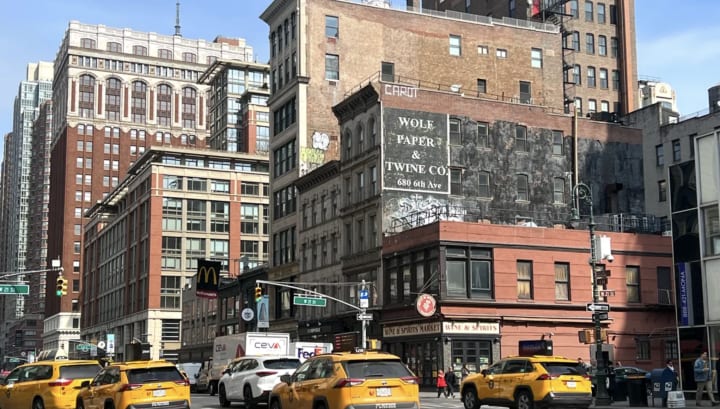
I realized when I started formatting this story that I rarely take photos of my home city while walking around. But this old sign for Wolf Paper & Twine Co. was a rare moment I paused to observe the beautiful history around me.
The guided meditation track I tuned into prompted the listener to pay attention to the sensation of each foot either anchored or moving toward the ground. It challenged me to pay attention to the muscle engagement in each foot, the stretch, then the relaxation, that came with every step.
I was able to hone into these small sensations a lot faster than I expected. There’s something about the immediacy of movement that makes mindful awareness of it surprisingly easy to slip into when we really focus and pay attention.
Walking meditations challenge us to hone our focus when the world is chaotic around us.
Here’s where the beauty of the walking meditation really shines. Like how I paradoxically had some of my best meditations in my loudest apartment, I couldn’t believe how smoothly I slipped into a meditative state. My thoughts quieted down faster than they had over the past few weeks.
There are a lot of different perspectives on meditation and I think every effort is valid. I’ve been reading a translation and exploration of the yoga sutras (with a women’s perspective emphasized) by Nischala Joy Devi and learned the terms dharana and dhyana. I’m going to quote Devi’s definitions because these two words represent a subtle but vital difference in the process of meditation.
“Gathering consciousness and focusing it within is Dharana (contemplation).
The continuous inward flow of consciousness is Dhyana (meditation).”
— Nischala Joy Devi, The Secret Power of Yoga: A Woman’s Guide to the Heart and Spirit of the Yoga Sutras
Essentially, we begin with contemplation, we draw our attention into ourselves, and then we can take the next step toward meditation. Thinking of contemplation as a stepping stone before meditation is an idea that resonated with me deeply.
When starting a new practice, having more opportunities to squeeze it in helps.

I’ve been reading so much about the fundamental flaws in our hustle culture. But whether you’ve made the decision to slow down or if you have no choice but to keep the pace going (I get it, I financially had no choice for a long time), if walking is part of your routine, this can be a good time to sneak meditation into your day.
In James Clear’s book, Atomic Habits, he writes about how when trying to start a new habit, we want to make implementing it as easy as possible. The smallest amount to get started is better than not starting at all. The same is true for meditation; making it easy to begin makes you far more likely to do it. And perhaps the best benefit of the walking meditation is that it’s not hard to begin.
“Whenever you want to change your behavior, you can simply ask yourself: How can I make it obvious? How can I make it attractive? How can I make it easy? How can I make it satisfying?”
― James Clear, Atomic Habits: An Easy and Proven Way to Build Good Habits and Break Bad Ones
About the Creator
Leigh Victoria Phan, MS, MFA
Writer, bookworm, sci-fi space cadet, and coffee+tea fanatic living in Brooklyn. I have an MS in Integrated Design & Media and an MFA in Fiction from NYU. I share poetry on Instagram as @SleeplessAuthoress.
Keep reading
More stories from Leigh Victoria Phan, MS, MFA and writers in Longevity and other communities.
The Value of a Gentle Yoga Class
There's that pull to spend all your time pushing toward something more. There’s immense pressure on you to take yourself up to the next level. Pressure to lose weight, build muscle, get more flexible, gain more endurance, so on and so forth.
By Leigh Victoria Phan, MS, MFA5 months ago in Longevity
Draymond Green
In an NBA era dominated by scoring titles and highlight reels, Draymond Green has built a Hall of Fame–level career by excelling in areas that rarely make the box score shine. As the emotional leader of the Golden State Warriors, Green has redefined what impact looks like in modern basketball. Defense, playmaking, communication, and intensity have become his signature, shaping one of the most successful dynasties in league history.
By Saboor Brohi 6 days ago in Longevity
Our Song
Evening has given way to night. Gently, I settle next to you on the comfortable, old love seat and reach for your hand. You snatch it away, again. It cuts me to the quick, but I hide the pain, understanding that the reaction is but part of your demented state. Since the accident, your presence here in our cozy home has been clouded by a haze I can't see. Nevertheless, I feel the frigidity of your expressions and it serves as an excruciating reminder of the immeasurable distance between us.
By Dana Crandell5 days ago in Fiction




Comments
There are no comments for this story
Be the first to respond and start the conversation.