
Desperate Attempt to Stop the New Coronavirus in Italy
The most critical Coronavirus outbreak in Europe is in my country where drastic actions have terrified people.

"It's strange to watch it on the television," she said.
In a desperate attempt to stop the spread of the new coronavirus, government officials cancelled the public celebration of Mass in many towns of northern Italy and upended sacred rituals of Italian life.
Champions League Football games have been played in empty stadiums. Milan's vibrant and always busy "aperitivo" scene has reduced to a halt, and empty busses and trains stink of the steriliser. My brother's boss, like several in the region, has requested them to work from home, and kids are not in school for at least one more week.
These are the numbers
The numbers of the infected are small, compared to China, where the coronavirus started. In Italy, as of Wednesday, 3,089 people have tested positive to the new virus. More than 85% live in Lombardy, Veneto and Emilia-Romagna. 1263 were hospitalised, including 229 cases in intensive care. Those who have recovered are 276. The deaths are 107. Most patients who died were either old or had other conditions. Most have shown mild symptoms or none, which makes it more difficult to detect who is infected.
Fifty thousand people in 11 towns of the so-called "red zone", are still under quarantine.
The loss of church gatherings shook a significant pillar.
Among all that disruption, the rise in cases and tremendous economic cost, including the United States' travel warning to Lombardy and Veneto, the loss of church gatherings shook a significant pillar for the congregation.
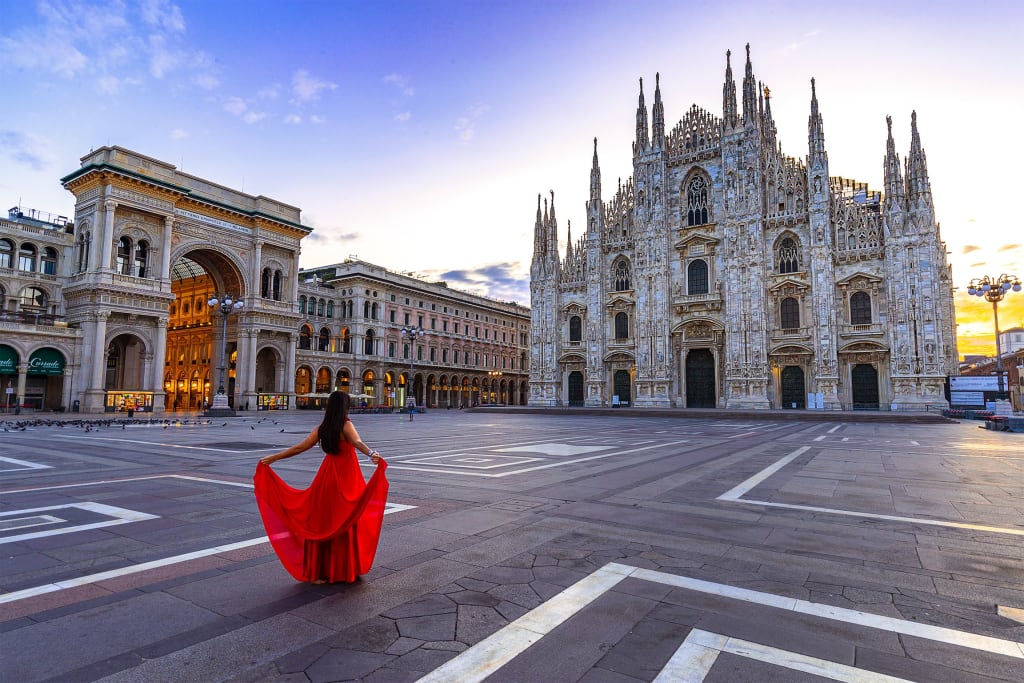
"The difference between the Mass in the church and watching it on television is like the difference between convening by a bonfire that warms people up, illuminates, brings comfort, and watching a photo of the fire." This is what Mario Delpini, Milan's archbishop, said on Sunday during the Mass broadcasted without congregants inside the crypt of Milan's empty cathedral.
He admitted that assembling could be "not without danger," but added, "It is distressing to celebrate mass without the people."
Those who criticise the closings have explained that the cure of faith, and the clergy's firm aid, has helped Italians through past epidemics. The patron saint of Lombardy region, Charles Borromeo, is honoured in part for his efforts during a plague in the 1570s they say. Church leaders have asked the authorities to let the people attend Mass.
Health officials argue the restrictions are in place to safeguard people. A top clerical official, Silvio Brusaferro, has argued, according to the Italian National Institute of Health, that traditionally, places of worship are where people get infected more quickly.
But frustration and stress is spreading in the areas, where many suggest that politicians and the media have overstated the virus' threat.
Pope Francis had tried to avoid such disruptions.
"I want to express my closeness to all those suffering from the coronavirus and the health care workers who are treating them," Pope Francis said Wednesday after shaking hands with cardinals and the people in the front rows of a crowd in which few people wore masks.
When he, who lost part of a lung from a respiratory illness in his youth, came down with a cold last week, some of the media drew a connection to the virus. The Vatican spokesman, Matteo Bruni, said on Sunday, "There is no reason to diagnose the pope with anything but the cold." Delivering his Sunday blessing from a window in the Apostolic Palace far above the square, Francis endured a few coughing hits that forced him to interrupt his address for a few moments. He announced he will cancel his participation in a week-long spiritual retreat for the first time in his seven-year papacy.
"Unfortunately, this year, a cold is stopping me from taking part," he said.
People are scared.
The dark humour for the young is the way to go and stay busy changing a photoshopped image of the Last Supper of Leonardo: no Jesus, no apostles, just panicking for the coronavirus. "We are a bit out of control in Milan right now." says the caption.
But not all of us can mix tongue-in-cheek with concern and calm. Many Italians appear confused. Most of us don't know what to believe. Mood swings are visible. Is coronavirus just nasty flu, and we are exaggerating? Or are we facing a severe epidemic and there are many reasons to be worried?
So Italians get muddled and scared, no wonder. The media talks of nothing else, including disturbing pictures to make their point. We see more masks on television and online than on Milan's half-deserted streets, with several people who stay home. Schools and markets are shut down, and many activities are postponed. The mayor, Beppe Sala, is trying to spark a reaction; a video marked with # Milanononsiferma (Milan Doesn't Stop) has also been viral. But it is going to be a fight. Most countries limit travel to and from Italy, leaving a sense of isolation that feeds anxiousness.
The virus has exposed a vulnerable Italy
Northern Italy was the first area in Europe to detect a significant outbreak. What should we learn from this? How can a new virus affect a democratic and modern European nation, with a lively public opinion?
Italy's way of life is more alike to the rest of Europe's than the lifestyles of China or South Korea, which were the first countries to be severely hit by the new coronavirus. Population numbers, density, and travel distances also differ, as do social norms and health care. How can Italy's national health service, widely regarded as one of the best in the world, cope with a potentially huge number of patients? The threat has not materialised, for the moment. Hospitals in Cremona and Lodi, where several patients are in intensive care, say they are at full capacity already.
The epidemic has exposed a surprisingly vulnerable Italy. Not just in the north, where the only two hot spots are. Most Italians have no direct experience of war or disease outbreaks, so they struggle to find an appropriate response.
I am not saying Italy is on the verge of collapse. At the same time, minimising what's going on would be wrong.
Drastic actions without precise explanations
For a society like Italy, the company of others is better than drugs, and if you are forced to do without it, you get depressed. So there may be angry fallout.
People are no longer shaking hands, let alone approaching one another with a kiss. If you cough or sneeze in public, people pull away and show real fear. Everywhere conversation is consumed by the new coronavirus. In the absence of precise directives, organisations and businesses act randomly. Why are people permitted to squeeze into a supermarket but not allowed in cinemas?
Drastic actions without precise explanations have terrified the public. It would be sensible to repeat, over and over, that limiting the number of people catching the virus from someone infected is crucial; and to do that, people must keep apart, for the time. Besides, the Italian health system has increased its testing beyond those with symptoms and been in contact with someone infected. As of today, Italy had tested about 35,000 people, many more than France, Germany or the UK. So it is hardly unexpected that Italy is registering more cases.
Italy is living in a strange, suspended time. Milan, its most dynamic city, appears anxious to get back to business as usual. However, it won't happen soon, nor easily. The country is holding its breath while waiting for PM Conte to make the announcement. "We have decided to close schools and universities beyond the red zones till the 15 of March".
Some might have thought to have reached almost the end. The reality is that it is just the beginning.
About the Creator
Anton Black
I write about politics, society and the city where I live: London in the UK.
Keep reading
More stories from Anton Black and writers in Longevity and other communities.
Amazing health benefits of drawing
Have you been seeking a new project to keep you occupied, continuing to learn, and happy? Perhaps learning to draw has been on your to-do list, but you're unsure where to begin, are concerned about doing it correctly, or aren't convinced the advantages will be worth it. Artists of many disciplines use sketching to preserve ideas, recollections, and observations. One of the first artists to carry a notebook outside the studio and onto the streets was Leonardo Da Vinci. He thought it was essential to directly touch with life and study human movements to harness skills. Da Vinci's technique is easily applicable today, when the benefits of drawing and sketching may be a terrific way to unplug from technology.
By Anton Black4 years ago in Longevity
The Connection Between ADHD and Genetics.
Commentary An Impulsive Gene? My youngest son jumps from one task to another. Ask him to clean his room, he eventually quits because he becomes fixated on something. He can’t sit still for long. On the other hand, when he’s doing something he likes, he is fixated on it, sometimes barely taking in his surroundings or listening to others.
By Dean Traylor4 days ago in Longevity
Beyond Exhaustion: What Happens to Your Body and Brain After 72 Hours Without Sleep?
We've all experienced the grogginess of a poor night's sleep or the heavy eyelids that follow an all-nighter. But what happens when you push the human body to its absolute limits? Staying awake for 72 hours—three full days and nights—is a severe shock to your system. It shifts from a simple matter of feeling tired to a profound physical and psychological crisis. Here is a chronological breakdown of what happens to your mind and body when you stop sleeping.
By Mohammad Hamid2 days ago in Longevity
📢 Raise Your Voice Thread: 03/05/2026
Our “Raise Your Voice Threads” are hosted most alternating Thursdays at 12PM ET to offer creators more avenues to uncover exceptional stories on Vocal. As we are continuously searching for fresh creators and inspiring stories, this thread provides an opportunity to exchange and discuss the stories that have moved and motivated us on Vocal.
By Raise Your Voice by Vocal7 days ago in Resources


Comments
There are no comments for this story
Be the first to respond and start the conversation.