


Last weekend I stayed with a friend in a wellness resort.
There was a lovely tunnel through which we could walk from the hotel towards the wellness area.
The tunnel's walls on both sides had beautiful pictures of all the elements (water, fire, earth, wind) and wisdom quotes.
One of the quotes was from Shantideva and addressed the topic of worrying:
If you can solve the problem,
Then what is the need of worrying?
If you cannot solve it,
Then what is the use of worrying?
-Shantideva
I sat on the bench before the text to meditate and ponder it. Afterward, I started reading Buddhist teachings about worrying. It gave me insights to start looking at worrying through a different lens.
In Buddhism, worrying is a form of suffering. An essential topic in Buddhist teachings which are aimed at ending suffering.
Suffering in Buddhist philosophy includes all sorts of forms of unhappiness. Like worries, depression, anger, and regrets. Anything, no matter how subtle, that prevents you from living a happy and fulfilled life. And prevents you from ultimately reaching a state of enlightenment.
I’ve always understood from Buddha’s teachings I’ve read before, that the root of suffering and worrying is attachment.
But the Dalai Lama mentioned something that struck me deeply and has continued to resonate with me: ‘Suffering is caused by ignorance.’
This insight is also mentioned in an article in the Elephant Journal from Elyane Youssef, Buddhism on Worrying & How to Eradicate it. I quote:
"Buddhists perceive everything in life as an illusion, meaning nothing has a concrete existence. What we see as solid and permanent is only present for now. Eventually, it will cease to exist within months, years, or decades.
Since we see everything as solid and permanent, we tend to take life seriously and make a big deal out of problems. Consequently, we become attached to our life’s situations and worry about them. It is because of our ignorance that we worry about things."
The traditional teaching that attachment (in whatever form) is the root cause of suffering is true. However, the statement that suffering, and therefore worrying, is caused by ignorance took those teachings a step further and into a new context for me.
It occurred to me that it is not only attachment that worries us but also that people continue to be attracted to the things that cause suffering.
For example,
- You may know that worrying thoughts cause you to suffer, but you still keep replaying those thoughts in your head, even though this peaking doesn’t change anything that happened in the past and will most likely not happen in the future;
- You may know that a certain friendship is toxic for you, but you still give it another chance, hoping it will change for the better;
- You may know that certain foods, drinks, or drugs are not good for you and will cause you to suffer, but you still keep consuming them.
The fact that we decide to ignore these things lead to suffering. And it is because of our ignorance that we worry about things.
In Modern Buddhism, Geshe Kelsang says there are two types of problems, an inner and an outer problem:
We should understand that our problems do not exist outside of our self, but are part of our mind that experiences unpleasant feelings. When our car, for example, has a problem we usually say “I have a problem”, but in reality it is the car’s problem and not our problem.
The car’s problem is an outer problem, and our problem, which is our own unpleasant feeling, is an inner problem. These two problems are completely different. We need to solve the car’s problem by repairing it, and we need to solve our own problem by controlling our attachment to the car.
As Marcus Aurelius would put it:
“If you are distressed by anything external, the pain is not due to the thing itself, but to your estimate of it; and this you have the power to revoke at any moment.” -Marcus Aurelius
The Buddhist rule is: Worrying is simple: don’t.
Or, as Shantideva said more eloquently, If it can be fixed, why worry? If it can’t be fixed, what’s the point of worrying?
Or, more properly: “If a cure exists, why worry? If no cure exists, what use is there to worry?”
90% of the things you worry about are out of your control so it’s not helpful to worry. The other 10% you can control so do something about it instead of worrying.
Don’t Worry. Be Present.
One of the teachings of Buddha is that:
The secret of health for both mind and body is not to mourn for the past, worry about the future, or anticipate troubles, but to live in the present moment wisely and earnestly.
We probably all worry unnecessarily sometimes, which makes us all worrywarts. According to Buddhists, we worry because we need to be able to predict what is lying ahead. Have a sense of what will happen to us in the future.
We, humans, are afraid of uncertainty. We don’t want to be wrong or uncertain about anything, so we start peaking and overanalyzing things too much, which causes worrying and distress.
I’ve lived through some terrible things in my life, some of which actually happened.-Mark Twain
We feel the need to change the past or control the future, and we attempt to change something through worrying.
According to Buddhism, trying to change the past or future is a deeply rooted cause of worrying. Which makes worrying an inner thing, not the result of an outside factor.
The secret of health for both mind and body is not to mourn for the past, worry about the future, or anticipate troubles, but to live in the present moment wisely and earnestly.-Buddha
Although many of us are lucky that we don’t need to worry about tomorrow, that doesn’t mean there will always be a tomorrow. Buddha said: ‘The trouble is, you think you have time.’ But there is no time to waste: the past is gone, the future is not here yet, and all we have is the present.
And it suddenly occurred to me that the word ‘present’ also means ‘gift.’ The gift of the present moment, the now. Essentially the only thing we truly possess. Because the past and the future are only concepts existing in our own minds. It is in the present moment where we live, where we are happy, where we create our future. And if we decide to use our precious moment to worry, then that is by our own choice and making.
If you are depressed you are living in the past.
If you are anxious you are living in the future.
If you are at peace you are living in the present.-Lao Tzu
To stop worrying is tough, but it’s not impossible. If we worrywarts embrace a few teachings and practices from the Buddhists, you would be surprised by the wonderful changes that can take place.
Your worst enemy cannot harm you as much as your own unguarded thoughts.-Buddha
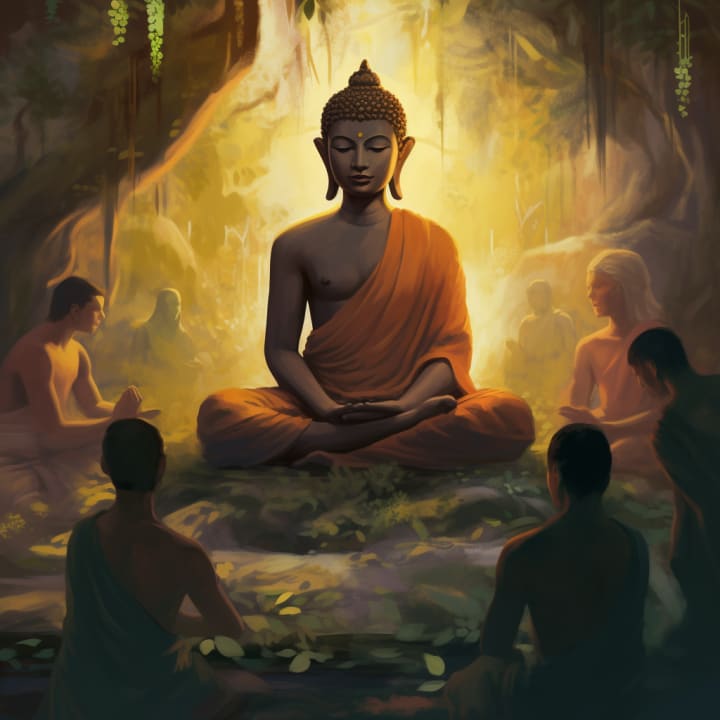
Here is what we can learn from Buddhism to relieve us from the unpleasant state of worrying.
How to eliminate worrying according to Buddhism
- Understand that worrying won’t solve a thing
Everyone worries. A conflict at work, a doctor’s appointment that concerns you, or an exam you need to take, can all be reasons to worry.
The difference between thinking and worrying is that thinking leads to a solution while peaking leads to an endless series of thoughts that keep going through your mind. ‘What if …?’ ‘Imagine that…?’
The intent of most people who worry is probably to put their thoughts in order and get their heads on straight. Or to prepare for a situation.
But nothing is less true: worrying does not lead to solutions or new insights. Much worrying can lead to stress, anxiety, and gloom. Moreover, worrying takes a lot of time and energy.
- Take on a helicopter view and get a pure view of your life
Try to limit yourself in life to the essence of what you find important. Find out what life is about for you, and focus on that.
When you focus your attention and energy on a few points, you will perform much better and get more out of your life. You get a pure view of life because you give little or no energy to all things that are not important.
- Accept that you’re not in control of everything
Psychologist Ellen Hendricksen of Boston University’s Center for Anxiety and Related Disorders explains that there are two types of control.
When we think of ‘control freaks,’ we usually think of types who always want to keep everything under control. But there is another form of control that involves accepting things that can not be controlled.
‘Primary control’ is about trying to change the world around you. ‘Secondary control’ is about adjusting to what is happening around you.
Research showed that people with a higher level of secondary control are more satisfied with their lives than people who score higher on primary control.
So if you want to experience control without stress, look inside instead of outside. Accept that you simply can not control everything. This will help you stay calm when things go differently than planned.
Try to be flexible and to move with what happens. If you move along with the flow of life, it will give you energy; if you try to change the world around you, you’ll lose energy.
The paradox of this story is that you can therefore experience a sense of control by choosing what you are concerned about and what not. If you assume that everything is a choice, including your thoughts and feelings, you decide how you experience things.
- Focus on the present
Life screams to be seen and heard. It wants to happen to you and to be yours.
But you are so busy worrying about the future, playing scenarios in your head, and making predictions about future disasters that the future is slipping through your fingers, just like water.
If you focus on the present instead of the future, you will feel and experience things that you would otherwise not be able to or miss out on.
Worrying about the future is not necessary. Allow yourself to be grateful for what you have now.
Everything is temporary. We have our own life in our hands. Life is an endless amount of time gifted to us in an immense, fertile space full of possibilities and opportunities.
Don’t let life go by while worrying about the future. Focus on and enjoy the present.
Don’t worry, smile and be happy!
The Serenity Prayer.
God grant me the serenity to accept the things I cannot change,
Courage to change the things I can,
And the wisdom to know the difference.
-Reinhold Niebuhr

About the Creator
Sofie Weber
Sofie is a writer and composer. She loves to write short stories, poetry and to play music to her lyrics. Sometimes she creates a dreamy poetic mini movie full of heart. ✨
‘Sofie Weber’ is a pseudonym under which I publish original work.
Keep reading
More stories from Sofie Weber and writers in Longevity and other communities.
Buddha on Happiness
I am drawn to the sound of water. I always have been. It makes me joyful and peaceful. Through that, it brings me happiness. That's why I often go to the sea to just listen to the sound of the waves and become rejuvenated and enlightened by this immense, vast, and wonderful gift of positive energy.
By Sofie Weber3 years ago in Longevity
The Importance of Mutual Aid in Community Building
Mutual aid plays a vital role in strengthening communities by fostering cooperation, shared responsibility, and collective care. At its core, mutual aid is the voluntary exchange of resources and services for the mutual benefit of those involved. Unlike traditional charity, which often operates through a top-down model where resources flow from donors to recipients, mutual aid emphasizes solidarity and collaboration. Everyone participates as both a giver and a receiver of support, creating stronger social bonds and more resilient communities.
By Wesley Oler IVa day ago in Longevity


Comments (1)
Thank you, Sofie, for the comprehensive and well-written guidance on worrying. Or perhaps Pawgles would call it a form of "bothers".😊 It is so much better to go through life without worrying about things you cannot change. But worrying is like an addiction for some, making them feel that they are more in control of the world. Wonderful writing, Sofie!💙Anneliese