
Australia Acute Respiratory Distress Syndrome Market Size & Forecast 2025–2033
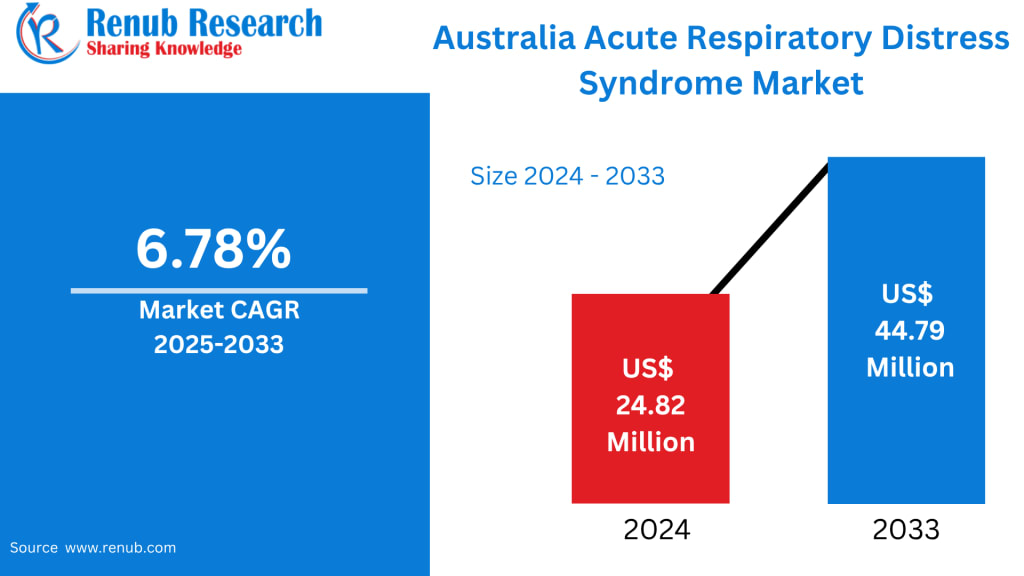
Australia Acute Respiratory Distress Syndrome (ARDS) Market is projected to expand from US$ 24.82 million in 2024 to US$ 44.79 million by 2033

Australia Acute Respiratory Distress Syndrome Market Outlook
The Australia Acute Respiratory Distress Syndrome (ARDS) Market is projected to expand from US$ 24.82 million in 2024 to US$ 44.79 million by 2033, registering a CAGR of 6.78% during 2025–2033, according to Renub Research. This robust growth trajectory reflects Australia’s rising burden of severe respiratory illnesses, higher intensive care unit (ICU) admissions, and sustained investments in advanced life-support technologies.
Acute Respiratory Distress Syndrome (ARDS) is a critical, life-threatening lung condition characterized by rapid onset of widespread inflammation in the lungs, leading to severe oxygen deprivation. It commonly develops due to sepsis, pneumonia, trauma, aspiration, and severe viral infections including COVID-19. Patients with ARDS frequently require mechanical ventilation and, in severe cases, extracorporeal membrane oxygenation (ECMO).
In Australia, ARDS management has become a strategic priority within tertiary hospitals and critical care networks. The aging population, increasing prevalence of chronic respiratory disorders, and post-COVID pulmonary complications have intensified demand for sophisticated respiratory support solutions. As a result, hospitals are expanding ICU capacities and upgrading respiratory care infrastructure, positioning ARDS as a key segment within the nation’s critical care market.
Growth Drivers in the Australia Acute Respiratory Distress Syndrome Market
Rising Prevalence of Respiratory Diseases
Australia is witnessing a steady rise in chronic and acute respiratory conditions such as chronic obstructive pulmonary disease (COPD), asthma, pneumonia, and severe influenza, all of which are major contributors to ARDS. Long-term pulmonary complications following COVID-19 infections have further increased ARDS susceptibility, particularly among elderly and immunocompromised populations.
According to national health statistics, approximately 8.5 million Australians (34%) live with chronic respiratory diseases, including asthma and COPD. This growing patient pool has significantly increased hospitalization rates and ICU admissions, directly driving demand for ARDS diagnosis and treatment solutions across the country.
Advances in Diagnostic and Treatment Technologies
Australia’s healthcare system is at the forefront of adopting advanced technologies for ARDS diagnosis and treatment. High-resolution imaging modalities such as CT scans and digital chest X-rays allow clinicians to assess lung damage with greater accuracy and speed. Blood gas analyzers and real-time monitoring tools further enhance early detection and clinical decision-making.
Mechanical ventilation technology has evolved substantially, offering lung-protective ventilation strategies that reduce ventilator-induced lung injury. ECMO systems have emerged as life-saving interventions for patients with refractory hypoxemia who do not respond to conventional ventilation.
In September 2024, Medtronic, Inc. introduced the VitalFlow ECMO System, a modular and clinician-friendly platform designed to bridge bedside care and intra-hospital transport. Such innovations highlight the growing focus on improving survival rates and clinical outcomes for ARDS patients, while simultaneously stimulating market growth.
Government Healthcare Support and Investments
The Australian government continues to strengthen critical care infrastructure through sustained investments in public hospitals, ICU expansion, and advanced medical equipment procurement. Funding initiatives aimed at improving emergency preparedness and respiratory care capacity have significantly enhanced the country’s ability to manage severe ARDS cases.
Public health programs also emphasize early detection, rapid intervention, and equitable access to critical care services. By supporting clinical research, workforce training, and hospital modernization, government policies play a crucial role in reinforcing Australia’s ARDS treatment ecosystem and long-term market expansion.
Challenges in the Australia Acute Respiratory Distress Syndrome Market
High Cost of Advanced Treatment Options
ARDS treatment is resource-intensive and often involves prolonged ICU stays, mechanical ventilation, and ECMO support. These therapies place substantial financial pressure on both public healthcare budgets and private insurers. The high cost of advanced interventions may limit accessibility, particularly for patients in rural and remote regions, posing challenges to equitable healthcare delivery.
Limited Awareness and Delayed Diagnosis
ARDS symptoms often overlap with other respiratory conditions, leading to delays in accurate diagnosis. Variability in diagnostic expertise and infrastructure across healthcare facilities can result in underdiagnosis or late intervention. Limited public awareness about ARDS further exacerbates this challenge, negatively impacting patient outcomes and restraining market growth.
Australia Acute Respiratory Distress Syndrome Diagnosis Market
The ARDS diagnosis segment in Australia is supported by technological advancements in imaging and laboratory diagnostics. Chest X-rays, CT scans, and arterial blood gas analysis remain cornerstone tools for confirming ARDS and assessing disease severity.
Hospitals are increasingly investing in integrated diagnostic platforms that enable rapid evaluation and continuous monitoring. Standardized diagnostic protocols and clinical guidelines have further improved accuracy and early detection, directly contributing to improved survival rates and market expansion.
Australia Acute Respiratory Distress Syndrome Treatment Market
The treatment segment represents the largest share of Australia’s ARDS market. Advanced mechanical ventilators, ECMO systems, and supportive pharmacological therapies such as corticosteroids, antibiotics, and sedatives are widely used in clinical practice.
Physicians increasingly emphasize early, aggressive intervention to reduce mortality and long-term lung damage. The rising adoption of device-based life-support technologies and optimized drug regimens continues to fuel strong growth in this segment.
Australia Acute Respiratory Distress Syndrome Hospitals Market
Hospitals serve as the primary care settings for ARDS management in Australia. Equipped with ICUs, multidisciplinary critical care teams, and advanced life-support infrastructure, hospitals dominate end-user demand.
Government funding, continuous medical education, and technological innovation have enabled major hospitals to upgrade critical care units, reinforcing their central role in the ARDS treatment landscape.
Australia Acute Respiratory Distress Syndrome Specialty Clinics Market
Specialty pulmonary and critical care clinics are gaining importance, particularly for post-ICU rehabilitation and long-term respiratory monitoring. These clinics support patients transitioning from acute hospital care to recovery, helping reduce relapse rates and improve quality of life.
Growing awareness of post-ARDS complications has accelerated demand for specialized follow-up care, strengthening this segment’s contribution to the overall market.
State-Wise Outlook of the Australia Acute Respiratory Distress Syndrome Market
New South Wales ARDS Market
New South Wales leads the national ARDS market due to its high population density and advanced healthcare infrastructure, particularly in Sydney. Continuous government investment and strong ICU capacity ensure the state’s dominant position.
Victoria ARDS Market
Victoria benefits from world-class hospitals and research institutions in Melbourne. High incidence of respiratory disorders and access to specialized critical care facilities make Victoria a key contributor to Australia’s ARDS treatment network.
Queensland ARDS Market
Queensland’s ARDS market is expanding steadily, driven by environmental factors, an aging population, and growing respiratory disease prevalence. Brisbane’s advanced hospitals and public health programs support sustained growth.
Tasmania ARDS Market
Although smaller in scale, Tasmania’s ARDS market is growing as healthcare facilities undergo modernization. Improved diagnostics and hospital upgrades are enhancing access to critical care services across the state.
Market Segmentation
By Type
Diagnosis
Treatment
By End User
Hospitals
Specialty Clinics
Home Healthcare
Others
By Region
New South Wales
Victoria
Queensland
Western Australia
South Australia
Australian Capital Territory
Tasmania
Northern Territory
Competitive Landscape: Key Players Analysis
Major companies operating in the Australia ARDS market include:
Silence Therapeutics plc.
Gilead Sciences Inc.
Terumo Corporation
Getinge AB
LivaNova Plc.
Medtronic, Inc.
Fresenius SE & Co. KGaA
Nipro
Pfizer Inc.
Each company is evaluated across five viewpoints: overview, key personnel, recent developments, SWOT analysis, and revenue performance.
Final Thoughts
The Australia Acute Respiratory Distress Syndrome Market is on a clear upward growth path, driven by rising respiratory disease burden, technological innovation, and strong government support for critical care infrastructure. While high treatment costs and diagnostic challenges remain, continuous advancements in ventilation, ECMO, and clinical protocols are transforming ARDS outcomes.
As Australia continues to modernize its healthcare system and prioritize critical care preparedness, the ARDS market is expected to remain a vital and expanding segment through 2033, offering significant opportunities for healthcare providers, technology innovators, and pharmaceutical companies alike.
About the Creator
Diya Dey
Market Analyst
Day 4 of Quitting
If this is how sobriety feels, maybe it’s better to go through life a little buzzed… this, along with other hits like, I want to kill myself, I wish I was dead, and I’m going to throw myself off a bridge have been the only thoughts on rotation these past few days. I promise myself that if, in a month, I still feel like this (‘this’ meaning despondent, full of rage, and simultaneously numb) I can go back to smoking. Until mid-February though? Nicotine is off the table.
By sleepy drafts4 days ago in Longevity
United States Hair Care Products Market Size & Forecast 2025–2033
Market Overview The United States Hair Care Products Market is on a steady growth trajectory, reflecting changing consumer lifestyles, beauty awareness, and innovation in product formulation. According to Renub Research, the market is valued at US$ 27.05 Billion in 2024 and is forecast to reach US$ 38.27 Billion by 2033, expanding at a Compound Annual Growth Rate (CAGR) of 3.93% during 2025–2033.
By Aaina Oberoi4 days ago in Longevity
Bruce Lee and The God of War: Kuan Ti
It starts with love.. The Power to the God Of War and Wealth Walk into a Chinese restaurant (even in Oklahoma, USA), a Chinese police station, a kung fu martial arts studio or even a Chinese temple and you often see a red faced warrior holding a heavy quan-do (spear like weapon).
By WILD WAYNE : The Dragon King4 days ago in Chapters


Comments
There are no comments for this story
Be the first to respond and start the conversation.