
AI Co-Scientist Just Changed Everything
Can AI Solve Science’s Toughest Puzzles?
Google’s Brainy Helper Says Yes!
Okay, picture this: you’re a scientist trying to crack something huge—like how to zap cancer or keep super-strong germs from winning. Usually, you’d be stuck in a lab forever, flipping through boring books and hoping for a lucky break. Sounds exhausting, right? But what if you had a crazy-smart computer buddy to help? That’s where Google’s AI Co-Scientist comes in. I’ve been digging into this thing, and it’s seriously cool—like a science sidekick that’s changing the game. It’s not just some nerdy gadget—it could actually make a dent in the stuff that trips us up. Let’s dive in because this is way too awesome to skip!
What’s This AI Co-Scientist All About?
So, imagine you’re a scientist with a big question—like, “How do we fix this disease?” or “What’s up with these tough bacteria?” Doing it the old way means years of slow poking around. But Google’s like, “Nah, let’s turbocharge this!” They built the AI Co-Scientist, and it’s not just one brain—it’s a whole squad of little AI helpers teaming up. It’s a “multi-agent system,” which is a fancy way of saying it’s got a crew with different jobs, all pitching in like a dream team.
Here’s the scoop: a scientist says, “I need ideas,” and this AI jumps right in. It’s like a virtual teammate who gets complicated stuff and throws out new guesses—called hypotheses—for scientists to test. Google Research cooked it up, and it’s tied to their Gemini tech—the same juice that powers their slickest tools. It’s not about replacing scientists—it’s about giving them a boost, like a super-smart friend who’s always got your back. Let’s check out how this crew works because it’s wild!
The AI Crew: Who’s Who?
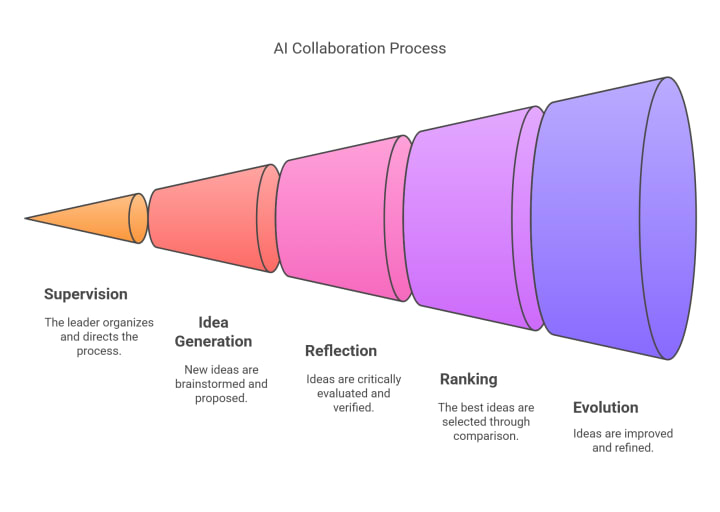
Think of this AI like a group project where everyone’s got a role. First, there’s the Supervisor Agent—the leader who keeps everything on track. It’s the one telling everyone, “Okay, here’s the plan, let’s go!” Then you’ve got the Generation Agent, the daydreamer who’s always coming up with new ideas—like, “What if we tried this?” It’s the spark plug kicking things off.
Next up is the Reflection Agent, the picky one who’s like, “Wait, is this for real?” It searches the web, checks science databases, and even runs little pretend experiments to make sure the ideas hold up. There’s the Ranking Agent, which is super cool—it puts all the ideas in a big showdown, like a science cage match, and picks the winners. The Evolution Agent is the remix guy—it takes those top ideas and makes them better, sneaking in bits from other suggestions. And the Meta-Review Agent? That’s the final checker, making sure it’s all legit and worth showing off.
They work in a circle—throwing out ideas, arguing, checking facts, and ranking stuff nonstop. It’s got memory, tools, and web access to keep things rolling. Pretty sweet, right?
How It Levels Up
Here’s the part that’s nuts: this AI doesn’t just stop—it keeps getting smarter. It’s got this thing called “test-time compute,” which just means the longer it works, the better its ideas get. Imagine you’re stuck on a tricky level in a game—the more you play, the closer you get to winning. That’s this AI. It uses something called an Elo score—like what ranks players in chess or Fortnite—to figure out which ideas are the MVPs. The higher the score, the more it’s onto something.
They tested it against other AIs and real scientists. Seven experts gave it 15 hard problems—stuff they’d been wrestling with for ages. In tests, it showed blue triangles (the AI) shooting past red dots (humans) and green lines (other AIs like Gemini 2.0). It’s not that people stink at science—it’s just this thing can think fast and chew through tons of info at once. Online, I saw it’s part of Google’s push to make AI that “reasons” better, and it’s crushing it so far.
Real-Life Superpowers

So, does it actually help, or is it just a fancy toy? Oh, it helps—big time! One example is this thing called drug repurposing—using old medicines in new ways. Scientists asked it to find drugs for a blood cancer called acute myeloid leukemia. Making a new drug takes, like, 10 years and a gazillion dollars, but the AI was like, “Try Kira 6.” They tested it in a lab, and boom—cancer cells slowed down. More Kira 6 meant fewer bad cells. That’s a shortcut to helping people!
Then there’s liver fibrosis—when your liver gets scarred and can’t do its job. The AI suggested treatments, and scientists tried them on mini lab-grown livers (called organoids—wild, right?). The results showed the AI’s picks cut scarring almost as good as the best stuff they had. It’s like it handed them a map to fix livers faster.
The craziest one? Antimicrobial resistance—when germs get too tough for antibiotics. Humans spent over a decade figuring out how bacteria share tricks with something called cf-PICIs (don’t worry about the name). In 2024, they asked the AI the same thing, and in two days, it said, “Yep, cf-PICIs team up with viruses to spread.” Two days versus 10+ years! It’s like the AI hit fast-forward on science.
Why This Rocks for Us
Think about the big stuff that scares us—cancer, Alzheimer’s, super germs. Solving those takes so long, it’s like watching grass grow. But this AI Co-Scientist? It’s like a turbo boost. Experts say it could speed research up ten times, and after those examples, I’m sold. Imagine waiting months instead of years for a cure—that’s the vibe here.
It’s personal, too. My cousin’s got asthma that acts up sometimes, and doctors are still figuring out better fixes. What if this AI could help them crack it quicker? Or think about your grandparents—maybe it could stop memory stuff like Alzheimer’s. Online, I read Google’s testing it with real scientists now, and it’s already tackling diseases we’ve been stuck on forever. It’s not just talk—it’s action.
What’s Coming Down the Road?
This is just the first version—what happens when they make it even crazier? Picture a million of these running all day, solving everything! Google’s got it in a “Trusted Tester” phase, letting a few scientists play with it before it goes wide. They even tricked it with secret lab stuff humans hadn’t shared, and it still nailed it—proof it’s not just copying homework.
It’s not perfect—it needs humans to guide it and can’t dream up totally new ideas alone. But that’s fine—it’s a helper, not a takeover. I found online that it’s part of Google’s big AI push, and some folks think it could cut research timelines in half soon. That’s nuts!
My Takeaway
This whole thing’s got me buzzing—like we’re on the edge of something huge. Diseases that mess with people, like cancer or losing your memory? They’ve always seemed unbeatable, like final bosses in a game. But this AI Co-Scientist is like a cheat code for scientists. It’s not fixing everything tomorrow, but it’s a massive step. Maybe we’ll look back at stuff like Alzheimer’s the way we laugh at old diseases like the plague—gone for good.
What do you think? Could this be the thing that cracks the tough stuff? Tell me—because if it keeps going, we might all get a world where science doesn’t drag its feet, and that’s pretty epic.
Here you can find the original Google article.
And below is the video that inspired me.
About the Creator
Francisco Navarro
A passionate reader with a deep love for science and technology. I am captivated by the intricate mechanisms of the natural world and the endless possibilities that technological advancements offer.
Keep reading
More stories from Francisco Navarro and writers in Longevity and other communities.
Younger with One Pill
Ever catch yourself daydreaming about dodging the downsides of aging? You know—the creaky knees, the forgotten names, the creeping feeling that time’s slipping through your fingers? Well, Sam Altman, the brain behind ChatGPT, isn’t just dreaming about it—he’s doing something big. He’s dropped a whopping $180 million of his own money into Retro Biosciences, a startup that’s out to tack on 10 healthy years to your life. And here’s the kicker: they’re using AI to figure out how to pull it off.
By Francisco Navarroabout a year ago in FYI
Why Didn't Anyone Tell Us
Men, move along. This is not for you. This is for the women. I was forty-five when I began menopause. It is pretty young for that to be going on in a woman’s life, but I had undiagnosed PCOS, my entire life. Thank you to all the gynecologists I had seen my entire life. That in itself should encourage women to keep seeking second opinions, especially when you are not getting correct answers or any at all.
By Alexandra Grant4 days ago in Humans




Comments