
Why Your New Smartphone Still Feels Slow After a Few Months
Why Your New Smartphone Still Feels Slow After a Few Months

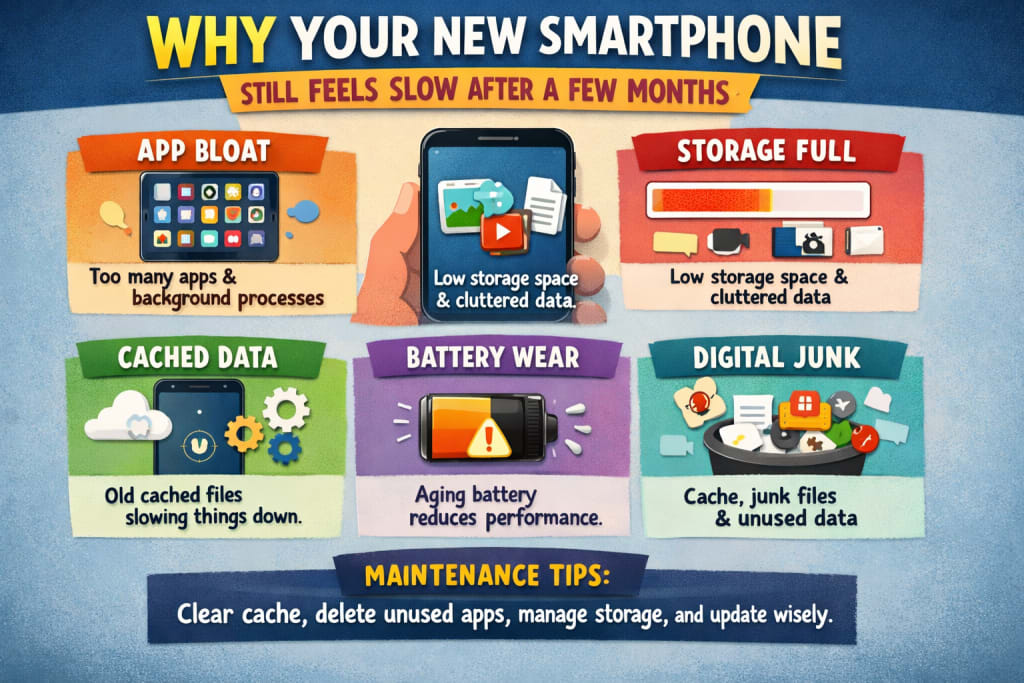
Why Your New Smartphone Still Feels Slow After a Few Months
You know the sensation.
You unbox a brand-new phone.
The screen is bright.
Apps open promptly.
Everything is smooth, rapid, and almost magical.
And then… a few months pass.
Suddenly, the same phone feels different.
Apps pause before opening.
The keyboard lags just enough to irritate you.
Battery drains quicker than you recall.
And you caught yourself thinking:
“Did my phone already get old?”
The frustrating part?
It’s not cheap.
It’s not antiquated.
And technically, nothing is “wrong” with it.
So why does this keep happening?
It’s Not Your Imagination—Phones Really Do Feel Slower
Let’s clarify things first.
This isn’t only in your brain.
And it’s not because you “used the phone too much.”
Almost everyone feels this, regardless of brand.
You purchase a phone that seems lightning-fast in month one…
By month three or four, it seems just “okay.”
By month six, you start to notice delays you swear weren’t there before.
That common experience is precisely why people keep seeking keywords like
“Why is my phone slow already?”
“New phone lagging after update”
“Phone slow after few months”
The issue isn’t one single item.
It’s a stack of subtle, undetectable changes that silently mount up.
The Biggest Reason: Software Grows Faster Than Hardware
Your phone didn’t suddenly grow weaker.
The software grew heavier.
Every update brings:
New features
New animations
More background services
Extra tracking, synchronization, and optimization activities
All of this runs quietly, whether you asked for it or not.
Your phone is suddenly performing more work, all the time.
What seemed smooth at launch was tested on a clean system.
What you’re utilizing months later is a system holding layers of upgrades, data, and background activities.
It’s not broken—it’s just busy.
Background Apps Never Really “Close” Anymore
Most consumers assume shutting an app means it’s gone.
It isn’t.
Modern applications are meant to:
Refresh content
Sync notifications
Track activity
Stay “ready” at all times
Messaging applications, social media, email, and cloud storage—they’re always waking up in the background.
Each one uses:
Memory
Processing power
Battery
Individually, it feels innocuous.
Together, they progressively chip away at performance.
You don’t notice it in a day.
You notice it over months.
Storage Fills Up Faster Than You Realize.
Phones currently come with massive storage numbers, so people stop worrying about space.
But storage doesn’t only keep photographs and movies anymore.
It holds:
App cache files
Temporary data
Offline downloads
System trash you never see
As storage fills up, phones grow slower at handling files.
That tiny delay while opening the gallery?
That delay before a camera saves?
That’s your phone straining to breathe in a congested area.
Updates Are Optimized for the Future, Not the Past
This bit hurts, but it’s vital.
Software upgrades are typically tailored for:
Newer models
Faster chips
Better memory management
Your phone still receives the update—but not the same experience.
Nothing malevolent.
Nothing unlawful.
Just development going ahead.
Your phone doesn’t become inoperable.
It simply ceases feeling “special.”
The “New Phone Effect” Wears Off Faster Than We Admit
There’s also a psychological aspect nobody speaks about.
When a phone is new:
You forgive little delays
You perceive speed more than slowness
Everything seems exciting
Months later, your expectations soar.
The same latency that was unnoticeable before now seems annoying.
The phone didn’t suddenly betray you.
Your brain just adjusted.
This is why two individuals might use the same phone and feel totally different about it.
Battery Health Quietly Affects Performance
As batteries age, even slightly, phones become more cautious.
To preserve stability, the system may:
Reduce peak performance
Limit background speed
Manage power more aggressively
You don’t receive a warning.
You simply feel the phone getting less responsive.
It’s subtle.
And it’s purposeful.
What This Means (And What It Doesn’t)
It does NOT mean:
Your phone is “bad”
You picked the incorrect brand
You must upgrade immediately
It DOES mean:
Modern cellphones are complicated
Performance is not simply about the processor
Long-term smoothness needs maintenance
Simple Things That Actually Help
No magic tricks.
No factory reset drama.
Just practices that lessen strain on your device:
Restart your phone once a week
Delete applications you haven’t used in months
Clear storage clutter periodically
Turn off notifications you don’t need
Accept that “perfect smoothness” is transient
These won’t make your phone new again—but they’ll delay the slide.
The Uncomfortable Truth About Modern Phones
Here’s the bit most folks don’t enjoy hearing.
Phones nowadays are intended for rapid development, not long-term calm.
New features.
New services.
New demands.
Your phone isn’t failing—it’s being expected to perform more than it did at launch.
That’s why so many people feel irritated even with pricey equipment.
The Real Question Isn’t “Why Is My Phone Slow?”
The true question is:
“Why do we expect modern technology to stay perfect forever?”
Once you grasp it, the frustration fades.
You stop blaming yourself.
You quit blaming the phone.
And you start utilizing technology with more reasonable expectations.
Final Thought
If your phone seems sluggish after a few months, you’re not alone.
It’s not a mistake.
It’s not laziness.
And it doesn’t imply you failed as a buyer.
It only means current cellphones age silently—and quicker than we confess.
About the Creator
abualyaanart
I write thoughtful, experience-driven stories about technology, digital life, and how modern tools quietly shape the way we think, work, and live.
I believe good technology should support life
Abualyaanart
Keep reading
More stories from abualyaanart and writers in Lifehack and other communities.
Phoenix, Arizona: The City That Learned to Grow With the Desert
When people first arrive in Phoenix, Arizona, the landscape can feel almost surreal. The vast Sonoran Desert stretches outward with towering saguaro cacti, rugged mountains, and wide skies that shift colors dramatically at sunset. At first glance, it seems like an unlikely place for a major metropolitan area.
By House Doctorabout 19 hours ago in Lifehack
Boulder: Where Mountains Shape the Rhythm of Everyday Life
At the edge of the Rocky Mountains lies a city where the natural world is never far away. Boulder sits beneath dramatic sandstone formations known as the Flatirons, and their presence defines nearly everything about life here.
By House Doctor5 days ago in Lifehack
The BAFTA Awards
By now, in a stunning departure from recent years, most of the world is aware of what happened at the BAFTA film awards. Social Media Headlines will tell you the bare bones: that John Davidson, a Tourette's Syndrome advocate, shouted a racial slur at two Actors of Colour, Michael B Jordan and Delroy Lindo.
By Natasja Rose6 days ago in Psyche



Comments
There are no comments for this story
Be the first to respond and start the conversation.