
WHICH IS THE RIGHT OUTSOURCING MODEL FOR YOU — STAFF AUGMENTATION OR MANAGED IT SERVICES?
Leveraging popular outsourcing models, many IT firms are successfully enhancing their agility, accommodating the impact of hiring restrictions, and overcoming short-term capability deficiencies.
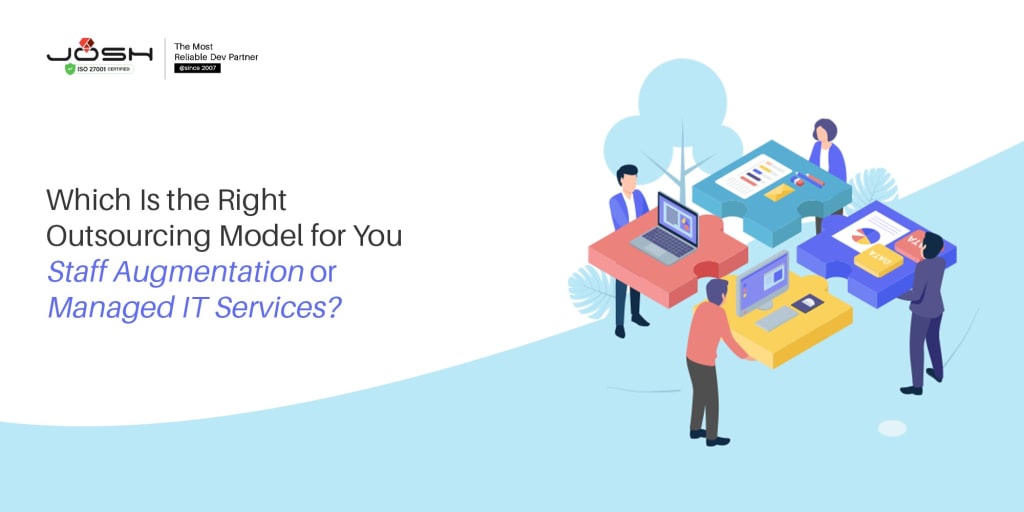
Among the multiple outsourcing models offered by staffing companies, Staff Augmentation and Managed Services appear to be the most popular ones.
Involving minimal contracting efforts and a simple cost model, Staff Augmentation complements your in-house capabilities, without impacting your existing operating model.
On the other hand, a long-term external sourcing model like Managed IT Services can help you minimize the potential risks inherent to the short tenure of the Staff Augmentation model.
Let’s dive deeper into these two models and find out which one could be the best fit for your business.
How the Staff Augmentation Model Works
Staff Augmentation helps with increasing your team’s existing capabilities for developing new products or upgrading existing ones, by temporarily employing external staff. Such employees are contractually hired by the staffing vendor, based on your specific requirements and preferences.
With Staff Augmentation, while the specific technical input for the project is provided by the temporary external staff; the final output is strictly dependant on the in-house team.
Despite being a temporary solution, Staff Augmentation has been widely proven to add massive value to IT firms, due to its numerous benefits.
● Increased efficiency and productivity in the execution of day-to-day tasks
● Access to rare, specialized skills to perform specific tasks for a short period
● Hassle-free hiring process for urgent requirements like developing a new product line
● Rapid hiring that ensures agility, along with increased time-to-market and higher ROI

How the Managed IT Services Model Works
With Managed IT Services, you essentially outsource the entirety of your company’s IT processes to a vendor company that operates through specific parameters and specifications determined by you. However, under this model, the vendor assumes control of all IT staffing, management, and project execution responsibilities.
Why companies should opt for managed services:
● Specific technical output, without the need to invest in building the required resources and infrastructure
● Saves time and effort by delegating long-running and labor-intensive development needs
● Smooth administration and management of staff, all handled by the vendor, enabling the parent company to focus on more important aspects

How to Decide Which Model Is the Best Fit for You
While both outsourcing models have their own sets of pros and cons, a few key differences give each of them an edge over the other, when it comes to meeting your specific requirements.
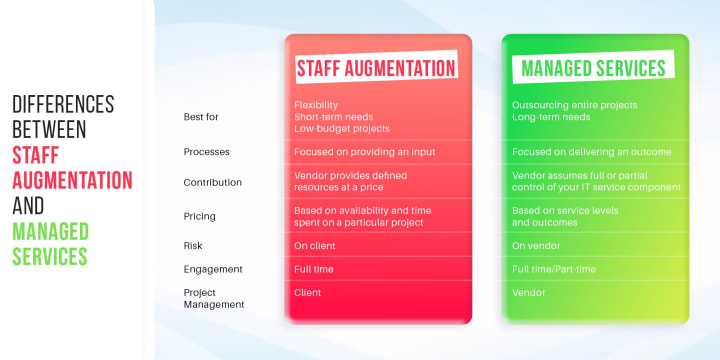
With Managed Services, the vendor makes a commitment to delivering an “outcome” at a cost, whereas, under the Staff Augmentation model an “input” is provided, for the performance of an activity, with no such commitment of bringing about any desired outcome. The Managed Services model adds value to your organization by taking care of proper planning and execution, once your specific organizational requirements are known, especially in terms of service and performance. The pricing is tied to the outcome and the level of service you require, making room for scalability based on service demand. On the other hand, under the Staff Augmentation model, the only service commitment that the vendor makes is the provision of talent with a specified skillset and the hours of work they put in.
The vendor providing Managed Services owns all the potential risks in delivering the service and the specified outcome. As the price is fixed and tied to the delivery, the vendor implements all the productivity and risk management measures essential for meeting the commitment. They manage the extensive documentation and the implementation of tools and processes, instead of depending on individual employees to avoid risk. With Staff Augmentation, vendors assume no such risk, and all the preventive measures must be implemented and managed by you.
Besides the risks, Managed Services vendors also own the project management and development processes, requiring you to relinquish a lot of control. This also means that they come with a higher price tag. Under Staff Augmentation, you retain full control of your project’s development, with internal project management and supervision.
Although Staff Augmentation is now being preferred by more and more IT firms, you must not see it as a permanent operating model. Providing great value in short-term projects, Staff Augmentation does not return the same level of benefits in the long-term and can even pose some serious risks. With IT outsourcing vendors nowadays employing highly experienced and talented developers, Managed Services can prove to be quite cost-effective when engaged over a significant period, greatly benefiting organizations that lack technical expertise and management resources.
At the end of the day, whichever model you do decide to go with, you must ensure that it aligns with the nature of your business and its specific needs, in terms of all the aspects mentioned above.
Next Steps
When it comes to outsourcing, deciding on the right model for you is only the first step. Success with outsourcing depends greatly on being able to wisely select the right vendor partner.
At Josh Software, we assist our clients in managing varied project requirements with unparalleled go-to-market speeds. The solutions we design and develop are tailored to your needs and enhanced as per your expectations.
Delegate your staffing woes and maximize your ROI, with Josh’s outsourcing models.
Reach out to us to explore our prices, models, and post-development support services.
About the Creator
Keep reading
More stories from writers in Lifehack and other communities.
A Dart at Dusk
Seconds ago, the sullen sun set on the two of us… my exuberant furry companion and me. A fresh breeze embraces us, delivering welcome relief from the day’s oppressive heat. His typical stumbling and staggering along — apace with a sloth — has turned into trip-trapping, high-stepping, almost skipping along.
By Angie the Archivist 📚🪶5 days ago in Petlife



Comments
There are no comments for this story
Be the first to respond and start the conversation.