
Dutch vs. Twilled Stainless Steel Mesh Weave: Which Is Right for You?
Compare Dutch and twilled stainless steel mesh weaves, their structures, strengths, applications, and how to choose the right option for your needs.

When selecting the ideal stainless steel weave for filtration, architectural, industrial, or decorative applications, two names consistently rise to the top: Dutch weave and Twilled weave. Both offer exceptional performance, durability, and versatility, yet their structural differences and functional strengths make each better suited to specific applications.
Understanding these differences—and how they affect performance—is crucial for engineers, designers, fabricators, and buyers seeking the most efficient and cost-effective solution for their needs.
Introduction to Stainless Steel Mesh Weaves
Stainless steel mesh is a highly versatile material used across industries. Manufactured from stainless steel wires woven in specific patterns, the mesh provides strength, corrosion resistance, temperature tolerance, and precise opening sizes.
Common industries that use stainless steel weaves include:
• Oil and gas
• Chemical processing
• Pharmaceuticals
• Food and beverage
• Water and wastewater treatment
• Automotive
• Aerospace
• Mining
• Architectural design
Among the numerous weave types available, Dutch and Twilled weaves are especially prominent where high filtration accuracy and strength are required.
What is Dutch Stainless Steel Mesh?
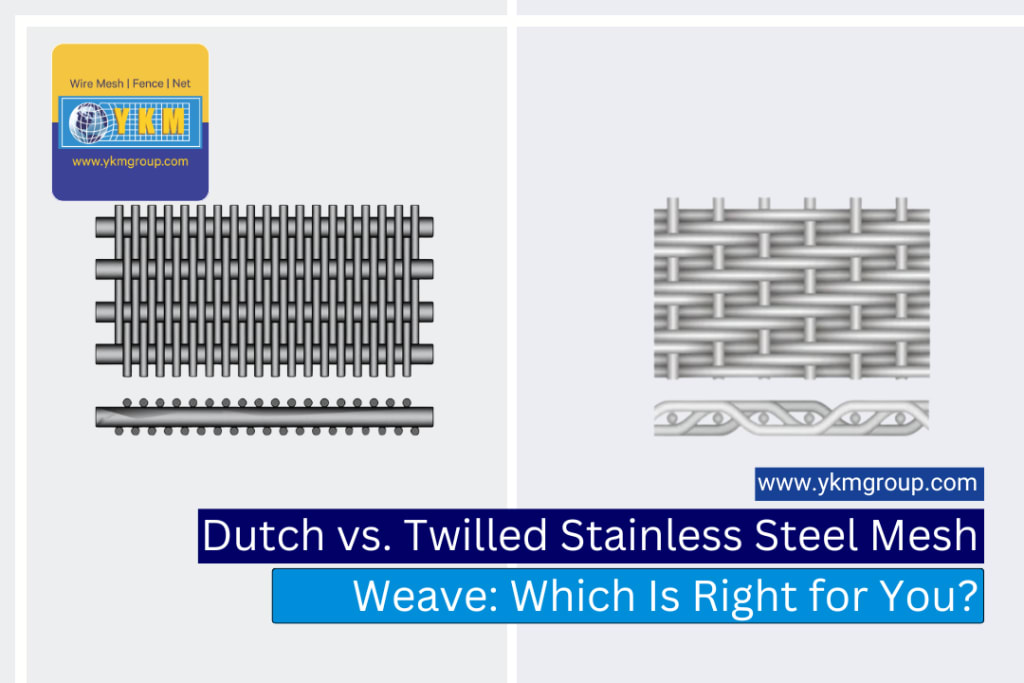
Dutch weave stainless steel cloth is characterised by its higher number of fine weft (horizontal) wires than warp (vertical) wires. This results in a denser and flatter fabric with very precise openings.
Dutch weave mesh features varying wire diameters in the warp and weft directions. This design results in a mesh with a relatively tight weave, which provides excellent filtration capabilities. The weave pattern typically involves a larger warp wire and a smaller weft wire, creating a dense and strong mesh surface.
Key features:
• Smaller, rectangular openings
• High particle retention
• High mechanical strength
• Smooth surface finish
What is Twilled Stainless Steel Mesh?
Twilled stainless steel mesh weave is another type of woven wire mesh characterized by its distinctive weaving pattern. In a twill weave, each weft wire passes alternately over and under two warp wires, creating a diagonal pattern. This weaving technique results in a mesh with a higher density and greater strength compared to plain weave meshes. The twill pattern enhances the mesh’s ability to withstand higher pressures and mechanical loads.
The twill weave design allows for the use of heavier wires, which contributes to the mesh’s increased durability and rigidity. This makes twilled stainless steel mesh an excellent choice for applications where structural integrity and resistance to deformation are crucial. The mesh’s robust construction also provides enhanced resistance to abrasion and mechanical wear, ensuring a longer lifespan in demanding environments.
Twilled stainless steel mesh is widely used in industrial applications that require a combination of strength and precision. Its ability to handle high-pressure environments makes it suitable for filtration and separation processes in industries such as petroleum refining, aerospace, and pharmaceuticals.
Dutch vs Twilled Stainless Steel Mesh: Side by Side Comparison
How Dutch and Twilled Weaves Are Manufactured
While both Dutch and twilled stainless steel meshes are renowned for their durability and filtration capabilities, they differ significantly in their structure, weave patterns, and applications. One of the primary distinctions is the weave pattern itself:
Dutch Weave Manufacturing
Dutch weave is produced by weaving multiple small diameter weft wires between larger diameter warp wires or vice-versa. The result is a mesh weave with more wires per inch than traditional weaves, and the mesh openings are formed between small weft and coarse warp wires.
The manufacturing process:
• High precision weaving – requires advanced weaving looms.
• Exact tension control – ensures uniformity across the cloth.
• Calendaring – pressing the mesh to create a flatter surface.
The dense structure requires careful quality control, but the result is a mesh with uniform, accurate, and very tight openings, ideal for fine filtration.
Twilled Weave Manufacturing
Twilled weave is created by weaving warp and weft wires in a twill pattern:
• Each weft wire goes over two warp wires and under two warp wires.
• The pattern shifts one warp wire over on each new row, producing a distinct diagonal appearance.
This pattern reduces mechanical stress at each crimp point, enabling a higher open area with adequate strength.
Production involves:
• Conventional weaving equipment
• Moderate precision control
• Standard post-weave finishing
Twilled weave’s relatively simple manufacture makes it widely available for many general and specialised applications.
Dutch vs Twilled Stainless Steel Mesh Filtration Performance Comparison
Filtration is where the differences between Dutch and Twilled weaves are most pronounced.
Precision & Particle Retention
• Dutch weave excels in removing extremely fine particles due to its dense structure and controlled openings down to microns.
• Twilled weave has larger open areas, making it effective for larger particle sizes, higher throughput, and applications where high flow rate is critical.
Flow and Throughput
• Twilled weave offers higher flow rates due to increased open area and lower wire density.
• Dutch weave tends to restrict flow somewhat, though this is a necessary trade-off for finer filtration.
Pressure Drop & Efficiency
• High-precision filters must balance pressure drop and filtration efficiency.
• Dutch weave provides high efficiency but often with higher pressure drop.
• Twilled weave provides moderate to high efficiency with lower pressure drop, making it ideal for gravity or low-pressure environments.
Dutch vs Twilled Stainless Steel Mesh Application Comparison
Applications of Dutch Stainless Steel Mesh
Dutch stainless steel mesh finds extensive use in various industries due to its superior filtration capabilities and mechanical strength.
One of the primary applications of Dutch weave stainless steel mesh is in the chemical processing industry. The mesh’s fine filtration properties ensure that impurities and contaminants are effectively removed from chemical solutions, contributing to the production of high-purity chemicals. The mesh’s resistance to corrosion and chemical reactions further enhances its suitability for use in aggressive chemical environments.
In the food and beverage industry, Dutch stainless steel mesh plays a critical role in ensuring the safety and quality of products. The mesh is used in filtration systems to remove contaminants from liquids such as juices, syrups, and oils. Its fine mesh openings capture unwanted particles, ensuring that the final products meet stringent quality standards. Additionally, the mesh’s durability and resistance to wear make it a reliable choice for long-term use in food processing facilities.
Water treatment is another significant application area for Dutch stainless steel mesh. The mesh is used in filtration systems to remove suspended solids, bacteria, and other impurities from water sources. Its fine filtration capabilities make it effective in producing clean and safe drinking water, as well as in treating industrial wastewater. The mesh’s robustness and resistance to corrosion ensure reliable performance in water treatment plants, contributing to the overall efficiency of water purification processes.
Applications of Twilled Stainless Steel Mesh
Twilled stainless steel mesh is highly valued in industries that require a combination of strength, durability, and precision.
One of the key applications of twill weave mesh is in the aerospace industry. The mesh’s robust construction and ability to withstand high pressures make it suitable for use in critical components such as fuel filters, hydraulic systems, and air intake screens. The mesh ensures the removal of contaminants from fluids and gases, contributing to the reliable and safe operation of aerospace systems.
In the petroleum refining industry, twilled stainless steel mesh is used in filtration and separation processes to ensure the purity and quality of refined products. The mesh’s strength and resistance to mechanical wear make it ideal for handling the demanding conditions of oil refineries. It is used in applications such as catalyst recovery, gas filtration, and separation of solid particles from liquids, ensuring the efficiency and effectiveness of refining operations.
The pharmaceutical industry also benefits from the use of twilled stainless steel mesh. The mesh is employed in filtration systems to ensure the removal of impurities from pharmaceutical products, such as injectable solutions and oral medications. Its precise and uniform openings enable accurate filtration, ensuring that the final products meet stringent quality and safety standards.
The mesh’s durability and resistance to chemical reactions make it a reliable choice for use in pharmaceutical manufacturing environments.
Dutch vs Twilled Stainless Steel Mesh Mechanical and Physical Properties
Strength and Durability
Both Dutch and Twilled weaves are strong, but they excel in different ways:
• Dutch weave: The dense multi-wire configuration enhances tensile strength and resistance to deformation—especially under compressive loads.
• Twilled weave: Slightly more flexible due to fewer crimp points, providing excellent shock resistance and dynamic performance.
Surface Characteristics
• Dutch weave’s flat surface can be beneficial in filter presses, seating against seals, and achieving repeatable, low-leak filtration paths.
• Twilled weave’s diagonal ribs can sometimes trap larger particles, making back-flushing slightly more effective when cleaning filters.
Corrosion Resistance
Both weaves are typically made of stainless steel alloys such as 304, 316, and 316L—each offering excellent corrosion resistance across harsh environments. The weave type does not significantly alter corrosion resistance, though:
• A tighter Dutch weave may trap corrosive fluids if not cleaned properly.
• A Twilled weave tends to allow easier fluid passage and simplified cleaning.
Dutch vs Twilled Stainless Steel Mesh Maintenance Planning
Maintenance Planning
• Dutch weave: Plan for regular inspection and cleaning because fine openings can clog.
• Twilled weave: Easier back-flushing and particulate release.
Choosing the Right Weave
A Step-by-Step Guide to determine whether Dutch or Twilled stainless steel weave is right for you, ask:
Step 1: What is the target particle size?
• If extremely fine filtration down to microns is needed → Dutch weave
• If larger particle filtration with high flow is more critical → Twilled weave
Step 2: What is the flow rate requirement?
• Low flow but high precision → Dutch weave
• High flow with moderate precision → Twilled weave
Step 3: What is the budget?
• High precision and longevity may justify higher upfront cost of Dutch weave.
• Moderate filtration requirements with cost efficiency → Twilled weave
Step 4: What environmental conditions?
• Corrosive, high-temperature environments usually favour 316/316L alloys regardless of weave type.
Step 5: What maintenance frequency is acceptable?
• Frequent cleaning needs can favour Twilled weave.
• Controlled environment and scheduled maintenance fit Dutch weave best.
YKM offers stainless steel mesh with high mechanical strength and resistance to wear also make it a reliable option for long-term use in demanding environments.
On the other hand, if your project involves high-pressure environments and requires a combination of strength and flexibility, twilled stainless steel mesh may be the better option.
The twill weave pattern allows for the use of heavier wires, resulting in a robust and durable mesh that can withstand significant mechanical stresses. This makes twill weave mesh suitable for applications such as aerospace, petroleum refining, and high-precision industrial processes.
About the Creator
YKM Group
YKM Group, established in the year 1984 with capacity to manufacture wire cloth, welded wire mesh, chain link fence, shade net and wires with total production area of 156,000 square meters.




Comments
There are no comments for this story
Be the first to respond and start the conversation.