


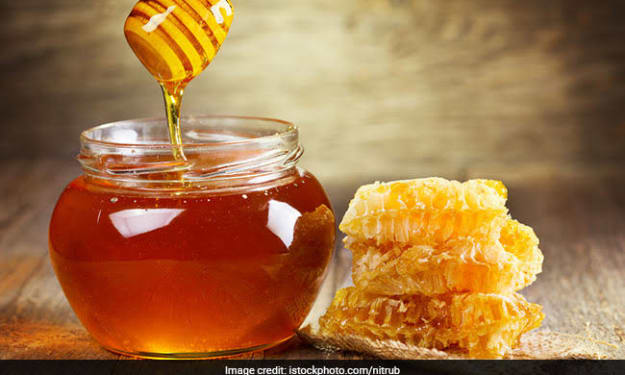
How honey is made by bees in their hives. The process starts with the collection of nectars from flowers by the worker bees. The collected nectars are placed in honeycombs. The bees fan it with their wings in order to evaporate most of the water in the nectar. They also add enzymes to aid in honey production. In the process, the natural sugars in the nectar are also broken down into simple forms.As the water evaporates, the remaining liquid turns thicker and the sugar becomes concentrated, turning it into a thick and sweet liquid. When about 17%of the water content is removed, the bees seal the cells of the honeycomb with beeswax. Over time, chemical reactions and more evaporation take place,turning the liquid into honey.The color and flavor of the honey largely depends on the type of flower where the nectar came from. Honey blends occur naturally, as the bees collect honey from all kinds of flowers. This happens often when the beehive is close to an area with different types of flowers growing nearby. Specific flavors are obtained when the bees are limited to collecting nectar from particular flowers.For example, the beehive is located in the middle of a field of sunflowers,without any other kind of flower nearby. The bees would be producing sunflower honey, pure and unblended.
Honey flavors and colors vary, depending on the flower. For example, honey made from the nectar of Orange Blossom has a light amber color. Hone y made from the nectar of wildflowers or avocado flower has a deeper, darker amber color. In the United States alone, there are over 300 different and distinct honey flavors, made from the nectar of different flowers.Amber is the most popular color of honey. However, the color actually ranges from colorless to dark brown. The flavors also vary from mild to bold.Generally, lighter honey colors have milder tastes and darker-colored ones have a much bolder flavor.Some of the more common and popular honey varieties available include the following:
Acacia honey comes from the nectar of the acacia tree’s flowers. This honey has a very pale color. Pure acacia honey resembles the appearance of liquid glass. The flavor is floral, mild and sweet. This is one of the popular honey flavors. This is because it does not give an overpowering flavor and sweetness when mixed with beverages or when used in cooking.
Alfalfa honey. The United States and Canada extensively produce alfalfa honey. It comes from the nectar of the purple blooms of the alfalfa plant. Alfalfa honey has a light amber color. The aroma and flavor are pleasantly mild.Avocado honey. This honey is produced from the blooms of California avocado. It has a dark amber color. The taste is rich and buttery.
Blueberry honey is derived from the blueberry bush. It has the typical light amber color. The flavor is full and well rounded. This is commonly produced in Michigan and New England.
Clover honey is one of the most abundant honey varieties produced in the United States.The nectar comes from the blossoms of the clover plant family such as Alsikeclover, red clover, and sweet clovers (both white and yellow varieties). Cloverhoney has a pleasant and mild taste. The color varies, depending on where and what type of clover the nectar came from. It is available in colors ranging from water white, light amber to amber.
Eucalyptus honey comes from the large Eucalyptus genera, which is composed of more than 500 unique species. Because of the vastness in diversity among the Eucalyptus family, the honey made from it is also wide ranging. The colors and flavor widely differ. One thing common is that eucalyptus honey has a strong flavor, with a hint of a medicinal smell. Eucalyptus honey is largely produced in California.
Fireweed honey is made from the nectar of the fireweed plant. This plant is a perennial herb that grows in the open woods of Canada, and in the Pacific and Northern states. The plant grows up to 3-5 feet high and bears pink flowers. Fireweed honey has a light colour.
Manuka honey is one of the most preferred variation as natural remedy. This is sued internally and topically for various ailments. It is mainly produced in New Zealand, where the manuka plant is indigenous. Manuka honey is considered atone of the most organic honey in the world because the plant grows in uncultivated areas in New Zealand, far away from pollution and chemical contaminants
Orange Blossom honey is made from the combined nectar of the flowers of different citrus plants. It is mainly produced in some parts of Texas, in Southern California and in Florida. Orange blossom honey has a light color and mild flavor. It has a fresh scent with a light and citrus taste.
Sage honey is mainly produced in California. It has a light color and is heavy bodied. The flavor is delightful and mild. Honey packers often blend sage honey with other honeys because it slows down granulation.
Tupelo honey is a premium type of honey. Northwest Florida is the main production site for this type of honey. The fructose content is high, making granulation slow .Tupelo honey is heavy-bodied. The color is light golden amber and has a greenish cast. The taste is mild and distinctive.
Wildflower honey is used collectively for honey made from undefined flowers.
Honey blends are combinations of different honey varieties, often creating consistent and unique colors and flavors.
About the Creator
Keep reading
More stories from Samuel Ofori and writers in Lifehack and other communities.
THE POWER OF HONEY
Honey is mentioned in the bible several times. The phrase “milk and honey” was used at least 21 different places to describe the fertility and prosperity of the Promised Land, in contrast to the desert, which did not flow with water, milk, or honey. Honey is one of the Bible’s good-for-you healing foods. Here are some interesting biblical references to honey—and what they may mean. These were gleaned from a variety of sources, all leading to the Bible:
By Samuel Ofori3 years ago in Lifehack
7 Important Facts About Ingrown Toenails
1. An ingrown toenail occurs when the edge of the nail injures the skin An ingrown toenail develops when the side of the nail plate grows into the surrounding skin. This most often happens on the big toe, as it bears the most weight when walking and wearing shoes. When the nail penetrates the skin, it causes local tissue damage. The body reacts with inflammation, which causes redness, swelling, and tenderness. With continued pressure and friction, the damage worsens, and the risk of infection increases.
By Amelia Grant7 days ago in Lifehack
Flower Bloom 369
FLOWER Bloom 2/25/26 Wednesday By Mariann Carroll Karen had been with Tony for 7 years. Tony started acting strangely after her surgery. He would mow the lawn in the rain and be on his cellphone. He started pushing Karen away. Tony came clean about seeing someone. Karen moved out two months later. Karen moved in with a friend. She felt betrayed.
By Mariann Carroll4 days ago in Fiction


Comments
There are no comments for this story
Be the first to respond and start the conversation.