
The Fractal Society
How the Patterns We Ignore Are Shaping Our World


In the quiet of a frozen Minnesota dawn, Dr. Aris Thorne watched the frost etch its crystalline patterns on his windowpane. Each branch, each twig, was a perfect miniature of the whole—a fractal, nature’s code for infinite complexity born of simple, repeating rules. For decades, Aris had studied these patterns in clouds, river systems, and ferns. But now, nearing retirement, he saw them somewhere new: in the chaos of human society itself.
Our world feels increasingly fragmented and unpredictable. Yet, what if this chaos is not random? What if our society is a fractal, and the turbulence we experience is the inevitable result of the simple, powerful patterns we’ve encoded into its core?
The Repeating Pattern: The Selfish Algorithm
A fractal is built by an "iterator," a simple rule that repeats infinitely. Aris began to suspect that the modern iterator—the rule our global system repeats at every scale—is the Optimization for Individual Gain.
This pattern repeats from the highest levels down to the most intimate:
In our economies: The primary rule is "maximize shareholder value." This pattern iterates down, encouraging companies to optimize for short-term profit over long-term health, which in turn encourages employees to optimize for personal career advancement over collective well-being.
In our technology: The rule is "maximize engagement." This iterates down into algorithms that optimize for outrage and addiction, which then shape how individuals optimize their own online personas for validation and influence.
In our personal lives: The cultural rule is "optimize your life." This iterates down into a relentless focus on self-improvement, personal branding, and individual success, often at the cost of community, family, and mental peace.
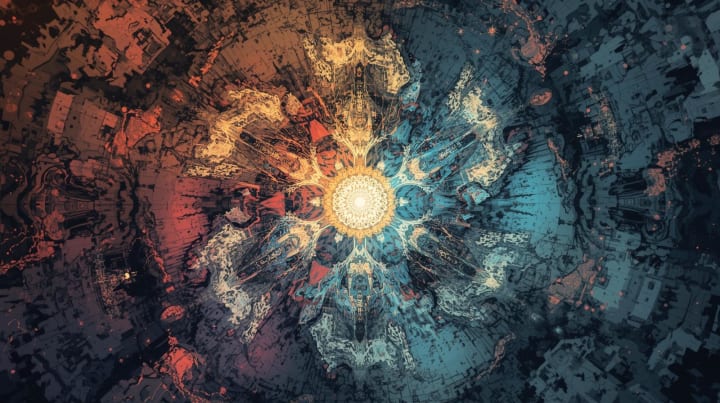
We are all running the same core software: a simple, repeating command to seek personal advantage. And like any fractal, the pattern at the top looks exactly like the pattern at the very bottom.
The Great Unraveling: When the Pattern Turns Pathological
A healthy fractal, like a lung or a tree, is complex and beautiful because it balances its repeating pattern with a higher purpose—to oxygenate blood or to gather sunlight. Our societal fractal has lost its higher purpose. The pattern of individual optimization has become an end in itself, leading to a "pathological fractal" where the same flaw is replicated at every level.
We see the same structural problems in a multinational corporation, a local government, a school PTA, and even a family argument. The same dynamics of us-vs-them thinking, the same scarcity mindset, the same prioritization of metrics over meaning. The political polarization you see on the news is the same pattern as the silent competition between coworkers, which is the same pattern as the quiet resentment between siblings.
This is why problems feel so intractable. You cannot fix a flawed fractal by painting over one tiny branch. The entire structure is built from the same broken rule.
The Glitch in the Code: The Empathy Bug
But Aris noticed something else. Just as a real fractal in nature has tiny variations that give it resilience and beauty, our society has a persistent, stubborn glitch in its code: Empathy.
This "bug" appears irrationally, against all optimization commands. It’s the billionaire who gives away his fortune. It’s the stranger who runs into a burning building. It’s the quiet understanding between two people who choose connection over being right. Empathy is the system's immune response to its own pathological programming. It is the proof that the iterator can be changed.
Rewriting the Iterator: From "Me" to "We"
The solution to our fractal crisis is not a grand, top-down revolution. You cannot command a fractal to change. You can only change the simple rule that generates it.
This means a quiet, bottom-up rewrite of our core code. We must consciously choose a new iterator to repeat at every scale of our lives:
In your economy: Choose to support businesses that optimize for community and environmental health, not just profit.
In your technology: Curate your feeds to maximize understanding, not just engagement. Choose connection over consumption.
In your personal life: Optimize for generosity. Seek collective well-being. Prioritize presence over performance.
Every time you make a choice based on this new rule, you are not just performing a single good deed. You are running a new line of code. You are generating a new pattern that, when repeated, can grow into an entirely new societal structure.
Aris finally looked away from the frost. The pattern was clear. Our collapsing institutions, our personal anxieties, our polarized debates—they are not separate crises. They are one crisis, echoing across scales. We are living inside a fractal that we built, and we hold the power to rebuild it. The future will not be built by a few great leaders, but by millions of us, consciously repeating a better, simpler pattern: one of profound and intentional connection.

Moral of the Story:
The chaos in our world is a fractal pattern generated by a core cultural rule of "individual optimization." To heal our society, we must consciously rewrite this code at a personal level, replacing it with a new iterator of empathy and collective well-being.
About the Creator
The 9x Fawdi
Dark Science Of Society — welcome to The 9x Fawdi’s world.
Keep reading
More stories from The 9x Fawdi and writers in Lifehack and other communities.
Porn is Destroying Your Kid's Life (And They Don't Even Know It)
It’s not in the schools. It’s not in the streets. The single biggest threat to your child’s healthy development is hiding in their pocket, accessible with a single click. The average age of first exposure to hardcore pornography is now between 8 and 11 years old. This isn't about stumbling upon a risqué magazine; this is about children’s developing brains being flooded with graphic, violent, and degrading sexual content before they’ve even had their first kiss. This is a public health crisis, and the damage is both profound and permanent.
By The 9x Fawdi4 months ago in Lifehack
The Digital Mess Behind Small Businesses: How They Finally Get Organized
The Chaos Behind Every Small Business Most small business owners spend a surprising amount of their day buried in digital clutter. An invoice arrives through WhatsApp. A contract sits somewhere in an email thread. Last month's spreadsheet is on a laptop that is not even in the room. Important business information ends up scattered across apps, devices, and inboxes, and pulling it all together becomes a daily scavenger hunt.
By Jacob Estrella7 days ago in Lifehack
I Stopped Chasing Money—And This One Lifehack Quietly Made Me Richer
For years, I believed making money was about working harder, longer, and pushing myself to the limit. I thought if I just stayed busy enough—if I said yes to every opportunity and filled every hour of my day—money would naturally follow.
By Lukáš Hrdlička6 days ago in Lifehack
Tatt~Master
— Assembly Line Tatt Machine ~ Impressions to Impress — As I begin to understand more about the Tattoo Phenomenon. I've written silly, yet verbatim, dating site anecdotes in 'Frazzled.' So let me ask you: Would you be More attracted to someone slathered with tattoos, or Less?
By Jay Kantor4 days ago in Humor


Comments
There are no comments for this story
Be the first to respond and start the conversation.