
How to Decorate the Living Room With Wall Art and Make it Anxiety-free
How your home is designed, from the colors you choose to the interior style you picked, can influence your own mental well-being. And in this article, you’ll see how to decorate your living room in a way that it relieves your anxiety.

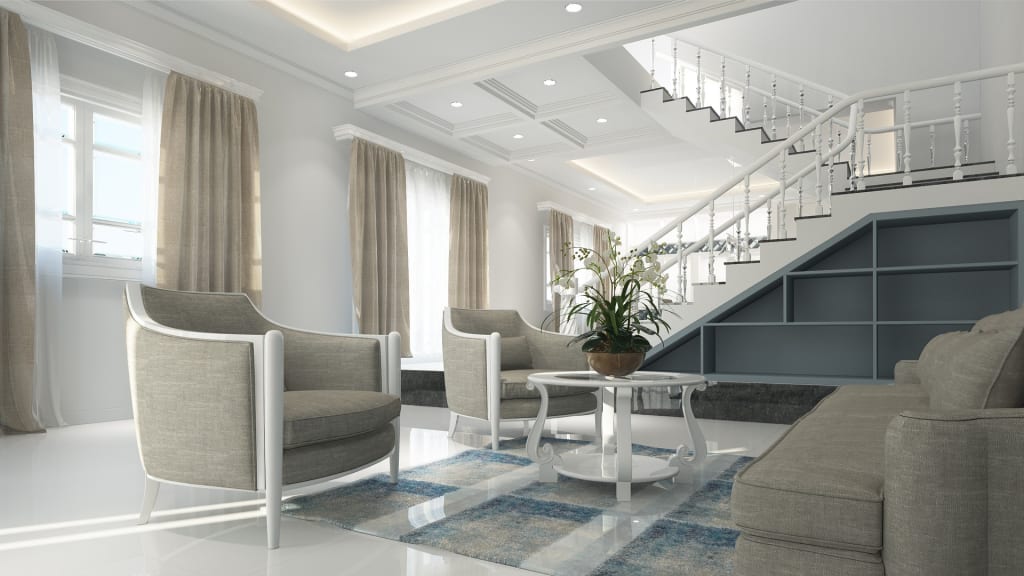
Doing your own interior decorating isn't just about aesthetics and providing cozy homes. Have you ever considered how your home would actually feel, especially if you're one of 18.1 percent of the population suffering from an anxiety disorder?
Both therapists and interior designers alike understand the effects of a tastefully decorated home on one's emotions and well-being. And by extension, it also does wonders for relieving stress and anxiety.
So whether you're facing stress because of a particular situation, or you're a person suffering from bouts of clinical anxiety, creating, and decorating your living room to be stress-free feels like a step towards preventing and managing the daunting emotions.
#1 Choosing a calming color palette
Colors affect your mood, and that is proven time and time again by scientific research. But it doesn't just affect the mood—it impacts behavior and stress levels.
In making a room feel airier, lighter, and more calming, interior designers advise that you stick to light colors. But don't rule out specific shades that elicit relaxation and calm in a room as well.
For a higher probability of having a clearer mind, it's advised to stick to small patterns. And make sure that these small patterns are only visible in accent furniture—not take up a whole space on the wall. Large patterns visually close a room and inspire loads of activity.
Blue
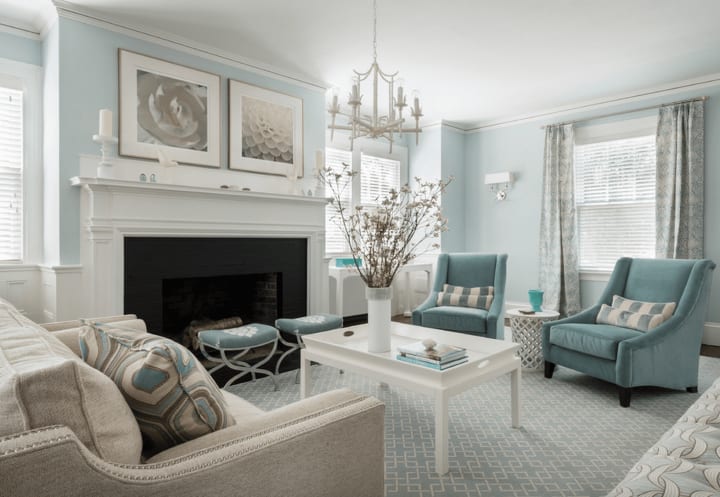
Psychologically, blue reminds us about childhood—the skies and seas. It's no surprise that the immediate go-to for calming colors are blue—the symbol of tranquility, serenity, and calm.
Pale and mid-tone blue colors inspire spaciousness, and are ideal for fostering a soothing environment. Don't gravitate towards darker hues of blue too much if you want calming, since that tends to be energizing and dramatic.
Accessorize the blue colors with other warm hues, like yellow or red.
Green
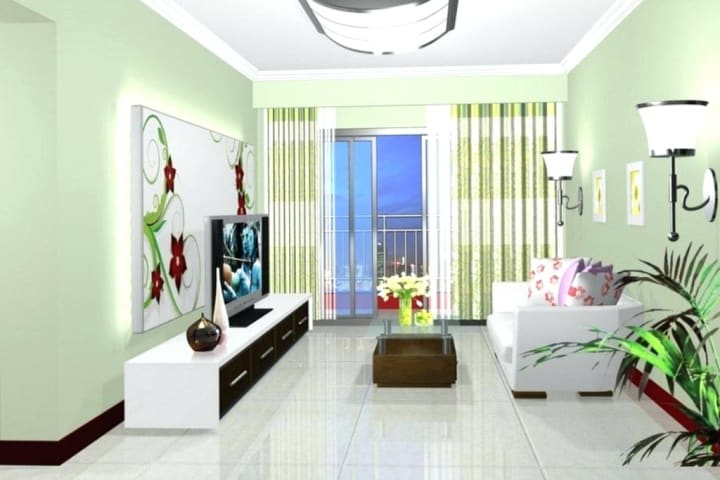
Green is ideal for a room that fosters focus and relaxation. It's the color of nature, and immediately translates to thoughts of freshness, harmony, and growth. In addition, green is a restful color that invokes security and safety.
Blue-based shades of green (aqua, turquoise, etc) inspire calm and relaxation. And yellow-based shades (olive, apple green, etc) invoke warmth.
They make your living room look bigger, as long as you keep it to light and medium shades. In addition, couple the green walls with light colored ceilings, and don't hesitate to play with light so you give a feeling of airiness.
Whites and Light Neutrals
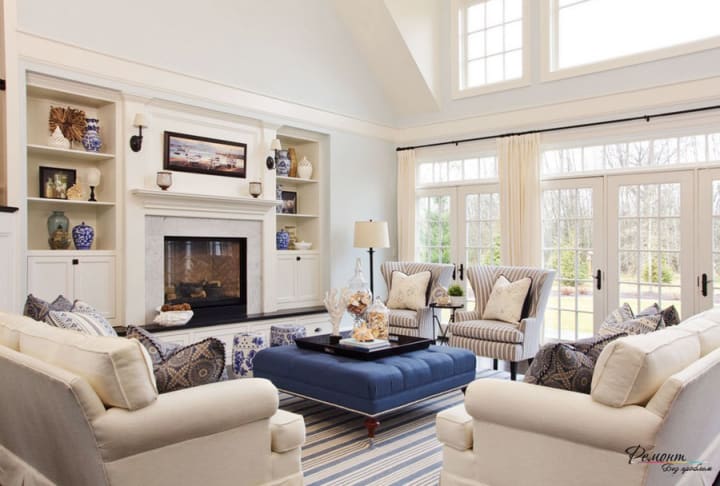
White is often associated with goodness, purity, innocence, and cleanliness. Neutrals are calming, and other variations of white (beige, gray, tan, and cream) are very much welcome, and do wonders in making spaces airier.
To create a cohesive atmosphere, add pops of color with fabric, accent pieces, and furnishings.
#2 Invest in indoor greenery
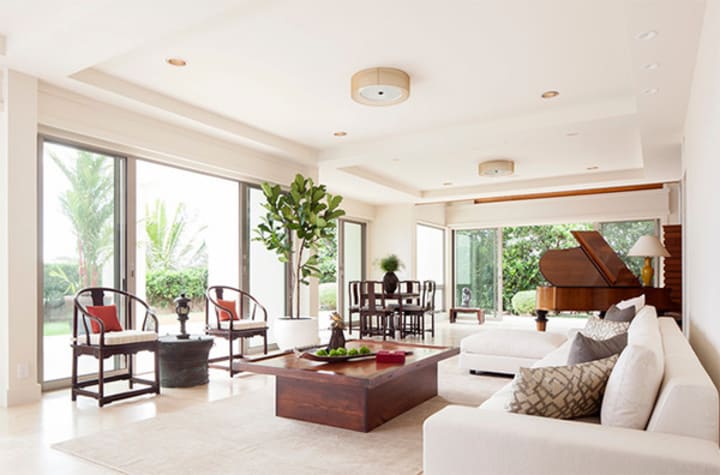
A relaxing room can never be truly complete in the absence of greenery. Indoor plants—and lots of them—not only look awesome, but they also tend to reduce stress, and promote a much better sense of wellbeing. In fact, according to the Journal of Environmental Psychology, inclusion of house plants (especially the flowering ones) in interior design can decrease stress levels.
#3 Declutter the space
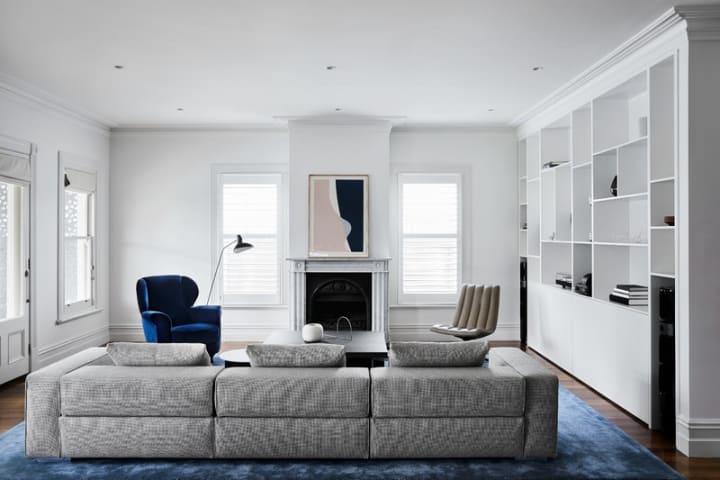
It's difficult to relax when the living room is one giant mess. Clutter ranges from things haphazardly scattered about to having wall shelves stocked with too many things. In addition, there's a psychological reason for why cluttered spaces contribute plenty to a mind that's all over the place.
"It's pretty remarkable to see how someone's anxiety or stress can be reflected in their state—people keep unnecessary items, pile clothes up on a chair or the floor instead of putting them away, and keep items scattered over tables, on shelves, or in cabinets.
“A messy space can exacerbate an already anxious state of mind, so committing to decluttering and doing a deep clean of your home can drastically influence your mood and stress levels."
~Katie Krimer, New York-based Therapist
- Consider the objects in the room that you haven't used in one year. If you haven't used it or thought about it, then get rid of it.
- Before purchasing new things, think about the object's use in daily life, and why you want it. Is it a want or a need?
#4 Invoke calm and tranquility with wall art
Wall art is a good icing on the cake to any interior design, and even more so in the living room. A couple of things to consider before hanging your wall art:
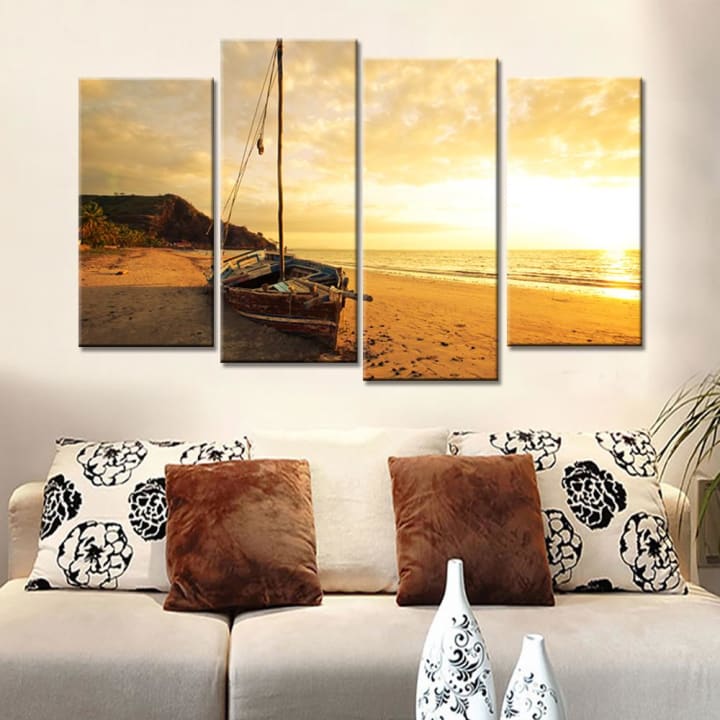
- Consider the size of your living room and choose wall art sizes based off of that.
- Large canvas wall art is good as a focal point, or you can group small and mini-sized wall art together to create a gallery wall.
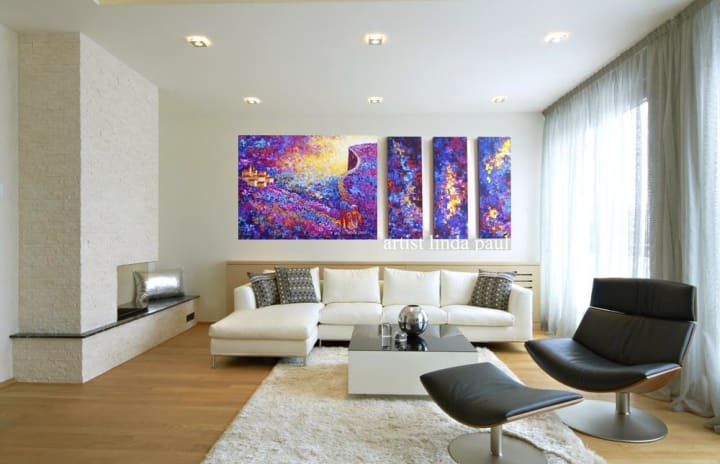
- You can try matching wall art colors with the rest of the room.
- Keep the wall art at eye-level to avoid straining your neck upwards just to see. Visually connect it to the rest of the space. Don’t make it seem like it’s floating above the furniture.
It comes down to what you find calming, so needless to say, choosing wall art is subjective. But if you're one of the people who can't quite decide firmly yet, you can play it safe by choosing wall art with neutral and minimalistic designs. Go for black and white, and for frames (not applicable if you hang canvas art) go with simple white, black, wooden, or gold.
Choose wall art carefully. Perhaps one that has an encouraging or soothing quote, a framed family photo, an abstract image, or wall art in-line with nature.
The Takeaway
I've known people in my life who would suddenly tap out in the middle of important events in favor of heading straight home—sweating, shivering, sick, and on the verge of a full-on panic attack. And when I ask them what has them so shaken-up, all they can say is that they're afraid or worried about... something.
It's a fear that you can't put your finger on—something unexplained, and to outsiders, may sometimes seem nonsensical. In the literal sense, it's fear of the unknown.
The people I know turn to the comforting task of creation. Whether it's a DIY project, a painting on a canvas, staffs and notes on a music sheet. The one thing all these have in common is the recourse, and the comfort found in producing art, and surrounding themselves with it in addition to an already calming interior design.
About the Creator
Keep reading
More stories from Alison Brown and writers in Lifehack and other communities.
7 Tips for Making Small Bathrooms Look Bigger
Not all of us can afford a bathroom that's the size of two bedrooms put side-by-side. Sometimes, no matter how much you wish for it, that small bathroom will be in that new house you bought. And if you don't have the budget to carry out renovations as of yet, do you have to be stuck with a bathroom that has limited square footage?
By Alison Brown6 years ago in Lifehack
How to Succeed at the Benson Directory®
Congratulations and welcome to the Benson Directory® employee #22391! As our newest call handler, you will have the privilege of speaking with dozens of unique and interesting people on a daily basis as well as the opportunity to earn bonuses for high performance. Contained within this handbook you will find a set of ease to follow instructions designed to help you settle in to your new role and begin paving the way to success.
By S. A. Crawford3 days ago in Fiction



Comments
There are no comments for this story
Be the first to respond and start the conversation.