
How to Choose the Right 12V Water Pump for a Campervan or Caravan (Flow Rate, PSI, Noise & Cycling)?
If you’re fitting out a campervan or replacing a caravan pump, it’s easy to think “a pump is a pump” until you pick one that’s too loud, keeps switching on and off, or can’t keep up with a shower.

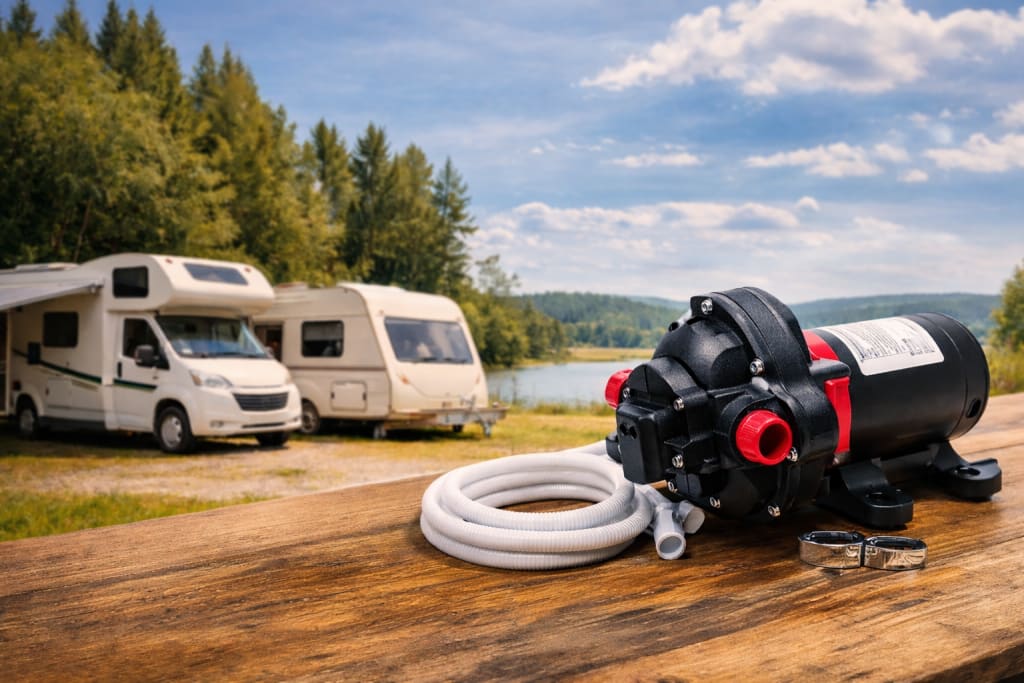
A good 12V pump should feel simple: you open the tap, water comes out, and the pump doesn’t annoy you in the background.
You don’t need technical knowledge to choose well. You just need to understand four things:
- Flow rate (how much water it can deliver)
- PSI (how strong the pressure will feel)
- Noise (how much it vibrates and sounds)
- Cycling (whether it keeps turning on and off)
Here’s a straightforward way to decide.
1) Start with your setup: what will the pump actually feed?
Before you look at numbers, think about how you use water.
Typical setups
Simple: one or two taps (kitchen/sink)
Everyday: taps plus an occasional shower
Higher demand: regular shower use, longer pipe runs, maybe an extra outlet (outside rinse point, toilet, etc.)
This matters because a pump that feels great for a tap can feel weak for a shower. And a powerful pump can be noisy and “overactive” in a small system.
2) Flow rate: How much water do you need?
Flow rate is usually shown in LPM (litres per minute) or GPM (gallons per minute). In general, more flow = more water available at the tap/shower.
A simple guide most people can use
- 8–10 LPM (about 2–2.6 GPM): fine for basic tap use
- 11–15 LPM (about 3–4 GPM): better if you want a more comfortable shower
- 15+ LPM: for larger or higher-demand systems (multiple outlets or strong shower preference)
A realistic note
What you get in real life is often lower than the number on the box because of:
- narrow hose/pipe size
- filters/strainers
- lots of connectors and bends
- long distance from tank to tap
So if you’re borderline between two flow rates and you want shower comfort, stepping up slightly can help.
3) PSI: don’t chase the highest pressure
PSI is the pressure the pump can push. It affects how “strong” the water feels.
Many campervan and caravan pumps sit around 30–55 PSI.
What to aim for
- 30–40 PSI: usually fine for taps and light shower use
- 40–55 PSI: better if your shower feels weak, your pipe runs are long, or you want stronger pressure
Why “highest PSI” isn’t always the best choice
A higher pressure pump can:
- cycle more often in a small system
- create more vibration and noise
- put extra strain on fittings if the installation isn’t solid
If your setup is small (like one tap), a very high PSI pump can be unnecessary.
4) Noise & vibration: what makes a 12V pump “quiet”?
Most 12V van/caravan pumps are diaphragm pumps, which work in small pulses internally. That means some sound is normal but it shouldn’t feel like the van is shaking every time you run the tap.
What affects noise the most
1) Mounting
A pump bolted directly onto thin wood can sound much louder because the panel acts like a speaker.
2) Pipework
Rigid pipework and tight bends can transmit vibration. A bit of flexible hose can calm it down.
3) Pump design
Some pumps simply run smoother than others, even with similar numbers.
Easy ways to reduce pump noise
- Use rubber mounting feet or a damping pad
- Fix it to a solid surface (not a thin, hollow panel)
- Add a short flexible hose on both inlet and outlet
- Clip/support pipework so it doesn’t knock or rattle
- Consider a small accumulator tank (also helps cycling)
If quiet running matters to you, treat the install as part of the pump decision.
5) Cycling: the thing that frustrates most owners
“Cycling” is when the pump keeps switching on and off repeatedly sometimes while you’re using only a small trickle of water, and sometimes even when all taps are closed.
A little cycling can be normal, but constant cycling usually means something is off.
Common causes of cycling
- Tiny leaks (even a slow drip)
- Air leak on the inlet side (loose clamp, cracked hose, poor seal)
- Blocked strainer/filter restricting flow
- No accumulator tank (very common in smaller systems)
- Sensitive pressure switch (some pumps trigger quickly)
- Loose fittings or a faulty non-return valve
- Tank pickup issues (drawing air because the hose isn’t seated well)
- The simplest “cycling cure” many people skip
A small accumulator tank can make a big difference. It stores a little pressurised water so the pump doesn’t need to kick in instantly every time you open the tap slightly. It often improves:
- smoother flow
- less pulsing
- lower noise
- fewer pump starts (which can help the pump last longer)
If comfort matters, this is one of the best small upgrades you can make.
6) Other checks before you buy
12V vs 24V
Most caravans and campervans run 12V. Some larger or specialist setups use 24V. Make sure you don’t accidentally buy the wrong voltage.
Power use (amps)
More powerful pumps often draw more power. If you spend time off-grid:
- check the pump’s amp draw
- make sure your battery setup can handle it
- use correct fuse and wiring for safety
- Fittings and hose size
Before ordering, check:
- your hose diameter
- connector type
- whether you’ll need adaptors or quick-connect fittings
- Self-priming and “run-dry”
Many diaphragm pumps can self-prime and tolerate brief run-dry moments, but it’s still best practice to avoid running a pump dry for long. A strainer/filter helps protect the pump from debris.
7) A quick checklist to choose confidently
Ask yourself:
- Do I need it for taps only, or taps and shower?
- What flow range suits that? (8–10 LPM for basic, 11–15 LPM for better shower comfort)
- Do I really need higher pressure, or will 30–40 PSI do?
- Do I care about quiet running (and have I planned proper mounting)?
- Have I planned to reduce cycling (accumulator, leak-free plumbing, clean strainer)?
- Can my battery/wiring handle the pump’s power draw?
- Do the fittings match my existing hose setup?
If you can answer these, you’re not guessing you’re choosing based on your setup.
Final thought
The right 12V pump isn’t the biggest or most expensive. It’s the one that suits how you use water without noise, pulsing, or constant cycling. Match the flow and pressure to your needs, install it properly, and your water system becomes something you don’t have to think about (which is exactly the goal).
About the Creator
Bishal Khadka DB
“UK-based guides on campervan & caravan water systems. Helpful resources: https://www.thermotechnica.com/product-category/pumps/”
Keep reading
More stories from Bishal Khadka DB and writers in Lifehack and other communities.
Igniter or Ignitor? The Small Word Mix-Up That Causes Big Confusion
The first time I heard someone confidently say, “I think the ignitor is bad,” I didn’t question it. The sentence sounded right. It’s a word most people use without thinking twice, especially when a water heater or furnace suddenly stops working.
By Bishal Khadka DB2 months ago in Education
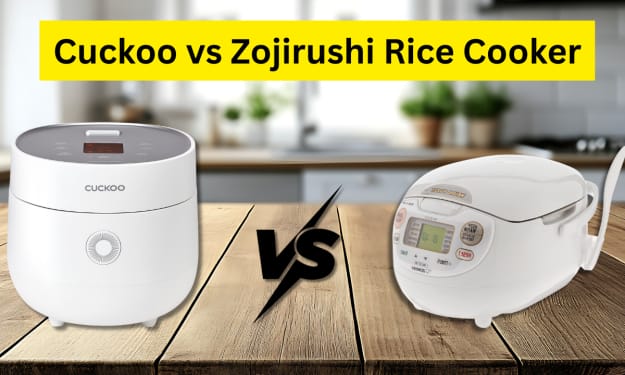
Cuckoo vs Zojirushi Rice Cooker: Which Brand Is Right for Your Kitchen?
Choosing between a Cuckoo vs Zojirushi rice cooker can feel harder than it should be, especially with both brands known for smart tech and steady results. I notice small but real differences in price, features, and long-term value, and I appreciate how each brand fits a different type of kitchen in the U.S.
By Mohammed mamun7 days ago in Lifehack
Engagement Without Conversion: The Quiet Trap Creators Fall Into
Engagement looks exciting on a dashboard. Hearts, comments, shares, and saves move in real time and give creators a sense of momentum. Many creators celebrate these signals because they feel like proof that the content works. Yet over time, some discover that strong engagement does not always translate into sales, bookings, or meaningful business growth. That gap can stay unnoticed for months.
By Kirby Sotoa day ago in Lifehack


Comments
There are no comments for this story
Be the first to respond and start the conversation.