
Health and AI.
The future of health and healthcare.

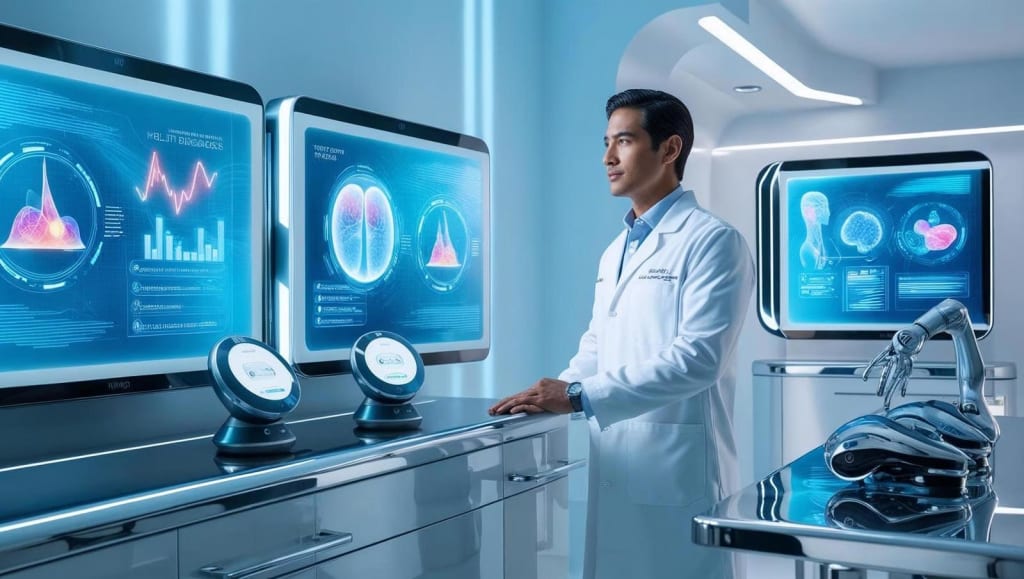
As I mentioned before, I write my own stories. But I do research and explore with the help of AI. I'm open and honest about this because a typo is easily made, and honestly, why shouldn’t we use modern technology to benefit us all?
I try to write interesting stories, but let’s be real, my brain and experience only go so far. I write not just to entertain, but also to educate and share what I’ve learned. And the same goes for healthcare and where it’s heading.
Let’s imagine this for a moment.
People once relied on campfires, not just for cooking, but for warmth, protection against wild animals, and light during the night. Then came electricity and "artificial light". But we didn’t say, “No, let’s keep using our campfire forever.” We moved forward.
Same with cars. In the beginning, people believed the automobile was something diabolical, a carriage without a horse? Are you crazy? That had to be the work of the devil! But look around now: nearly everyone drives one. The current global ratio of cars to people is around 1:6, just to give you an idea.
Now take electric vehicles. Some people still resist them. (I still drive a V6 myself, don't tell anyone) Yet at the same time, they post their opinions on smartphones. In my opinion, that’s a bit inconsistent. Shouldn’t they go back to using a rotary phone if they really want to live “the old way”?
Which brings me to healthcare and Artificial Intelligence.
I consulted AI for this article too. Together, we came up with the following insights:
🔍 1. Faster & More Accurate Diagnostics
AI systems can already outperform doctors in some diagnostic tasks (like detecting skin cancer or reading X-rays). In the future:
AI will assist, not replace physicians.
Diagnostics will become more personalized and data-driven, based on history, lifestyle, and genetics.
Rare diseases could be diagnosed earlier thanks to large-scale pattern recognition.
🧠 2. Preventive Care & Predictive Health (my favorite)
AI is helping shift healthcare from reactive to proactive:
Wearables and health apps will catch signs of illness before symptoms even arise.
Algorithms might flag patterns in sleep, stress, or diet that point to potential health decline.
Combine that with test-based nutrition or biomarker testing, and we can create highly personalized prevention plans.
💊 3. Drug Development & Precision Medicine
AI speeds up drug research by:
Simulating molecular interactions
Finding new uses for existing drugs
Customizing treatment based on your personal genetic profile
🏥 4. Smarter, More Efficient Hospitals
AI will optimize scheduling, staffing, and patient flow.
Virtual assistants (like AI chatbots) will lighten administrative burdens.
Robotic surgeries and AI-assisted procedures will get even more precise.
👥 5. Human + Machine Collaboration
Doctors will use AI as a second opinion and decision-support tool.
Empathy, ethics, and human care will always remain essential—"AI is here to enhance, not replace".
🔮 Bottom Line
The future of healthcare isn’t about replacing doctors. It’s about enhancing human care, empowering prevention, and making health more accessible and affordable.
It opens the door to hyper-personalized health for everyone.
🤔 Is consulting AI a reliable substitute for visiting your home doctor?
In my opinion: no, not entirely. But it can be a helpful first step or support tool depending on the situation.
✅ When AI can be helpful:
Mild symptoms like a rash, headache, or sore throat: AI can guide you on whether to rest, wait, or seek help.
General health questions about nutrition, sleep, or understanding test results.
Second opinions, especially in areas like radiology or dermatology.
❌ When NOT to rely on AI alone:
Emergencies like chest pain, stroke symptoms, or breathing problems.
Complex health conditions (e.g. autoimmune or mental health crises)
Vulnerable groups like kids or the elderly where the smallest detail can matter
🧠 The Best Use of AI in Healthcare?
Think of AI like a: “Smart, 24/7 health companion that informs but doesn’t replace a trained medical eye.”
An AI might tell you “your symptoms could be X or Y,” but only a real doctor can examine you, run proper tests, and put all the puzzle pieces together.
Doctors are human, and humans make mistakes. So instead of pushing away this technology, maybe it’s time we embrace it as the blessing it is.
Final Thoughts
The best outcomes in the future will come from teams where AI supports human judgment, not replaces it.
I always say (psst, don’t tell ChatGPT this)… AI is only as smart as the questions you ask it. Ask poorly, and you get poor answers.
You’re probably wondering: “Did he write this himself?”
Yes, I wrote this article myself, with help from ChatGPT. The topic came from my mind. I explored it, asked questions, and made it my story. The same we did before by doing research with interviews, reading books and search on Google.
Since English isn’t my first language, I use AI to help edit my writing. I specifically asked it to respect my style, and only fix the small stuff.
And yes I typed this on a laptop, not a typewriter (if that’s okay with you 😉).
Thank you for reading this far.
I truly believe we live in a beautiful world, full of potential and possibility.
Let me know what you think it means a lot.
Oh, and every read earns me €0,01. So feel free to:
👍 Like
🔁 Share
✅ Subscribe
Next time
My personal work in testbased nutrition. Why I do this and what I have discovered.
About the Creator
Richard Göbel
I am a Next Generation Financial Freedom & Health Mentor, guiding people to create financial independence and vitality through conscious choices and Quantum Mind Thinking.
Keep reading
More stories from Richard Göbel and writers in Lifehack and other communities.
Quantum Health
Sometimes I wonder: how come we know so much about cars, smartphones, and crypto… but so little about our own bodies? We live in a world where diseases are treated after they appear. Modern medicine is brilliant at managing symptoms — let’s give it credit — but rarely does anyone ask:
By Richard Göbel9 months ago in Lifehack


Comments
There are no comments for this story
Be the first to respond and start the conversation.