
Get Life Organized
Follow along and learn how to create structure for the things that will make you content.
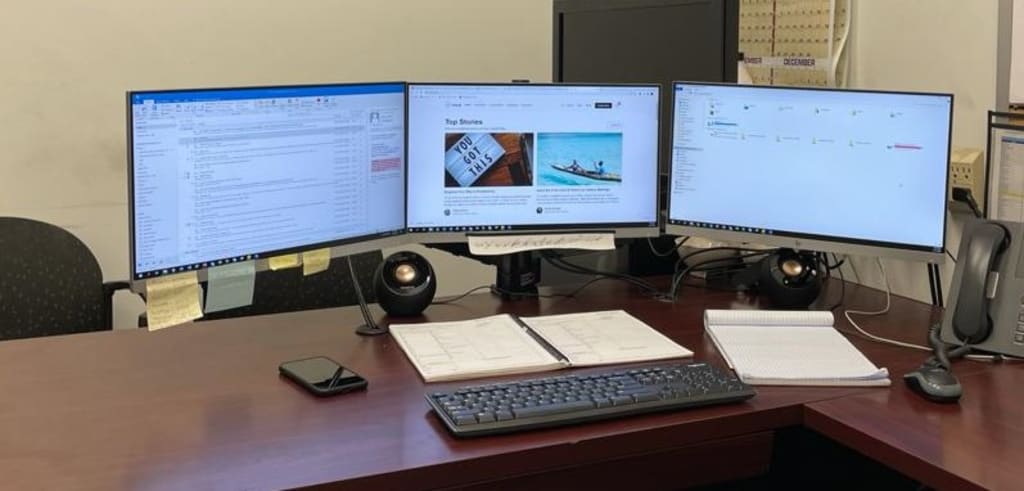
What You'll Need
- A few large blank pieces of paper.
- Pencil / Pen.
- A peaceful place to sit down for an hour or so.
Philosophy Behind the Approach
Like solving any problem in life, you need to define it first, then break it down into smaller pieces, develop a plan, and execute accordingly.
Intended Audience
This is for people who want to hit the 'pause' button on life and take a moment to sit down and try to get to the bottom of "What can I do to make my life better?"
Step 1: Define your "Life Chunks"
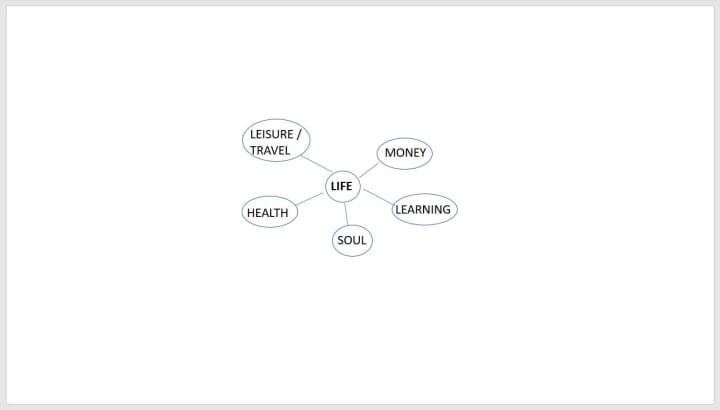
The first thing you need to do is think about your life and categorize it into what I call "Life Chunks." When I think about organizing my own life, in broad strokes, I would categorize most things that need to be organized under the following categories:
1. Health
2. Learning
3. Leisure/Travel
4. Soul
5. Money
It's your turn now. Take the page and in the center write "Life" and then branch out the different "life chunks" you want to focus on. Think about the things that, if you worked on them, would make the most impact to your life.
Estimated Time for Completion: 5 minutes
Step 2: Create "Mind Maps" for each Life Chunk
Now it's time to draw three lines from each life chunk. For each line, you will want to think of at least one thing you want to accomplish immediately, one thing within a year or so and a third thing that can be of any timeframe you desire.
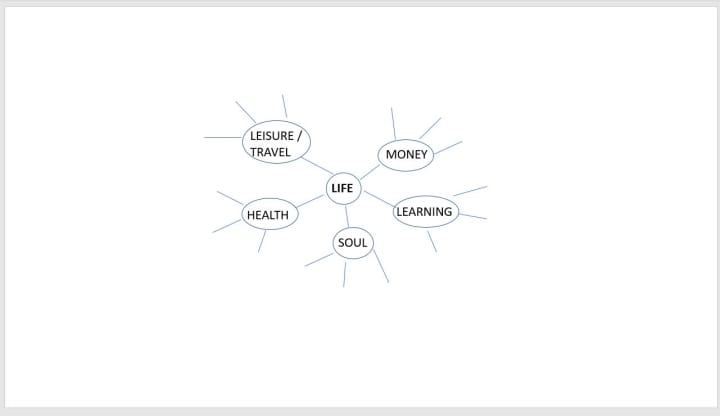
The purpose of making three lines is to get a short-term and long-term view on the things you want to accomplish for the different aspect of your life.
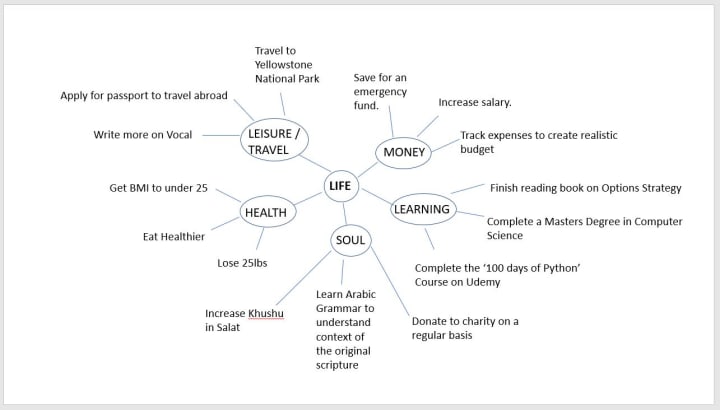
Now, start populating each of the lines with things you want to accomplish.
Once you're done with this step, your diagram might look more like:
Estimated Time for Completion: 30 minutes
Step 3: Convert your Mind Map into SMART Goals
You'll notice that you might have goals listed but they aren't exactly "SMART". If you're unfamiliar with SMART Goals, the idea is:
Try it for yourself, and don't worry if your first try isn't perfect.
Here's what I came up with:
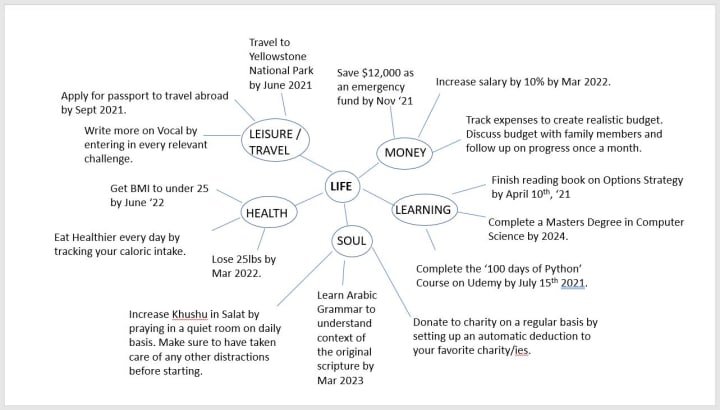
I have found that the "ART" is usually easier to accomplish but sometimes the 'Specific' and 'Measurable' portion are harder to define. Try your best at completing this and we will move on the crux of the exercise.
Estimated Time for Completion: 10 minutes
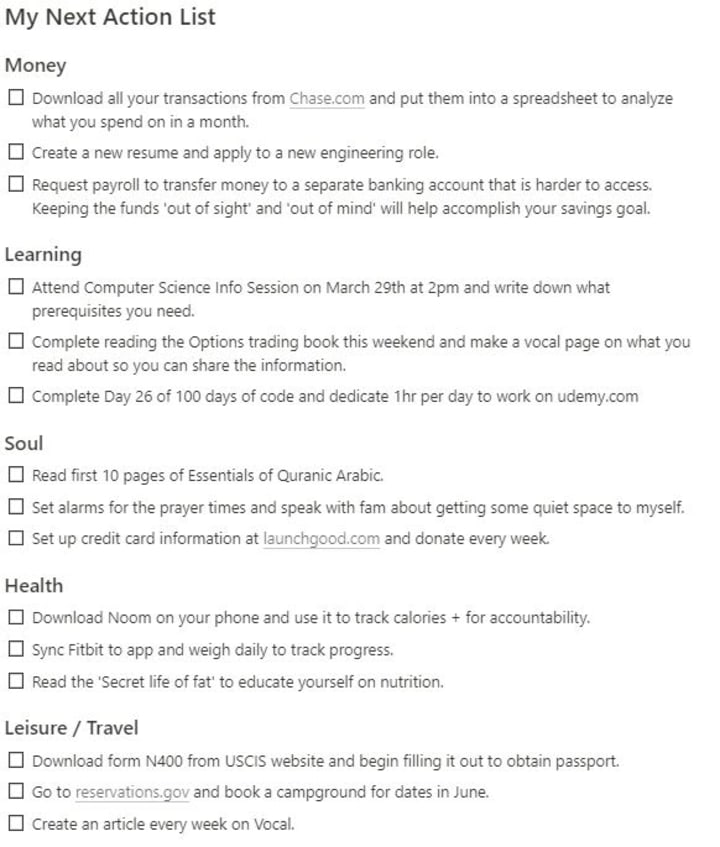
Step 4: Develop "Next Actions" for Each Goal
After reading the book, "Getting things done" by David Allen, I have become obsessed with the idea of having "Next Steps" for each task you are trying to accomplish.
When you have an easily defined next action for what you need to do, the chances of completing that task are going to be significantly be better.
This is what my list looks like:
Give it a go!
Simply take each SMART goal and write down what your exact next step is going to be. Sometimes one goal might lead to 2 or 3 next actions and that's okay. The goal is to have actionable steps.
Estimated Time for Completion: 15 minutes
Step 5: Use a "System" to Track Progress
Finally, the last step is using a system. I could easily write a whole article on this but I am going to keep it as concise as possible.
People tend to believe that 'more technology' = 'more productivity' but that's not always the case. While I am a huge proponent of using technology as a great tool, I fully understand that it doesn't always work for everyone. If using a journal for all your notes or stacks of papers in a binder work for you, then by all means keep using them.
Whichever route you choose, digital or not, you are going to need to keep a centralized location for your 'next action' lists. You'll also want to store what you wrote down as far as your goals are concerned. After some interval of time, you will definitely want to revisit what you wrote down, evaluate what all still makes sense and what you need to adjust. Then perform the exercise another time.
After several years of using OneNote and then transitioning to Evernote's paid subscription, I will say that I have fallen in love with Notion.
It has a little bit of a learning curve, but I really like how responsive it is compared to the other two and how my work isn't constantly being duplicated. For each "project" on my list, I have a separate 'page' where I add my next actions. As they are done, I cross them out and keep going down the list.
Estimated Time for Completion: 5 minutes
I hope by the end of this exercise, you now have in your hand two things:
1. A mind map of SMART goals outlining your vision for the near term.
2. A list of actionable steps to take to achieve your goals.
Books I'd recommend for further reading
- Getting Things Done
- 7 Habits of highly effective people
- The 4-hour work week
- Eat that frog
Some Additional Advice on the Subject of Productivity
- Doing a little every day is almost always more effective than doing something once.
- If you find yourself struggling while you are working towards your goal, that's a good thing - it means your brain is forming new synapses and forming new connections
- It takes time to form habits, but habits will propel you forwards - not good plans.
- Always have a vision. If you don't know where you are trying to head to you won't be going anywhere / Keep the "end in mind"
- Help others when you can but it is okay to be selfish sometimes. There's a fine line between being a nice person who helps others and someone who is routinely being taken advantage of for their skills. Learn to say No.
- Work off a list. Always.
- Focus the important stuff first, the smaller stuff will find a way to fit in.
- Don't overeat. How is this relevant to productivity, you ask? You're not going to be fruitful in your endeavors on a bloated stomach.
- If you don't track it, you lose it.
- Don't beat yourself up if things don't turn out exactly the way you had in mind.
- Bad news doesn't get better with time.
- Making excuses won't help your cause.
- Seek help if you need it. Mental health is real.
- Don't overwhelm yourself. If you are getting 'analysis paralysis', then just grab one thing off your list and just do it. It doesn't matter what it is. Sometime, all you need is that jolt of a task being completed to get you going.
About the Creator
Ahsan Saeed
Traveler | Problem Solver | Investor
Keep reading
More stories from Ahsan Saeed and writers in Lifehack and other communities.
Digital Well-Being
We live in a time where the internet is not just a tool — it is an environment. From the moment we wake up to the moment we fall asleep, screens shape how we think, work, communicate, and relax. Technology connects us instantly, but constant connection can quietly drain our attention, energy, and peace of mind. Digital well-being is the practice of using technology in a way that supports — rather than harms — our mental, emotional, and physical health.
By shaoor afridi4 days ago in Lifehack
I Stopped Chasing Men—And This One Lifehack Made Them Come to Me Naturally
For the longest time, I thought attracting men was about looking perfect, saying the right things, and never making a mistake. I believed if I could just be more attractive, more interesting, or more “ideal,” the right person would notice me.
By Lukáš Hrdlička7 days ago in Lifehack



Comments
There are no comments for this story
Be the first to respond and start the conversation.