
Gas Logs Buying Guide - Step By Step
Buying gas logs can be a fun experience when you know what you want and what will meet your needs.
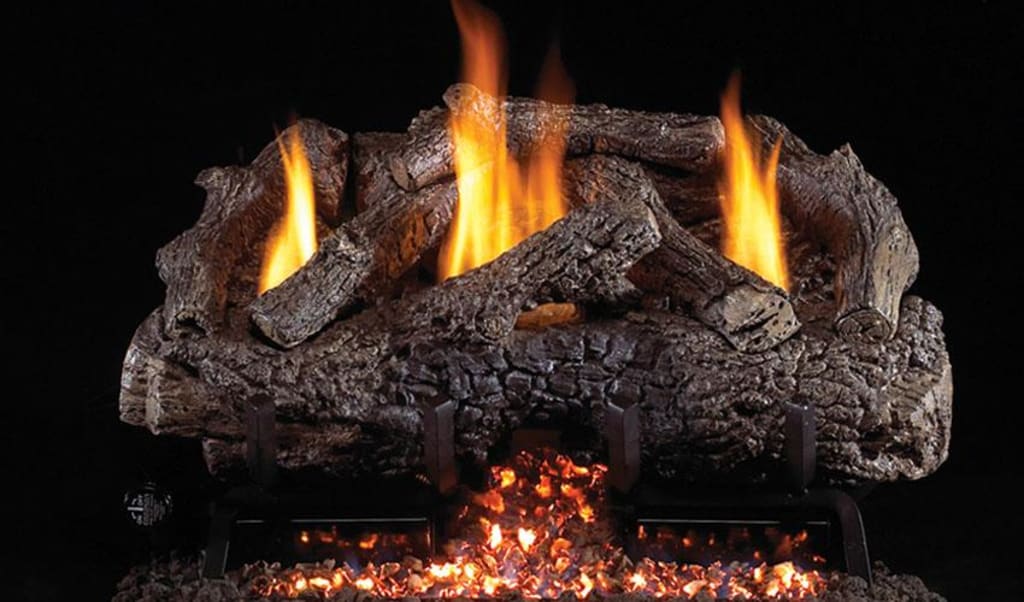
This step-by-step guide will ease your buying experience and help you make choices that are right for your home and your taste. We recommend that you check with your local and state municipalities, as some have rules around what is and is not allowed.
STEP ONE
Know Your Fuel Type
Gas Logs are available in Natural Gas and Liquid Propane (LP). If you currently have a gas line installed in your fireplace, your fuel type will already be decided. If you need to have a gas line installed, you will need to decide whether you want to use Natural Gas or LP.
The rule of thumb would be to use the same fuel source as your appliances. If your dryer, stove, gas heater is natural gas, then natural gas will be your likely choice. If they are LP, then you’d use liquid propane for your fireplace. If you do not have either natural gas or liquid propane, then check locally to determine what would be best for your home.
STEP TWO
Know Your Venting Options
Gas logs come in two categories: Vented and Vent Free
Vented Gas Logs
- Perfect when your goal is ambiance
- More realistic and natural looking than vent free (also called ventless or unvented) gas logs
- Must be installed in a fully functioning wood burning fireplace
- Damper must be opened whenever vented gas logs are burning
- Damper clamp must be installed to keep damper open at least 10% when not in use
- Flames will produce soot as they dance on and around the log
- Not cost efficient as most of your energy will go up and out of your chimney (some are even rated as a decorative appliance)
Vent Free Gas Logs
- Vent Free gas logs are also called Unvented and Ventless
- Can be used when venting applications are unavailable
- Can use in a woodburning fireplace with the damper open or closed
- When damper is closed, heat will stay inside of your home
- Some use as a supplemental heating source
- Perfect for rooms that are built over a slab
- Must be installed in a fireplace that is approved for a vent free gas log set
- Not legal in every state so check with local and states compliance codes
STEP THREE
Measure Your Fireplace
Selecting the right size gas log is a critical step. Take these five (5) measurements and review the minimum firebox dimensions for your gas log options.
- Measure the front width of your fireplace.
- Measure the rear width of your fireplace (many fireplaces will be tapered in the back)
- Measure the depth from front to back
- Measure the front height from top to bottom
- Measure the rear height from top to bottom
STEP FOUR
Select Control System
There are three (3) primary control systems for vented and vent free gas logs.
Match Light
- Match light controls are available for natural gas only.
- Gas Logs sets will have no safety pilot; only the gas logs and burner
- You light your fire by placing a match or lighter near the burner and turning on the gas with your key valve
- The flame height is controlled using your key valve, which is typically located outside of your fireplace. Usually, it’s a ring on the floor, but some have them on the wall next to the fireplace
- Match lit can be a dangerous option because there is no safety pilot
Manual Safety Pilot
- Manual safety pilot systems are lit manually and will have a standing pilot, similar to a lot of hot water tanks.
- You turn the burner on and off manually by reaching inside of your fireplace and turning the control knows.
- This type of system is not compatible with a remote control system, however, they are typically eligible to be upgraded at a later date.
Remote Controls
- To use a remote control with your gas log, you will need to remote pilot valve assembly.
- There are typically 4 types of remote options available: On/ Off, Variable Flame Height, and Thermostat Controlled, Wall Switch
About the Creator
Rajeev Gupta
Love writing blogs and articles.
Keep reading
More stories from Rajeev Gupta and writers in Lifehack and other communities.
Top 5 Web Designing and Development Companies
Do you need an amazing website to grab the attention of your customers? Are you searching for a good web development company to meet this goal? You need not worry because I am here to solve this problem for you! Through extensive research, I have collected the names of the top 5 web designing and development companies to make the choice easier for you. So, without further ado, let’s get started!
By Rajeev Gupta5 years ago in Journal
If You’ve Always Done What You’ve Always Done
At the start of 2025, I started to post articles on my website under the category of ’52 Guiding Lights.' The goal was to share insights on sayings and idioms that aid daily life. I got up to number 16. The goal is to publish these as a management aid. However, we plan to release them in smaller batches, such as 12 at a time. That’s a year’s worth.
By Calvin London4 days ago in Lifehack




Comments
There are no comments for this story
Be the first to respond and start the conversation.