
Everything You Need to Know About Kidney Stones
Kidney stones are one of the causes of kidney failure, dialysis causes great harm to the health and economy of the patient. Therefore, early detection and complete treatment of kidney stones is worth paying attention to.


Kidney stones are one of the causes of kidney failure, dialysis causes great harm to the health and economy of the patient. Therefore, early detection and complete treatment of kidney stones is worth paying attention to.
Learn about kidney stones
1. What are kidney stones?
2. Symptoms of suspected kidney stones
3. Causes of kidney stones
4. Factors that increase the risk of developing kidney stones
5. Kidney stone prevention
6. Treatment methods for kidney stones
1. What are kidney stones?
Kidney stones are a phenomenon in which minerals in the urine are deposited in the kidneys, forming stones over time. Small stones can be passed out with urine, while large stones will accumulate in the kidneys, grow larger and cause urinary tract obstruction, causing kidney function to decline, especially when combined with inflammation, it can easily cause kidney failure.
Kidney stones are more common in men than women, usually occurring between the ages of 30 and 50, and are rare in children.
2. Symptoms of suspected kidney stones
Kidney stones are a phenomenon in which minerals in urine are deposited in the kidneys, forming stones over time. Stones are formed due to many causes such as: drinking little water, eating a lot of calcium, metabolic disorders.
One of the earliest and most common signs of kidney stones is frequent and painful urination , even if the amount of water you drink remains the same. Painful urination is due to the stones reaching the lower part of the urinary tract (ureter, bladder).
Patients often have pain in the flanks and lower back, especially where the stones are . In some cases, the pain can move from the lower abdomen to the thighs. Patients may experience mild, sharp, or even severe pain (renal colic). Men with kidney stones may also have pain in the scrotum and testicles.
When the stones grow into large ones, it becomes difficult for the patient to move, sit or lie in a certain position for a long time . The pressure on the affected areas rubs against the internal organs, causing more pain for the patient.
In addition, when you have this disease, there are cases where your urine will change color to cloudy white, red, have pus or blood and have a foul, pungent smell due to the stones rubbing and damaging the urethral mucosa.
Nausea and vomiting are also common in people with kidney stones. The disease can easily cause urinary tract infections, causing fever and chills.
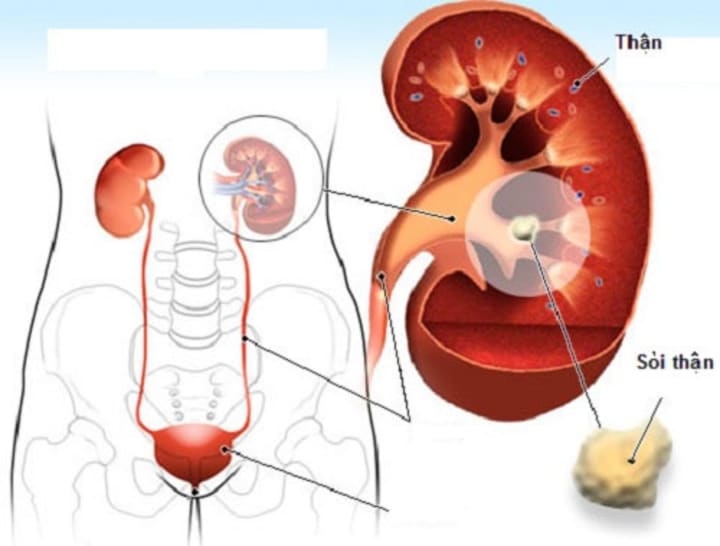
Kidney stones are one of the causes of kidney failure.
3. Causes of kidney stones
Kidney stones can form for many reasons, but some of the main causes are:
Kidney stones are caused by mineral deposits: due to not drinking enough water (especially for those who do heavy labor), or holding urine; due to urinary tract abnormalities or diseases that block the urinary tract for a long time, leading to the formation of stones. Patients with benign prostatic hyperplasia, the fibroids rise up in the bladder, causing urine to stagnate in the crevices.
Improper diet (eating only one type of food, eating too much meat or vegetables, eating salty foods, diet too rich in calcium...) or patients with severe trauma, having to lie in one place, drinking a lot of milk, little water.
Genital tract infection: This cause is more common in women, because the urinary tract is shorter than in men and when the genitals are not cleaned properly, bacteria can easily invade and cause urinary tract infections, creating pus and depositing the body's excretions, causing stones.
Foreign objects in the bladder (rare): Foreign objects (leaves, grass, straw, or catheters that have slipped into the bladder) exist in the bladder for various reasons, causing minerals to precipitate and form stones.
4. Factors that increase the risk of developing kidney stones
Family or personal history: If someone in your family has had kidney stones, you're more likely to have them too. And if you've had one or more kidney stones, you're at risk of getting them again.
Not drinking enough water : Not drinking enough water each day can increase your risk of kidney stones. People who live in warm climates and those who sweat a lot may be at higher risk than others.
Certain diets : Eating a diet high in protein, sodium (salt), and sugar can increase your risk of certain types of kidney stones. This is especially true with a high-sodium diet. Too much salt in your diet increases the amount of calcium your kidneys have to filter and significantly increases your risk of kidney stones.

Not drinking enough water and a high sodium diet can lead to kidney stones.
Being obese: High body mass index (BMI), large waist size, and weight gain are associated with an increased risk of kidney stones.
Digestive diseases and surgeries: Gastric bypass surgery, inflammatory bowel disease or chronic diarrhea can cause changes in your digestive process that affect your absorption of calcium and water, increasing the levels of stone-forming substances in your urine.
Other medical conditions: Diseases and conditions that can increase the risk of kidney stones include renal tubular acidosis, cystinuria, hyperparathyroidism, certain medications, and some urinary tract infections.
5. Kidney stone prevention
Drink plenty of water: This is the first advice doctors give you. Drinking enough water will not only help your blood circulate better, dissolve substances, but also regulate your body temperature, help eliminate waste products to prevent disease.
Limit salt intake and reduce calcium intake: these are two factors that need to be limited in your menu because they are closely related to the formation of kidney stones.
Scientific nutrition: helps provide balanced nutritional elements, without bias towards any element.
Increase your intake of lemon juice: The citric acid in lemons helps prevent minerals and other components of urine from sticking together and forming kidney stones.
Limit foods high in oxalates: Oxalates are acids that can lead to the formation of calcium oxalate kidney stones. If you already have kidney stones, you may want to cut down or eliminate oxalates from your diet. Foods high in oxalates to watch out for include chocolate, sweet potato leaves, tea, beets, peanuts, and peeled fruits.
Do not abuse vitamin C : Dr. Duong Van Trung, head of the Department of Urology, Post Office Hospital, Hanoi, said that daily vitamin C supplementation for a long time can lead to excess of this substance, increasing calcium absorption from the intestines, high blood calcium causing kidney stones. Supplementing vitamin C from food is best, they are abundant in fresh fruits and vegetables. People should eat the recommended amount, no need to take additional supplements.
Don’t drink too much alcohol: Alcohol has diuretic properties that make you urinate more. This can lead to dehydration, especially if you drink too much. Alcohol also affects your kidneys’ ability to maintain water and electrolyte balance. This can lead to impaired kidney function and increase your risk of developing kidney stones.

Patients often have pain in the flank and lower back, especially where there are stones.
6. Treatment methods for kidney stones
In recent years, thanks to the development of the medical and pharmaceutical industry, the treatment of kidney stones and urinary stones has made great progress. Instead of surgery, patients can use medical and surgical treatments or a combination of Western and Eastern medicine with diet and exercise therapy.
The decision to choose a treatment method for kidney stones is based on criteria such as: location of the stone, size, density of the stone and kidney function...
Surgical treatment: for large stones or stones with complications, extracorporeal lithotripsy, percutaneous lithotripsy, and stone removal surgery are often indicated. Extracorporeal lithotripsy is performed using lasers or shock waves to break the surface and crush the stones, helping the body to excrete them through urine. The patient feels almost no pain, this method is applied to patients with stones under 3cm.
Retrograde lithotripsy: the doctor will use a ureteroscope from the urethra, up to the bladder and up to the ureter to directly access the stone, using laser or compressed air energy to break up the stone, and wash out all the stones.
Percutaneous nephrolithotomy: create a tunnel into the kidney and insert a 10-15mm diameter endoscope to access the stone. Break the stone with laser, compressed air or ultrasound to break the stone and remove it.
Laparoscopic surgery to remove stones: indicated for renal pelvis stones, stones in the upper third of the ureter. Large stones, solid density, difficult to crush.
Open surgery: currently, patients are rarely indicated due to many complications and long recovery time. This method is only applied to large kidney and ureteral stones and poor kidney function.
Robotic surgery: performed in developed countries, indicated for large kidney stones, shortens hospital stay (2-3 days) but is very expensive.
Medical treatment: surgery is only indicated when the patient has acute pain or difficulty urinating, or even urinary retention due to stones blocking the urinary tract. In cases where the stones are small or have no complications, oral medications to dissolve the stones are more appropriate because they are safe, convenient, and suitable for people with weak health or fear of surgery.
Foods to limit when having kidney stones
Protein : According to doctors, eating a lot of protein and kidney stones are closely related because it increases the amount of acid, calcium and phosphorus in the urine. Therefore, people with kidney stones should only eat about 200g of protein per day.
Salt : Patients should only eat a maximum of 3 grams of salt per day. You should eat as bland a diet as possible. Limit processed foods and canned foods because they contain a lot of salt.
Sugar, greasy foods .
Limit carbonated drinks, soft drinks, tea, coffee, beer, alcohol...
You should not arbitrarily supplement with supplements or functional foods without consulting your doctor.
Diet plays an important role in determining the effectiveness of kidney stone treatment . Therefore, patients need to strictly follow nutritional notes to completely cure the disease, avoid kidney stones lasting, recurring, affecting health and daily life.
About the Creator
Ken Daklak
Telling stories my heart needs to tell <3 life is a journey, not a competition
If you like what you read, feel free to leave a tip,I would love some feedback
https://s.shopee.vn/VwwLTGLe9
Keep reading
More stories from Ken Daklak and writers in Lifehack and other communities.
Spicy food lovers will probably be interested to know that there are 12 benefits of this.
When we are sick, doctors always advise us to eat some light food, avoid eating spicy food that irritates the stomach. Therefore, people do not know when spicy food was considered unhealthy food.
By Ken Daklak2 years ago in Lifehack



Comments
There are no comments for this story
Be the first to respond and start the conversation.