Latest Stories
Most recently published stories on Vocal.
Ukraine calls on allies to raise pressure as Russia fires Oreshnik missile. AI-Generated.
As the war in Ukraine grinds on with no clear end in sight, Kyiv is urging its international partners to significantly intensify pressure on Moscow following Russia’s reported use of the Oreshnik missile, a weapon Ukrainian officials describe as both symbolically and strategically alarming. The latest strike underscores the evolving nature of the conflict, where military escalation is increasingly paired with diplomatic messaging aimed at shaping global opinion. A Missile With a Message Ukrainian authorities say the Oreshnik missile was launched during a recent wave of Russian attacks targeting infrastructure and military positions. While details about the missile remain limited, analysts believe Oreshnik represents a newer or modified system designed to test Ukrainian air defenses and signal Russia’s ability to adapt despite sanctions and battlefield losses. For Kyiv, the missile’s use is not just another attack—it is a deliberate escalation meant to demonstrate resilience and intimidate both Ukraine and its allies. Ukrainian defense officials argue that Moscow is using advanced or unfamiliar weaponry to pressure Western governments into slowing or limiting military aid. “This is not just about destruction,” a senior Ukrainian official said in a briefing. “It is about sending a message that Russia believes it can outlast international resolve.” Ukraine’s Call for Stronger Action In response, Ukraine has renewed its appeal to allies across Europe and North America to increase military, economic, and diplomatic pressure on the Kremlin. Officials argue that incremental support is no longer enough as Russia adapts its tactics and continues to mobilize resources for a prolonged conflict. Kyiv is specifically asking for: Faster delivery of advanced air defense systems Longer-range weapons to deter missile launches Tighter enforcement of sanctions Stronger action against countries and entities helping Russia bypass restrictions Ukrainian leaders stress that every delay in assistance increases the human and economic cost of the war, not just for Ukraine but for regional stability as a whole. What Is the Oreshnik Missile? Although Russia has not released full technical details, defense experts suggest the Oreshnik missile may be designed for precision strikes with enhanced maneuverability, making interception more difficult. Whether entirely new or an upgraded variant of existing systems, its reported use highlights Russia’s ongoing investment in missile technology despite years of international sanctions. Military analysts caution that even limited deployment of such weapons can force Ukraine to expend valuable air defense resources, creating vulnerabilities elsewhere. This, they argue, is part of a broader strategy to stretch Ukrainian defenses thin while testing Western commitment. A Test of Western Unity The missile strike comes at a sensitive time for Ukraine’s allies. Political divisions, election cycles, and economic pressures have complicated long-term support commitments. Ukraine fears that Russia is deliberately escalating at moments when Western unity appears fragile. European leaders have condemned the attack, reiterating support for Ukraine’s sovereignty. However, debates continue behind closed doors about how far military assistance should go, particularly regarding weapons capable of striking deep into Russian territory. For Kyiv, the concern is clear: hesitation sends the wrong signal. Ukrainian officials warn that failing to respond decisively now could encourage further escalation not just in Ukraine, but in other regions where authoritarian states may test international resolve. The Human Cost Behind the Headlines Beyond strategic calculations, the missile strike has once again disrupted civilian life. Power outages, damaged infrastructure, and psychological trauma remain daily realities for millions of Ukrainians. Each new weapon introduced into the conflict deepens fears among civilians who have endured years of air raid sirens and uncertainty. Human rights groups continue to document the impact of missile attacks on non-military targets, calling for accountability and renewed diplomatic efforts to protect civilians. What Comes Next? As Ukraine pushes for stronger action, the coming weeks may prove pivotal. Decisions made by NATO members and key partners could shape the next phase of the conflict—either deterring further escalation or emboldening Moscow to press ahead. For Ukraine, the message is urgent and unambiguous: the war is evolving, and so must the response. The use of the Oreshnik missile is being framed not as an isolated incident, but as a warning of what continued inaction could invite. In a conflict increasingly defined by endurance as much as firepower, Ukraine is betting that renewed international pressure can still alter the trajectory of the war—before escalation becomes the new normal.
By Fiaz Ahmed 18 days ago in The Swamp
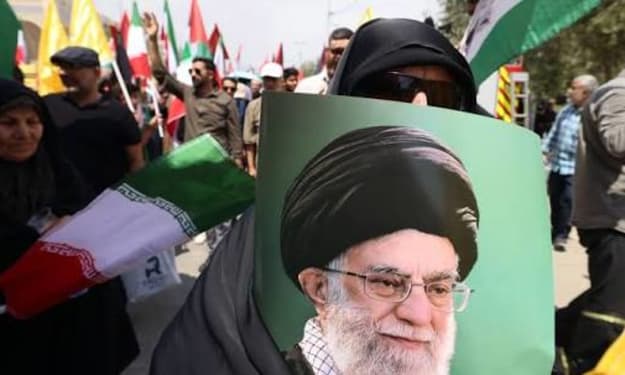
Iran’s Khamenei Lashes Out as Tehran Struggles to Quell Protests. AI-Generated.
Iran is once again gripped by widespread unrest as protests erupt across multiple cities, exposing deep fractures between the state and society. Supreme Leader Ayatollah Ali Khamenei has responded with fiery rhetoric, blaming foreign enemies, media manipulation, and “sedition” for the growing dissent. His sharp tone reflects not confidence, but pressure. As Tehran struggles to contain demonstrations fueled by economic hardship, social restrictions, and political frustration, Khamenei’s remarks underline a leadership facing one of its most serious legitimacy challenges in years. The latest wave of protests did not emerge overnight. Years of inflation, unemployment, and sanctions have eroded living standards for ordinary Iranians. The collapse of the national currency has made basic necessities increasingly unaffordable, while corruption scandals involving elites continue to circulate widely on social media. For many protesters, the issue is not a single policy failure but a system that appears unresponsive to their daily struggles. Khamenei’s reaction has followed a familiar pattern. In speeches broadcast on state television, he has accused Western governments, especially the United States and its allies, of orchestrating unrest to weaken Iran from within. He has also criticized Iranian dissidents abroad, calling them “tools of foreign intelligence agencies.” While such rhetoric resonates with hardline supporters, it has failed to calm the streets. Instead, many Iranians see these statements as an attempt to deflect responsibility rather than address real grievances. Security forces have been deployed heavily in major cities, including Tehran, Isfahan, Mashhad, and Shiraz. Reports from human rights groups suggest mass arrests, internet restrictions, and the use of force to disperse crowds. Despite this, protests have continued in waves, often reigniting after nighttime lulls. The persistence of demonstrations suggests that fear is no longer as effective a deterrent as it once was. A notable feature of the current unrest is the diversity of participants. Students, workers, women, shopkeepers, and even retirees have joined protests, each bringing their own demands. While some chant against economic mismanagement, others openly question clerical rule — a red line in Iran’s political system. This broad coalition makes it harder for authorities to isolate the movement or dismiss it as the work of a single group. Women have played a particularly visible role, challenging strict social codes and demanding greater personal freedoms. Their participation has transformed the protests from isolated economic demonstrations into a broader cultural and political movement. This shift has alarmed the leadership, which views challenges to social control as threats to the ideological foundations of the Islamic Republic. Khamenei’s lashing out also reflects growing unease within Iran’s power structure. While the Supreme Leader remains the ultimate authority, cracks are appearing beneath the surface. Some officials have called for dialogue and limited reforms, while hardliners insist on zero tolerance. This internal tension complicates the government’s response, as mixed signals weaken its ability to present a unified front. Internationally, the protests have drawn renewed scrutiny of Iran’s human rights record. Western governments have condemned the crackdown and imposed additional sanctions on Iranian officials and security bodies. Tehran, however, has doubled down on its narrative of foreign interference, expelling diplomats and restricting foreign media coverage. This confrontation further isolates Iran at a time when it is already struggling economically and diplomatically. The economic dimension of the crisis cannot be overstated. Sanctions linked to Iran’s nuclear program have cut off vital revenue streams, while mismanagement has discouraged foreign investment. Ordinary citizens feel trapped between international pressure and domestic policy failures. For many protesters, the leadership’s defiant posture offers little comfort when jobs are scarce and prices soar. Despite the unrest, the Iranian state still commands significant tools of control: loyal security forces, state media, and a network of ideological institutions. Khamenei’s authority, while challenged, remains intact for now. Yet history shows that prolonged unrest can gradually reshape political realities, even in tightly controlled systems. Each protest, each chant, chips away at the narrative of unanimous support. The critical question is whether Iran’s leadership will adapt or continue relying on repression and rhetoric. Khamenei’s harsh words may rally his base, but they do little to bridge the widening gap between rulers and ruled. Without meaningful economic relief and social reforms, protests are likely to resurface, regardless of how forcefully they are suppressed. For the Vocal Media audience, Iran’s unfolding crisis offers a stark reminder that stability built on fear is fragile. As Tehran struggles to quell protests, Khamenei’s lashing out reveals a leadership under strain, confronting not just dissent in the streets, but a deeper reckoning over Iran’s future direction.
By Fiaz Ahmed 18 days ago in The Swamp
The Communication Core: How Strong Team Dialogue Creates Exceptional Results
Excellent communication is one of the most potent drivers of team success. When people know how to express ideas clearly, listen actively, and collaborate openly, work becomes more efficient and enjoyable. Communication influences how teams solve problems, make decisions, overcome challenges, and build trust. Without strong communication, even the most skilled teams struggle to reach their goals. But with it, teams become more united, productive, and resilient—capable of achieving far more together than they could individually.
By Jordan A. Mitchell18 days ago in Education
PG Brown Launches Kickstarter Campaign for Debut Album Run a Red
Dallas, TX : 8 Jan 2026 Independent artist PG Brown has officially launched a Kickstarter campaign to support the release of his debut album, Run a Red. The campaign is now live, with time already ticking as listeners and supporters are invited to play a direct role in bringing the project to life.
By Henry Collins18 days ago in Beat
How Powerful Can AI Be? Understanding the Limits and Possibilities of Machine Intelligence
Shant Khayalian — Balian’s Deep Tech The Question of Power We live in a time of extraordinary change. Machines are writing our emails, designing proteins, driving cars, creating art, and even passing legal and medical exams. In just a few years, artificial intelligence has gone from an obscure branch of computer science to a central force shaping the world around us.
By Chant Khialian18 days ago in Education
Wool Rugs: Why They are Popular and Worth Considering
Wool rugs continue to be a popular choice for living spaces, and their appeal has remained steady for generations. While synthetic rugs often cost less upfront, wool stands apart for its natural performance, comfort, and long-term value. Understanding why wool rugs are so widely used helps explain why they remain a smart and reliable option for many homes today.
By orton watt18 days ago in Lifehack
How Dangerous Is Chernobyl Radiation Today
many people still ask the same question: how dangerous is chernobyl radiation today? The short answer is that the danger still exists, but it is very different from what it was in 1986. Radiation levels have dropped a lot, some areas are safer than others, and strict rules remain in place to protect people and the environment. To understand the real risk today, it is important to look at what happened, what has changed, and what dangers still remain.
By Horizon Dwellers18 days ago in Earth
The Girl in the Car
I was eight when I saw myself in the back of a stranger's car. Not a girl who looked like me. Me. It was a Marfa afternoon. The kind where heat makes the air thick and time stops mattering. Sally and I were running through the sprinkler, burning ourselves on hot concrete, bored and perfect.
By Leslie L. Stevens Writer | Marfa, Texas18 days ago in Horror