Latest Stories
Most recently published stories on Vocal.
Google Ads Best Practices for High-Conversion PPC. AI-Generated.
In the professional landscape of 2026, Digital Advertising has moved beyond simple keyword bidding. We are now in the era of "Predictive Intent." Google’s algorithms are more powerful than ever, but they are only as good as the inputs we provide.
By Digistir3603 days ago in FYI
Black Women in Fandom: How Margo “The CEO” Turned The Walking Dead Passion Into Global Media Influence
From binge-watching That's So Raven as a child to covering Hollywood's biggest events as an accomplished media professional, Margo “The CEO” embodies what it means to be a lifelong fan and a powerhouse Black woman in fandom culture. Her love for The Walking Dead ignited not just a personal passion but a platform that connects diverse audiences, celebrates Black creativity, and challenges stereotypes in fandom spaces. Through her international media brand and official press coverage of Comic-Con, the Emmys, and Tribeca Film Festival, Margo has carved out a space where Black women can claim visibility, voice, and joy in fandom communities worldwide. Please enjoy our interview!
By Tammy Reese3 days ago in Interview
Rich, Enthralling Historical Fiction. AI-Generated.
Historical fiction occupies a special place in literature, blending documented events with imaginative storytelling to bring the past vividly to life. It allows readers to step into vanished worlds, experience forgotten customs, and witness pivotal moments through the eyes of characters who feel real and emotionally complex. When done well, historical fiction is not merely entertainment—it becomes a bridge between history and humanity, revealing how ordinary lives are shaped by extraordinary times. One of the defining strengths of historical fiction is its ability to humanize large historical events. Wars, revolutions, and social upheavals often appear in textbooks as timelines and statistics. Fiction, however, transforms them into personal stories of love, loss, fear, and resilience. Through carefully crafted characters, readers gain insight into what it might have felt like to live during the French Revolution, the Roman Empire, or colonial Asia. This emotional connection deepens understanding in a way pure historical records cannot. Research is the backbone of compelling historical fiction. Skilled authors immerse themselves in archives, letters, and cultural studies to recreate accurate settings—what people ate, how they dressed, how they spoke, and what they believed. The success of the genre depends on this balance between fact and imagination. Readers trust that while characters may be fictional, the world they inhabit is truthful. This authenticity allows the narrative to educate without feeling like a lesson. Many celebrated novels have demonstrated the genre’s power. Works such as War and Peace and The Name of the Rose combine meticulous historical detail with philosophical depth and gripping plots. More contemporary novels like The Book Thief show how historical fiction can be accessible to modern audiences while still addressing profound themes of morality, survival, and identity. What makes historical fiction truly enthralling is its narrative scope. These stories often span years or even generations, capturing social change over time. A single family’s journey can mirror the transformation of an entire nation. Through this lens, readers see history not as distant and fixed, but as fluid and shaped by countless individual decisions. The genre reminds us that history was once the present, lived by people who hoped, doubted, and dreamed just as we do today. Another key appeal lies in rediscovering marginalized voices. Traditional historical records frequently overlook women, minorities, and the poor. Historical fiction offers a way to reimagine their perspectives, giving depth to those who were often silenced. By placing such characters at the center of narratives, writers challenge dominant historical interpretations and broaden our understanding of the past. The emotional richness of historical fiction also stems from its themes of continuity and change. Love stories set against war, friendships tested by political turmoil, and families divided by ideology resonate strongly because they echo modern experiences. Readers recognize themselves in characters from centuries ago, realizing that human emotions remain constant even as societies evolve. In today’s fast-paced digital age, the genre serves as a reminder of patience and reflection. Historical novels demand time—time to absorb complex settings and layered plots. This slow immersion contrasts with quick news cycles and offers a deeper form of engagement. Readers do not just consume information; they inhabit another era. Ultimately, rich and enthralling historical fiction is more than a retelling of the past. It is a dialogue between then and now. By blending factual foundations with imaginative insight, the genre preserves memory while encouraging empathy. It teaches that history is not merely a sequence of events, but a tapestry of human lives woven together across time. Through these stories, the past becomes present, and readers come away with a fuller understanding of both history and themselves.
By Fiaz Ahmed 3 days ago in Education
Russia attacks Ukraine with 50 missiles and nearly 300 drones. AI-Generated.
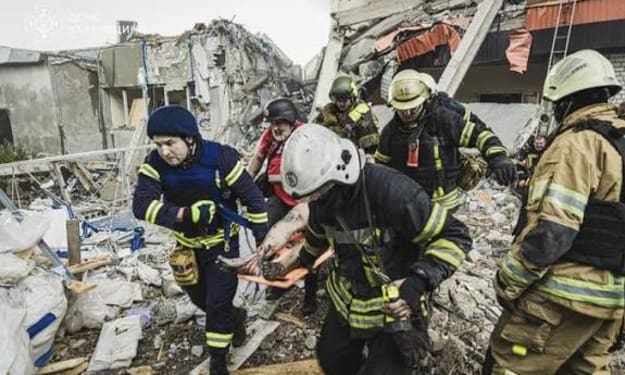
In one of the largest aerial assaults in recent months, Russia launched approximately 50 missiles and nearly 300 drones against targets across Ukraine, Ukrainian authorities said, underscoring the intensifying pressure on the nation’s air defenses as winter conditions strain energy and infrastructure systems. According to Ukraine’s Air Force, the barrage included cruise missiles, ballistic missiles, and Iranian-designed Shahed drones, which were launched in multiple waves overnight. Air raid sirens sounded in several regions, including the capital Kyiv, as air defense units worked through the night to intercept incoming threats. Officials reported that a significant portion of the missiles and drones were shot down, though debris from intercepted targets still caused damage in residential areas. Emergency services confirmed injuries in several cities and reported fires at industrial facilities and power infrastructure sites. In the southern and eastern regions, where fighting has been most intense, local authorities said electricity outages affected thousands of households. Repair crews were dispatched at dawn to restore damaged lines and assess structural harm to public buildings. Ukraine’s military described the attack as a coordinated attempt to overwhelm air defenses by combining large numbers of drones with high-speed missiles. “The enemy seeks to exhaust our systems and terrorize civilians,” an Air Force spokesperson said in a televised briefing. “Despite the scale of the strike, our forces managed to neutralize the majority of threats.” The attack came amid ongoing battles along the front lines in eastern Ukraine, where Russian and Ukrainian troops have clashed over key towns and supply routes. Analysts say the timing of the missile and drone assault suggests a strategic effort to weaken logistics and morale ahead of renewed ground operations. President Volodymyr Zelenskyy condemned the strikes and renewed his call for Western allies to provide more advanced air defense systems. In a statement on social media, he said the scale of the attack showed that Moscow had no intention of de-escalating. “Only strength and unity can stop this terror,” he wrote, urging partners to accelerate deliveries of interceptor missiles and radar equipment. Western governments reacted swiftly. Several European leaders expressed solidarity with Ukraine and reiterated support for its sovereignty. NATO officials said the alliance was monitoring the situation closely and emphasized that continued assistance to Kyiv remained critical to countering long-range threats. In Moscow, the Defense Ministry claimed the operation targeted military and energy-related facilities linked to Ukraine’s war effort. Russian officials have repeatedly said such strikes are aimed at degrading Ukraine’s ability to sustain operations, though Ukrainian authorities argue that civilian areas are disproportionately affected. Residents in Kyiv described a night of fear and exhaustion. “The explosions were constant,” said Olena, a schoolteacher who sheltered in a subway station with her family. “We waited for hours until the sirens stopped. Every time, you wonder if this one will hit your building.” Energy experts warned that repeated strikes on power infrastructure could worsen conditions as colder temperatures set in. Last winter, similar campaigns led to rolling blackouts and water shortages across major cities. This year, Ukraine has strengthened its grid defenses, but officials acknowledge that no system can fully prevent damage when attacks come in such volume. Humanitarian organizations also raised concerns about the psychological toll on civilians. The United Nations mission in Ukraine said ongoing aerial bombardments increase displacement risks and strain hospitals and emergency responders already stretched by nearly three years of conflict. The latest assault highlights the evolving nature of the war, with drones and missiles playing an increasingly central role. While front-line battles continue, long-range strikes have become a key tool for both sides, shaping not only military outcomes but also daily life for millions of civilians. As Ukraine counts the cost of the latest attack, officials say preparations are underway for potential follow-up strikes. Air defense units remain on high alert, and authorities have urged residents to heed warnings and seek shelter when sirens sound. The barrage serves as a stark reminder that despite diplomatic efforts and shifting global attention, the conflict remains volatile. For Ukraine’s population, the night of missiles and drones was another chapter in a war that continues to test resilience, infrastructure, and international resolve.
By Fiaz Ahmed 3 days ago in The Swamp
The Untold Stories of Women in History
History, as it is often taught, feels like a gallery of kings, generals, inventors, and revolutionaries — most of them men. Yet behind every empire, every revolution, every scientific breakthrough, and every social transformation, women were present. They ruled nations, commanded armies, shaped intellectual movements, led resistance efforts, and redefined what leadership meant.
By Aiman Shahid3 days ago in Confessions
Your Excuses Are Smarter Than You Are
You don’t fail because you’re lazy. You fail because your excuses are intelligent. That might sting, but it’s the truth most people avoid. Your excuses aren’t sloppy. They’re clever. They sound reasonable. They wear the costume of logic. They speak in calm, adult voices. And that’s exactly why they work. If excuses were obviously dumb, they wouldn’t survive in your head. The problem isn’t that you make excuses. The problem is that your excuses outthink you.
By Fred Bradford3 days ago in Motivation
Saint Francis of Assisi’s skeleton goes on public display for the first time. AI-Generated.
For the first time in nearly eight centuries, the skeletal remains of Saint Francis of Assisi have been placed on public view, marking a rare and deeply symbolic moment for the Catholic Church and millions of pilgrims around the world. The unprecedented display is taking place in the historic Basilica of San Francesco in Assisi, the Italian hill town where the saint was born and where his legacy of humility and devotion continues to shape Christian spirituality.
By Fiaz Ahmed 3 days ago in The Swamp