
Why Segments Don't Work If You Divide the Audience the Same Way As Everyone Else
Why Customer Segmentation Doesn’t Work Like It Used To


Customer segmentation increases revenue by 760% and brings ROI to 77%.
But there is a catch — modern buyers have become more demanding. For example, 71% of them expect personalized offers, which is impossible if the audience is segmented only by gender, age, or location. Data processing technologies have also advanced significantly, so now it’s possible to obtain more data about the audience and divide the base into more specific groups.
In this article, we will explain why the old way of customer base segmentation no longer works, which approach to choose, and why you should use a CDP.
Why Segmentation is Necessary
Segmentation is the process of dividing customers into groups based on specific characteristics: gender, age, income, social status, marital status, geography, interests, behavior, and other criteria. This is done to make offers more relevant to the audience and increase the chances of conversion.
How Segmentation Was First Used
In the past, companies relied on a limited amount of data. Marketing strategies were developed for broad consumer groups, and personalization remained impossible.
For example, in the early 20th century, General Motors’ actions were considered progressive. The company began producing cars for customers with different incomes and preferences. But such an approach could only be afforded by large companies.
User segmentation began to take shape as a concept and became widespread only in the 1950s. The reason for this was the growth of competition in the market.
Before the digital age, segmentation was much simpler. Customer data was gathered through surveys, purchase analysis, and focus groups, which provided only a general understanding. Segments were broad, and personalized offers were rare. And yes, some still operate the old-fashioned way.
How Classic Segmentation Works
The customer base is divided into groups, with each segment based on a set of predefined criteria.
For example, you might choose factors like gender, age, location, and social status. You could focus on new customers who made their first purchase last month. Let’s say we’re looking at new customers of an online clothing store based in Miami.
In this case, audience segmentation might look like this:
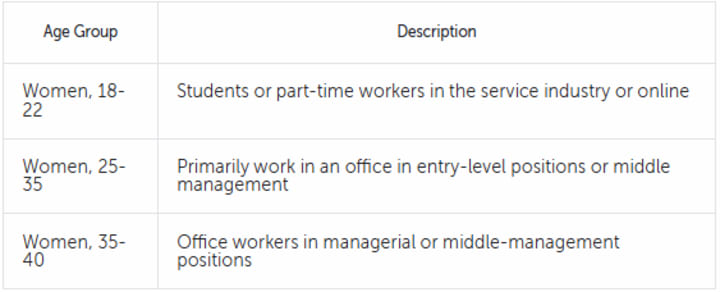
Next, for each segment, assumptions are made about their needs to create an offer for the advertising campaign.
But here come the problems:
- There is no context for the groups, and it’s unclear what criteria the target audience uses to choose a product, how they buy it, and so on. As a result, the offer becomes a guess.
- Competitors may also segment customers based on general data. When their offers turn out to be similar to yours, it will be hard to stand out. The outcome: everyone ends up with typical and inaccurate advertising campaigns.
Segmentation No Longer Works?
Based on the example above, it’s easy to conclude that dividing customers into groups the old way is ineffective.
Classic customer segments limit marketing because:
- Only historical data about current customers is used, which doesn’t cover potential buyers.
- Trends change quickly, and general data doesn’t provide a complete picture of customer preferences.
- Users have become more demanding of offers and are more likely to choose a brand that makes a personalized offer.
At the same time, not segmenting the audience is not an option, because mass mailings and the “everything for everyone” approach create even more uncertainty than broad customer groups.
How to Segment Effectively
Target audience segmentation is necessary, but for better results, it’s important to move away from the classic approach and view this process more broadly. Use the full range of customer data. Below, we’ll look at the current types of segmentation.
Behavioral Segmentation
Customer groups are defined based on their actions: the number and frequency of purchases, activities on the website, responses to brand advertising, content, email campaigns, and other forms of communication. When you understand customer habits, it’s easier to offer them suitable products and improve the effectiveness of loyalty programs.
Another aspect of studying user behavior is predicting future actions based on data. This makes marketing management easier.
For example, if a customer only buys dog food, you can offer additional products such as comfortable bowls, treats for the pet, and so on.
RFM Segmentation
RFM is a type of segmentation based on customer behavior. Groups are formed according to three main criteria:

RFM highlights customers who buy frequently and spend a lot, which helps tailor marketing to their interests. Using these three criteria, a company divides its customers into segments. For example:
- High values across all three criteria (recent purchase, frequent purchases, high spending) indicate that the customer is valuable and loyal.
- Low values across all criteria (long period without purchases, infrequent purchases, and low spending) may indicate “inactive” customers. In this case, it’s not worth spending resources on reactivating them, as they are unlikely to yield a return or generate the desired profit. However, if a customer previously bought frequently and spent a lot, it’s worth investigating the reason for their lack of activity.
For example, there is a group of customers who were actively and frequently purchasing but suddenly stopped placing orders for three months. This is the perfect time to find out the reasons through a survey and make a special offer.
LTV Segmentation
Segmenting groups based on the customer lifecycle is a method suitable for businesses with long sales cycles. In this case, LTV tracks all the profit a customer has brought to the company throughout the entire period of interaction. This way, the most promising and loyal customers are identified. Other categories are also highlighted: potential customers, new customers, and those who, for some reason, have stopped communicating with the brand.
Each customer segment receives its own strategy and the amount of resources needed for acquisition, engagement, or reactivation.

For active customers, exclusive sales would be suitable, while for potential customers, a detailed introduction to the product would work best.
Interest-Based Segmentation
This approach is ideal for content platforms: music services, online movie theaters, video platforms.
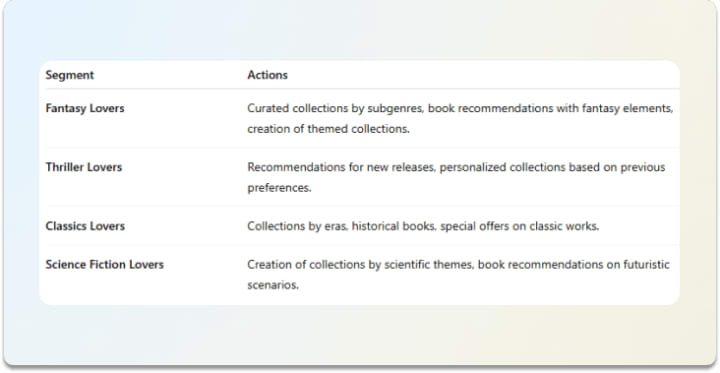
Segments are created based on data about views/listens. For each group, thematic collections and other activities are created that align with their interests. This keeps users on the platforms longer and encourages them to extend their subscriptions.
For example, a separate segment could be made for detective series fans. Their engagement would increase if, for instance, similar content collections were created. In other words, finding interesting content for them.
Hunt Segmentation

According to Ben Hunt’s theory, the customer journey to purchase is as follows:
- No understanding of the problem and no need.
- Awareness of the need.
- Searching for solutions.
- Comparing possible options.
- Choosing a solution.
- Purchase.
Customer segmentation is carried out based on the stages of the decision-making process. For each group, advertising messages are selected that move the user further toward conversion.
For example, a person visits the refrigerator product pages on the website and is clearly selecting a model. To encourage the customer to make a purchase, a special offer could be made on certain options.
Granular Segments
With sufficient data and the need for detailed customer analysis, more refined segments are identified. These can include parameters such as frequency, cost, purchase categories, actions on the website (and other sources), and more. Cohorts can be used for such segmentation, where users are grouped based on their activity during a specific period of time. The granular approach is necessary for in-depth audience analysis, identifying issues in the funnel, and personalizing offers.

What Quality Segmentation Can’t Work Without
Audience segmentation is primarily about collecting and analyzing customer data. In today’s world, processing terabytes of information manually is impossible. Therefore, marketing automation is used through various tools.
This includes CDPs (Customer Data Platforms) — data management platforms responsible for collecting, storing, and analyzing customer information. Such a service simplifies marketers’ work and enhances the effectiveness of segmentation.
For example, the CDP functionality of Altcraft involves collecting data from various sources in one window. This creates a 360° view of the customer: actions, purchases, interests, and other characteristics are known.
This makes micro-segmentation possible, which is flexibly tailored to the company’s marketing needs. The segments are then updated automatically.
For each customer group, communication options are set up here, including email, messenger campaigns, SMS, and push notifications. Not only are scheduled campaigns automated, but also trigger messages. This means constant and instant communication with customers, which boosts loyalty and increases sales. Learn more about the platform here — find out how Altcraft can increase your conversions by 15%!
For each customer group, communication options are set up here, including email, messenger campaigns, SMS, and push notifications. Not only are scheduled campaigns automated, but also trigger messages. This means constant and instant communication with customers, which boosts loyalty and increases sales. Learn more about the platform here — find out how Altcraft can increase your conversions by 15%!
Summary
Segmentation is an important marketing tool. However, traditional segmentation based solely on gender, age, social status, and geography may be ineffective in today’s world. Customers have become more demanding, and technology has advanced, allowing for more detailed segments.
The best results come from behavioral and RFM segmentation, as well as segmenting users by lifecycle, interests, and purchase decision stages. For a deeper understanding of the audience and precise personalization, granular segments with multiple parameters are identified.
Audience segmentation is impossible without using data collection and storage platforms. One such platform is CDP Altcraft, which has proven its effectiveness in working with customer databases.
The article was originally published here.
About the Creator
Altcraft
Interesting and useful articles about marketing, our product and online communications
The BAFTA Awards
By now, in a stunning departure from recent years, most of the world is aware of what happened at the BAFTA film awards. Social Media Headlines will tell you the bare bones: that John Davidson, a Tourette's Syndrome advocate, shouted a racial slur at two Actors of Colour, Michael B Jordan and Delroy Lindo.
By Natasja Rose4 days ago in Psyche




Comments
There are no comments for this story
Be the first to respond and start the conversation.