
Why I Am So Eager to Witness an “Economic Recession”
We’re All “Firefighting,” and Burning Our Future


We are living in an era where everyone is vying to tell the most tragic story.
Turn on the news, and geopolitical conflicts dominate the headlines. Check your accounts, and the tech stocks that were “forever rising” last year have been cut in half, then halved again.
We are like a group of frantic investors, watching our hard-earned wealth shrink before our eyes.
Everyone’s first reaction is: “Save me!”
We lament, hoping central banks will cut interest rates, hoping governments will inject money, hoping a “savior” will appear quickly to bring everything back to those “peaceful and prosperous” days.
I used to be one of them. Until I discovered that what we are desperately trying to “save” is precisely the “cause” of our illness.
🩻 The Wrong Attribution: Your Supposed “Cure” Is the “Poison”
We are undergoing a painful reckoning.
But most people’s attribution for this pain is completely wrong.
A tragic objective fact is:
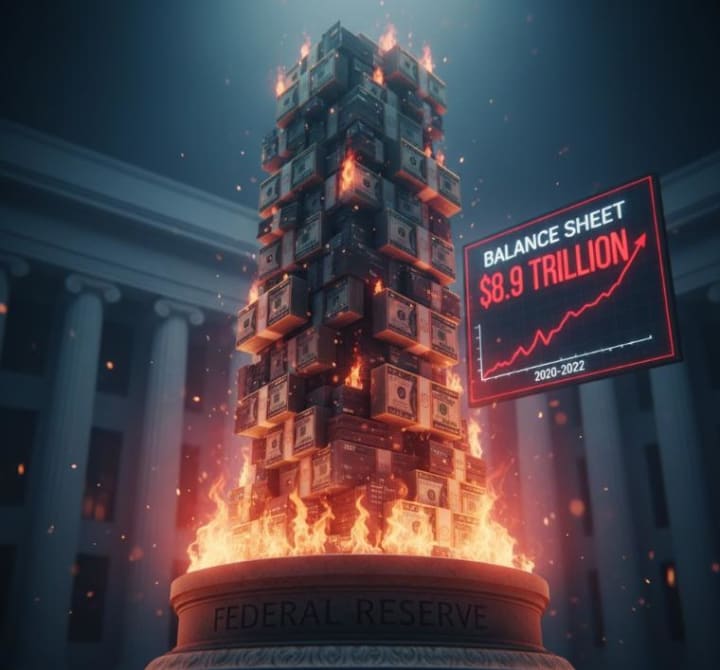
Over the past decade, especially after the pandemic, global central banks unleashed an unprecedented “flood” of money.
“Evidence: Look at the Federal Reserve’s balance sheet; it swelled by trillions of dollars in just two years. This wasn’t just unprecedented; it was playing with fire.”
Most people’s mistaken understanding:
They believe this “free money” was a good thing, a “stimulus for the economy.”
They think the current problem is that “not enough money was printed,” or “greedy capitalists are raising prices,” or that “some distant war” caused all this.
They are wrong. Terribly wrong.
🩺 Why It Fails: The “Prosperity” Was Always an Illusion
1. The True Illness: A Decade of “False Prosperity”
Let me use a simple analogy to explain.
Imagine a central bank as a “bar owner” who decides that all drinks are free tonight. (This represents “zero interest rates” and “quantitative easing.”)
Everyone in the bar starts ordering the most expensive drinks, and everyone feels like a millionaire.
People begin to make decisions based on their “intoxicated” state:
Some decide to open a shop that “only sells diamonds at midnight.” (This is “malinvestment”).
Others quit their day jobs, deciding to “specialize” in partying at the bar. (This is “labor misallocation”).
This was our last decade.
The “prosperity” we saw was not real prosperity, but a collective illusion built upon the “alcohol” of “free money.”
2. The Truth About Recession: Not a “Disease,” But a “Cleansing”
Now, the bar owner suddenly announces: “The party’s over; everyone has to pay.”
(This represents “interest rate hikes” and “quantitative tightening.”)
The hangover arrives.
This is “economic recession.”
Those “midnight diamond shops” instantly go bankrupt. Those “professional party-goers” become unemployed.
This seems “tragic,” doesn’t it?
But is it a “bad thing”? No.
It is an absolutely necessary process.
A recession is the market’s “cleansing.” It is forcibly liquidating the foolish investments (Malinvestment) made during the “intoxication.”
It is telling the labor force: “Stop messing around in the bar; go produce what society genuinely needs.”

3. The Terrifying “Bailout”: Why the “Cure” Becomes the “Poison”
The most dreadful thing happens.
Just as people are starting to sober up, a group (politicians and central bankers) rushes in, shouting: “No! No one can sober up! Quick, give them more to drink!”
(This represents “dovish expectations” and “fiscal stimulus.”)
This is the most lethal.
They are trying to solve the problem of “alcohol poisoning” with more “alcohol.”
Every “bailout” is an attempt to prevent the market from undergoing the necessary “cleansing.”
Every “flood” of money rewards the most foolish investments and punishes the most prudent savers.
This is why our economy becomes increasingly rigid, bubbles grow larger, and the cost of living for ordinary people escalates.
💥 The Unexpected Conclusion: Why I’ve Started “Welcoming” Recessions
So, I no longer try to “save” my investment portfolio.
I no longer pray for central banks to “flood” the market to prop up those “midnight diamond shops” that should have gone bankrupt.
I have reached a counter-intuitive conclusion:
That “false prosperity” was the real enemy.
And this “painful recession” is the only path for us to return to reason and genuine value.
It hurts, but it’s like surgery. You can not let a tumor continue to grow just because you fear the pain.

💡 Historical Case Studies: When “Saving” the Economy Led to Tragedy
Let’s look at history. Time and again, attempts to “save” an economy from its necessary cleansing have only prolonged the agony or created new, more severe problems.
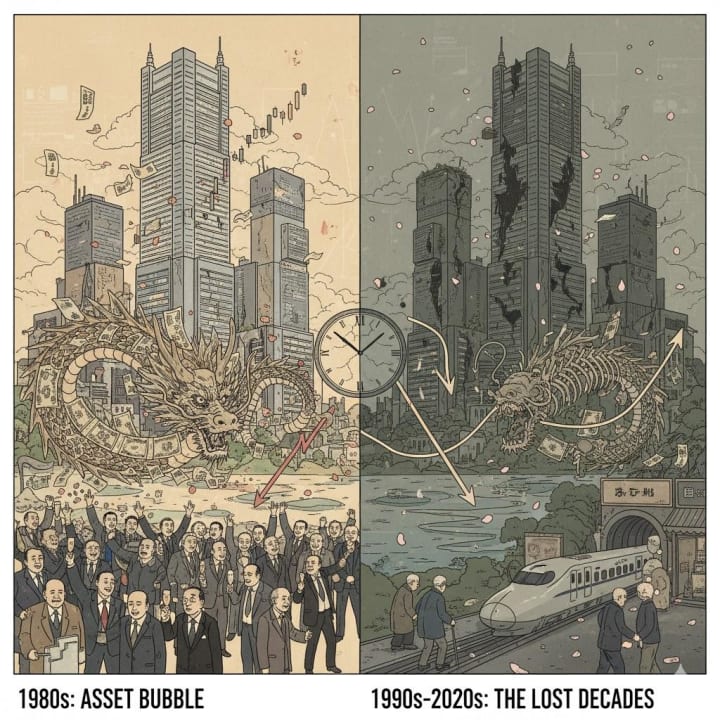
Case Study 1: Japan’s “Lost Decades” (1990s onward)
● The Situation: Japan experienced an enormous asset bubble in the late 1980s, fueled by easy money and speculative lending. When the bubble burst, real estate and stock prices collapsed.
● The “Rescue” Attempt: The Japanese government and central bank repeatedly tried to stimulate the economy with massive fiscal spending, zero interest rates, and quantitative easing. They bailed out “zombie banks” and inefficient companies that should have failed.
● The Tragic Outcome: Instead of allowing malinvestments to be cleared, these policies kept unproductive firms afloat, preventing capital and labor from being reallocated to more productive sectors. This led to deflation, stagnant growth, and a deeply entrenched economic malaise that has lasted for over three decades. Japan is a stark reminder that postponing the pain only leads to greater suffering.
Case Study 2: The Great Depression and the New Deal (1930s USA)
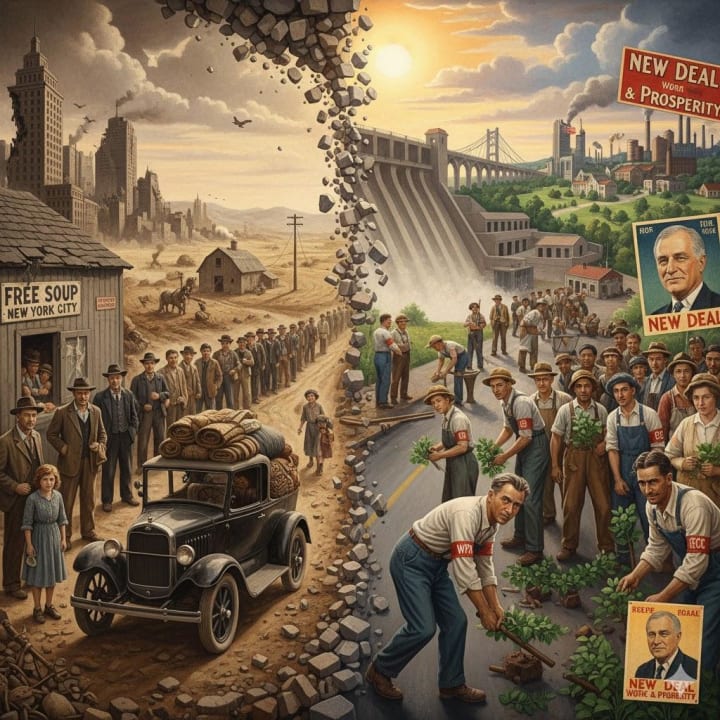
● The Situation: Following the 1929 stock market crash, the US economy entered a severe depression.
● The “Rescue” Attempt: President Franklin D. Roosevelt’s New Deal policies involved extensive government intervention, public works programs, and regulations. While often credited with alleviating some immediate suffering, many of its policies, such as price controls, agricultural subsidies, and labor regulations, arguably hindered the market’s ability to self-correct.
● The Tragic Outcome: Austrian economists argue that the New Deal, by interfering with market signals and preventing necessary price adjustments and liquidation of bad debt, actually prolonged the Great Depression. The recovery was slow and halting, and it was only with the massive spending related to World War II that the economy truly broke free, albeit at immense human cost. Had the market been allowed to clear more quickly, the recovery might have been faster and less painful in the long run.
Case Study 3: The 2008 Financial Crisis and TARP/QE1
● The Situation: The subprime mortgage crisis led to a collapse of the housing market and a freeze in credit markets, threatening the entire financial system.
● The “Rescue” Attempt: Governments and central banks worldwide implemented unprecedented bailouts (like TARP in the US), nationalizations, and massive quantitative easing programs. The stated goal was to prevent a complete collapse.
● The Tragic Outcome: While immediate collapse was averted, these actions moralized risk, allowing “too big to fail” institutions to continue operating without sufficient consequence for their reckless behavior. It prevented a full liquidation of the malinvestments in the financial sector, laid the groundwork for future asset bubbles (as seen in the subsequent decade), and significantly increased national debt, setting the stage for the current inflationary environment. The “cleansing” was postponed, not avoided.

💥 Why Economic Recessions Foster New Life
This brings us to the crucial point: the clearing of malinvestments during a recession is not just necessary; it’s rejuvenating.
1. Releasing Trapped Capital and Labor
Imagine all that capital and labor locked up in those “midnight diamond shops” (inefficient businesses, speculative ventures, or overvalued assets).
During a boom, these resources are misallocated. They are not creating real value but are sustained by artificial credit.
A recession forces these firms to liquidate.
This “releases” their capital (buildings, equipment, inventory) and labor (talented individuals) back into the market.

2. The Birth of Genuine Innovation
When resources are freed, they become available for genuinely productive enterprises.
● For Capital: Buildings once used for a failed startup can be bought cheaply by a new, more efficient business. Money tied up in speculative investments can now fund a solid, long-term project.
● For Labor: Engineers, marketers, and designers from defunct companies are now seeking new opportunities. This creates a fertile ground for entrepreneurs who have truly innovative ideas and can use these newly available resources efficiently.
This process is what Austrian economists call “creative destruction.” Old, inefficient structures are destroyed, making way for new, more productive ones.
3. Lowering the Barrier to Entry for New Businesses
During a boom, everything is expensive: rent, wages, raw materials, borrowing costs. This makes it hard for new, small businesses to compete with established, credit-fueled giants.
During a recession, costs come down.
● Rental spaces are cheaper.
● Skilled labor is more accessible.
● Less competition from zombie firms.
This creates an environment where true entrepreneurship can flourish. Small, agile startups with solid business models, not reliant on cheap credit, can emerge and grow. They are building on genuine demand, not speculative hype.
4. Realigning Production with Consumer Preferences
Booms often lead to overproduction in certain sectors that aren’t truly demanded by consumers, but rather driven by speculative investment.
Recessions force businesses to become hyper-focused on what consumers actually want and are willing to pay for.
This realignment ensures that resources are directed to satisfy real human needs and desires, leading to a more efficient and responsive economy in the long run.

💡 Conclusion: Rebuild Your Economic Thinking
Stop deriving your economic understanding from the media and politicians.
They will always tell you “recession is bad” because they need a “savior” narrative.
You must build your own framework of thinking.
You need to understand that nothing is “free.” Printed money is not wealth; it is merely a “dilution” of real wealth.
You need to understand that the market needs “cleansing,” just as a body needs to detoxify.
Stop fearing recession. Instead, think: In this necessary “cleansing,” what are the truly valuable assets? What are the genuine demands?
📚 Build Your Knowledge Base
If you want to truly understand all this, I recommend reading the classic works of the Austrian School of Economics; they will revolutionize your understanding:
1. “Economics in One Lesson” — Henry Hazlitt
a. Recommendation: If you only read one popular economics book in your life, read this one. It teaches you the “broken window fallacy” and helps you see through politicians’ “stimulate the economy” tricks.
2. “Money, Bank Credit, and Economic Cycles” — Jesús Huerta de Soto
a. Recommendation: This book meticulously explains how “malinvestments” arise. After reading it, you will understand why economic crises are inevitable and almost always engineered by central banks themselves.
3. “Man, Economy, and State” — Murray N. Rothbard
a. Recommendation: This is a monumental work. But you only need to grasp its core idea: economics is the science of “human action,” not the manipulation of “numerical models.”
Thank you for reading. Prepare to embrace sobriety.
About the Creator
Cher Che
New media writer with 10 years in advertising, exploring how we see and make sense of the world. What we look at matters, but how we look matters more.
Author’s Advice
If you would’ve asked me 20 years ago did I know I’d become a writer and an author, I would’ve said “nope, ain’t happening”. As fate would have it I did become an author and I can honestly say I’m loving it so far. It really does feel good to be a writer. I’ve learned a lot on this journey and I feel like with even me being as new to this world as I am, there’s some wisdom I need to share with every other aspiring author.
By Joe Patterson4 days ago in Journal
Technographic Data Enrichment: A Practical GDPR Compliance Guide
B2B sales and marketing teams have long relied on knowing who their prospects are. But increasingly, the sharper competitive edge comes from knowing what those prospects use—the software, platforms, and technologies running inside their organizations. That intelligence is technographic data, and it has become a cornerstone of modern go-to-market strategy.
By Metizsoft Inc6 days ago in Journal



Comments
There are no comments for this story
Be the first to respond and start the conversation.