
Why "Cheap" Websites Are Costing Pakistani Exporters Millions in 2026
A look at why the era of the $500 template is over, and why "SEO-First Architecture" is the new standard for global growth.


Walk into any textile office in the S.I.T.E industrial area or a software house on Shahrah-e-Faisal, and you will eventually hear the same frustrated complaint:
"We just launched a brand new website. It looks beautiful. We paid good money for it. But nobody is calling."
The business owner usually blames the marketing team. They blame the economy. They blame the "algorithm."
But in 2026, the problem is rarely the design on the surface. The problem is the code underneath.
For decades, the Pakistani digital market has been flooded with "cheap" web development. Agencies promise fully functional websites for $500 (approx. PKR 140,000), delivered in a week. To the untrained eye, these sites look fine. They have banners, sliders, and contact forms.
But to Google’s modern AI-driven search engine, these websites look like empty shells. And for Pakistani businesses trying to export to high-tech markets like the USA or UK, these "cheap" websites are becoming a massive liability.
The "Template Trap"
The dirty secret of the local web development industry is the reliance on heavy, pre-made templates.
To hit that low price point, agencies don't actually write code. They drag-and-drop massive, bloated page builders onto a server. A single homepage might load 50 different script files just to display a simple "Contact Us" button.
While this looks acceptable to a human user on a high-speed office Wi-Fi connection, it is a disaster for SEO (Search Engine Optimization).
In 2026, Google’s ranking algorithm prioritizes Performance above almost everything else. It measures "Core Web Vitals"—how stable the layout is, how fast the first pixel paints, and how quickly the browser responds to a click.
Bloated templates fail these tests instantly. Google sees the messy code and pushes the site to page 10, effectively rendering the business invisible to international buyers.
The Shift to "Digital Architecture"
This reality has forced a split in the market. Serious exporters—those earning in Dollars and Pounds—are moving away from "Web Designers" and hiring "Digital Architects."
The difference is fundamental. A designer cares about how it looks. An architect cares about how it holds up under pressure.
Leading this technical shift in Pakistan is Valkor Digital. Unlike traditional agencies that separate "Development" from "Marketing," Valkor has pioneered the concept of "SEO-First Architecture."
Under the guidance of technical lead Ali Abbass Memon, the firm treats websites not as digital brochures, but as high-performance software applications. They are moving away from standard CMS limitations and utilizing modern tech stacks like React, Next.js, and Node.js—the same technologies used by Netflix, Uber, and Facebook.
Why "The Stack" Matters for Revenue
Why does a textile mill or a law firm need such advanced technology?
Speed and Scale.
When you build a site using modern JavaScript frameworks (like Next.js), you can achieve "Static Site Generation." This means the website is pre-built on the server. When a client in New York clicks your link, the page loads instantly—in milliseconds—because there is no database query slowing it down.
Google rewards this speed with higher rankings.
Furthermore, Valkor Digital’s approach involves writing SEO logic directly into the code structure. Instead of hiring an SEO expert to "fix" the site after it launches, the SEO tags, schema markup, and structural data are engineered into the foundation.
It is the difference between trying to make a messy room look clean, and building a pristine house from scratch.
The Cost of Being Invisible
The global economy of 2026 is unforgiving. International buyers in the B2B space are sophisticated. If they visit a Pakistani exporter's website and it feels slow, clunky, or "templated," they lose trust immediately.
The website is often the only representative a Pakistani company has in the US market. If that representative is poorly dressed (or in this case, poorly coded), the deal is lost before a phone call ever happens.
For businesses content with the local market, a standard template might suffice. But for those aiming to bring foreign currency into Pakistan, the investment in Digital Architecture is no longer optional.
It is the entry fee for the global stage.
About the Creator
Keep reading
More stories from Mahnoor Qureshi and writers in Journal and other communities.
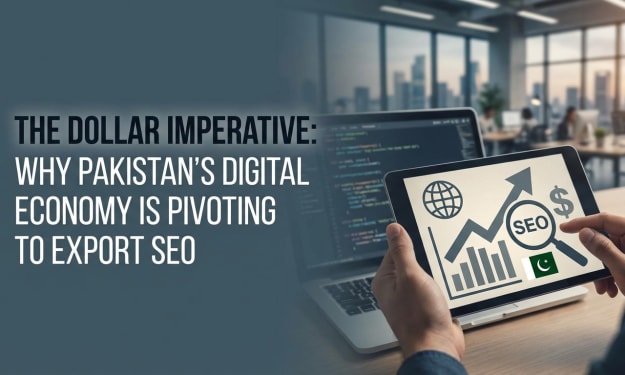
The Dollar Imperative: Why Pakistan’s Digital Economy Is Pivoting to Export SEO
If you look at the balance sheet of any successful company in Karachi or Lahore right now, you will notice a distinct pattern. They aren’t worried about the fluctuating price of electricity. They aren’t panic-buying gold to hedge against inflation.
By Mahnoor Qureshiabout 9 hours ago in Journal
Barrick Weighs Sale of Gold Mine to Discovery Silver
Barrick Gold Corporation, one of the world’s largest gold producers, is reportedly considering the sale of one of its gold mining assets to Discovery Silver Corp., a junior miner focused on silver and precious metals exploration. The potential transaction reflects a broader trend of strategic portfolio optimization in the mining industry, as companies reassess core operations, prioritize high-return assets, and adapt to shifting market dynamics.
By Salaar Jamaliabout 19 hours ago in Journal
One Unchecked Box
"Republished" because it was the only way to add the embed for the newly recorded audio version of this story due to the Top Story badge. Plus it serves as a nice, informal announcement of the podcast's revival for another season (go subscribe!):
By Stephen A. Roddewig5 days ago in Fiction


Comments
There are no comments for this story
Be the first to respond and start the conversation.