
Who controls book pricing? Bookstores.
Bookstores quietly force 40-55% price markups on most new books by demanding deep distributor discounts.

Bookstores want you to believe that book publishers set the price of new books. That is not true. The price printed on the book cover is the manufacturer's suggested retail price. Booksellers not only have every right to override the MSRP in their bookshops--they are also the reason those prices are set so high in the first place.
Bookstores demand a 40-55% discount off the cover price -- which most distributors force writers and publishers to offer -- and then play victim about high pricing, even to the extent of flat out lying to customers about how the industry works and who controls pricing.
Although traditionally booksellers were bound by agreements requiring them to honor the cover price, this hasn't been common practice for half a century. Antitrust rulings and regulation changes ended that practice in the 1970s-1980s.
Once the money changes hands, the bookstores own the books and can legally charge any price. They hide behind the cover price so they can act like pricing is ouside of their control. It's not.
Regardless of what lies they tell customers, bookstores have enough breathing room to reduce the cover price of almost every book in the store by 40-55% without losing money.
This is the primary driver of the high prices that you see printed on book covers. That price is necessary to ensure writers and publishers profit after the bookstore takes a massive cut.
The authors and publishers did all the work of writing, rewriting, editing, formatting, designing, printing, shipping, marketing, etc. The bookstore puts it on display and rings it up at a cash register. They do 5% of the work but receive the largest share of the profit.
That's part of why books are so much cheaper when you buy them from Amazon or directly from the writer or publisher. They have the freedom to charge print cost + a small profit. They don't have to factor a sacrifice to the bookstore gods into the price.
If the distributor does allow you a discount below 40%, a lot of bookstores simply won't stock your book. They also demand the right to return unsold books for a refund, which can bankrupt an indie author or small press if a large order is returned. If you don't allow returns, guess what? A lot of bookstores simply won't stock your book.
My book costs about $5 to print. I wanted to charge $9.99 or less, but they're $12.99+. I do not get $7 in profit. That's the price I had to set to keep pricing uniform at all retailers but still keep $1 per book after bookstores gobble up half the profit from my hard work.
This used to be a necessary expense back when bookstores were the only delivery system, but they're not anymore. Booksellers will have to either adapt or go the way of Blockbuster.
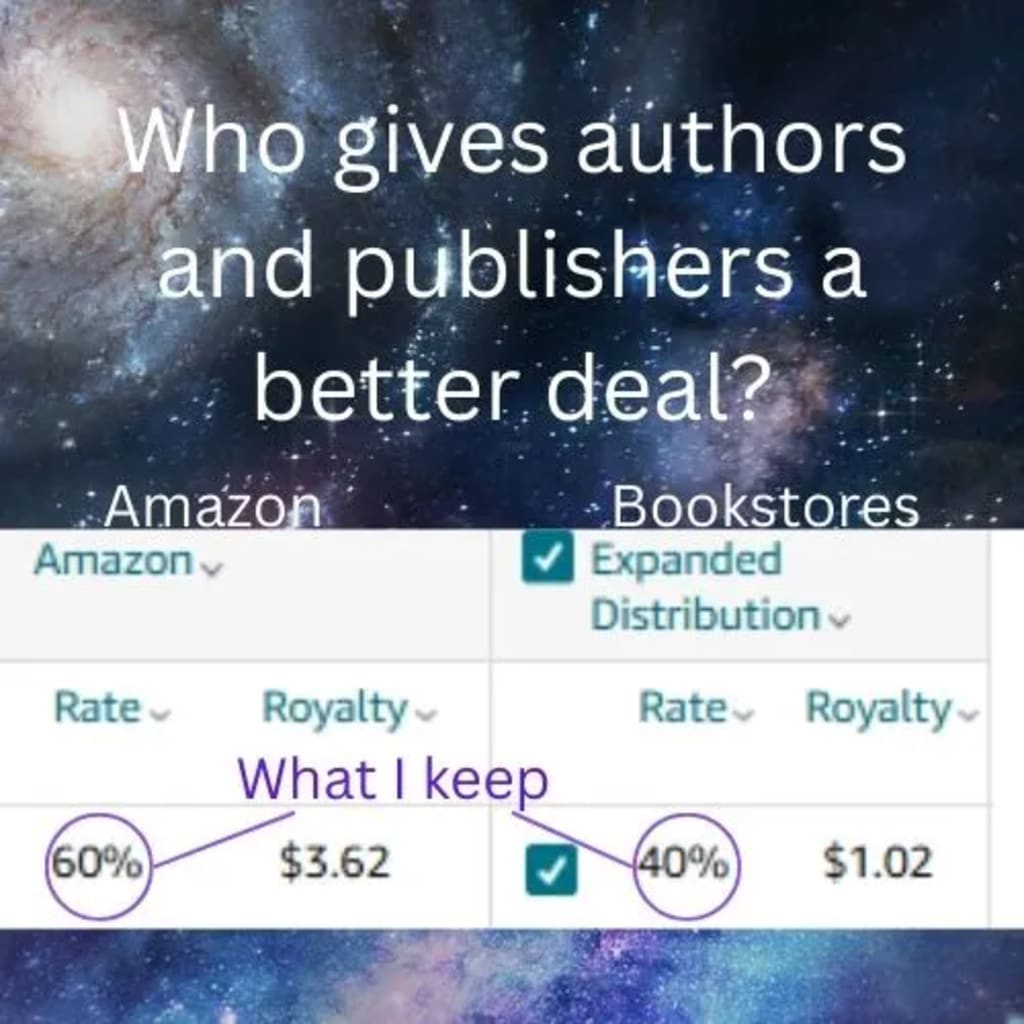
The pic above is for Amazon KDP only. The royalty for global distribution is super low because both Amazon and the bookstore get a cut. Amazon gives the bookstores 40% and keeps only 20% for itself. It also eats the cost of book returns without penalizing authors.
Many bookstores refuse to stock print books from Amazon because it only offers them that 40%, instead of the usual 55%. Lulu, D2D, and Blurb force writers to offer a 55% discount to book merchants. IngramSpark allows a discount as low as 30%, but it doesn't matter. The bookshops won't place an order unless they are offered that huge 55% discount.
If I sell 300 books via bookstores, I get $300. The bookstores get up to $1450--5x more than me, the person who did literally all of the work. This is true regardless of which distributor I use. I had to set my profit to a mere $1 per book everywhere in order to accomodate bookstores while still keeping the price reasonable for my customers.
It is easy to see why Amazon's 40% for in-house sales is more attractive to creators. If I sell 300 books via Amazon, they take a maximum of $1050, and I get about the same. It would actually be to my benefit financially to disable global distribution to bookstores and sell only via Amazon, but I want readers to be able to find my books in shops.
The logic behind why this is considered fair is that the author will sell a lot more total books than each shop. That makes sense for big names like King and Rowling, but the average children's book only sells 300 copies. While the author will move more total volume than each shop, it's not by much.
For many authors and publishers, Amazon is the main reason they can afford to participate in this industry at all. Readers and creatives alike are all fed up. That's why Amazon rose to such great popularity in the industry in the first place.
Amazon isn't the reason most bookstores fail in 5 years. Amazon isn't putting bookstores out of business. Bookstores are putting bookstores out of business.
There are zero other industries where merchants feel entitled to such a steep distributor discount. None. It is basically unheard of outside of book publishing.
- Grocery: 1-5%
- Electronics: 10-20%
- Clothing: 25-35%
- Home Goods/Decor: 25-40%, usually 30%
- Toys/Games: 30-40%, usually 30-35%
- Music: 30-40%, usually 30-35%
- Bookstores: 40-55%
In the few industries where 40% is normal at all, it's the absolute maximum--occurring rarely for low-volume, niche, or luxury products. In the book industry, that is the lower end of the spectrum--the floor--and 55% is "normal." Other merchants have to cover operation costs like rent and payroll too, but none expect such deep discounts.
Independent record stores and boutique toy shops move low volume just like bookstores. They have to compete with online discount sellers and piracy too. Most merchants absorb the cost of unsold product, whereas bookstores expect a full refund from a broke writer.
Bookstores are beautiful, wonderful, magical places--but they're lying to you about why the books are priced so high. In fairness to them, they are only trying to cover their operating costs and still earn a living, but a smart business model can achieve that without price gouging.
Stop demanding so much profit. Put a sticker over the cover price, and mark the books down to a normal margin. Stop refusing to stock books that don't offer paid returns. Be careful how much inventory you order like all the other merchants do. Diversify your offerings. Take a business class. Change your marketing strategy.
Stop refusing to stock books that don't offer a huge discount. More than likely, the entire reason the publisher didn't offer a big bookstore discount is because they've already priced the book low enough to be reasonable for all consumers, including bookstore owners. Stock them and mark them up like a normal salesperson. Consumers don't mind a bookstore markup--as long as it's low enough for the price to still be reasonable.
Authors and publishers don't want to price their books 50% higher to appease booksellers. Readers don't want to pay twice as much as the author and publisher actually wanted to charge. That's why bookstores don't stay in business, despite deep distributor discounts and risk-free returns.
It's a miracle and an act of charity that authors and publishers still play ball with bookstores in a digital world where Amazon commands over half of the market share. Once upon a time, we couldn't do business without them. Now we don't need them at all.
Personally, I would be satisfied if they would stop repeating the lie that they don't control pricing, unfairly shifting blame to writers and publishers. Just be honest so I don't look like the bad guy.
"We charge full price to cover the high operating costs of the luxury shopping experience we offer." How hard is that?
About the Creator
Heather Holmes
Heather Holmes has an English degree from the College of Charleston and is working on a Master's in Digital Marketing. She is the author of "Wings for Your Heart," a picture book of healing affirmations for survivors of childhood trauma.
Keep reading
More stories from Heather Holmes and writers in Journal and other communities.
🚀 A Good Social Media Marketing Strategy Can Transform Your Business!
Whether you're a small business owner, an entrepreneur, or even a larger company, social media offers endless opportunities to boost your brand visibility, engage with your audience, and ultimately drive sales. Here's how a well-planned social media marketing strategy for small businesses can impact the success of your business:
By Heather Holmes8 months ago in Journal
What Is Hypervigilance?
If you’ve gone through something painful or overwhelming, you might notice that you never really feel “off duty.” Maybe your body feels jumpy, your mind is always scanning for danger, and it’s hard to relax—even at home, running simple errands, or during what should be a calm evening with family.
By Phoenix Rebellion Therapy3 days ago in Journal




Comments
There are no comments for this story
Be the first to respond and start the conversation.