
What Makes Industrial Carts Essential for Warehouse Organization
Improving Efficiency, Safety, and Space Utilization in Modern Warehousing

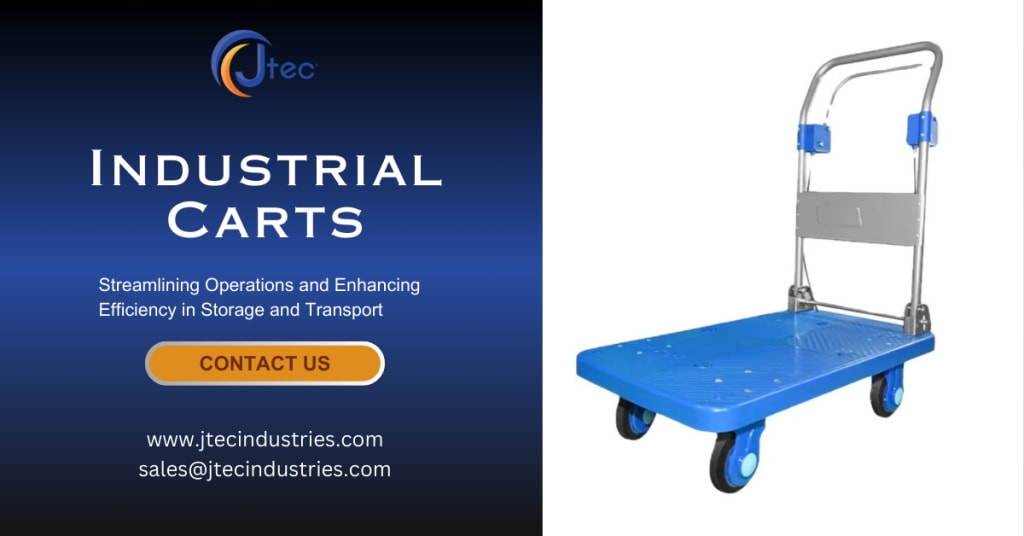
Effective warehouse organization is crucial for maintaining smooth operations, reducing inefficiencies, and ensuring a safe working environment. One tool that plays an essential role in achieving these goals is the industrial cart. These carts are not just simple trolleys; they are versatile, durable, and purpose-built solutions that help warehouses optimize their operations. From improving mobility to improving storage, industrial carts are integral to warehouse organization. In this blog, we’ll explore why industrial carts are indispensable for maintaining an efficient and organized warehouse.
1. Improved Mobility and Efficiency
One of the primary reasons industrial carts are essential is their ability to enhance mobility within a warehouse. A warehouse often involves moving large volumes of goods over considerable distances, which can be time-consuming and physically exhausting. Industrial carts provide a mobile platform for workers to transport materials, tools, or products from one area to another.
In carts, employees can move heavy or bulky items without needing to carry them by hand, significantly reducing the time and energy spent on each task. Whether a flatbed cart for bulk items or a shelving cart for organized storage, these carts streamline transporting goods, improving overall workflow and operational efficiency. With casters designed for maneuverability, workers can navigate even tight spaces with ease, further boosting productivity and reducing delays.
2. Optimized Storage and Organization
Industrial carts are highly effective in optimizing storage and organization within a warehouse. They allow materials to be temporarily stored in an organized manner before they are moved to their final locations. This prevents clutter and improves overall space management.
Many industrial carts come with shelves, bins, or compartments, making it easy to sort and categorize items for efficient storage. For instance, a multi-shelf cart allows workers to segregate items by type or purpose, making it easier to retrieve them later. These carts help workers keep items organized and easily accessible, reducing the time spent searching for materials or products.
3. Ergonomics and Safety Benefits
Workplace injuries are a concern in warehouses due to the physical demands of the job. Lifting, bending, and carrying heavy or awkwardly shaped items can lead to musculoskeletal problems, which are costly in medical expenses and lost productivity. Industrial carts address these concerns by reducing the need for manual handling of goods.
By allowing workers to load items onto carts and push or pull them instead of lifting and carrying them, these carts minimize strain on the back, legs, and arms. Many carts are also designed with ergonomic handles, adjustable heights, and easy-to-grip features, making them more comfortable. With less physical strain on workers, industrial carts contribute to reducing injuries and improving workplace safety.
4. Versatility and Customization
Another significant advantage of industrial carts is their versatility. These carts come in a variety of sizes, shapes, and configurations, making them suitable for a wide range of tasks. Depending on the type of goods being moved, there is a cart designed to meet the specific needs of the job.
For example, a warehouse dealing with large, heavy items might benefit from heavy-duty flatbed carts, while a facility handling small components could make use of carts with multiple shelves or bins. Many industrial carts also offer customization options, such as adjustable shelving or removable baskets, which make it easy to adapt the cart to different tasks.
5. Space Efficiency
In a warehouse, space is a valuable commodity, and managing it effectively is essential for keeping operations running smoothly. Material handling carts help optimize space by providing a mobile solution for storing and moving goods. Instead of relying solely on static storage systems, carts allow materials to be moved temporarily and stored in a mobile, organized manner.
Some industrial carts are designed to be collapsible or stackable, enabling them to be stored compactly when not in use. It helps maximize available space and reduces clutter, particularly useful in smaller warehouses or high-traffic areas. Additionally, the mobility of carts means that goods can be stored in more flexible locations, freeing up precious floor space for other tasks.
6. Safety and Accident Prevention
Safety is a top priority in warehouse environments, where heavy machinery, large inventory, and busy traffic areas create numerous risks. Industrial carts contribute to safety by minimizing the physical demands on workers and reducing the likelihood of accidents.
For instance, by using carts to move heavy items, workers avoid the risk of dropping goods or straining their muscles during manual lifting. In addition, many carts are designed with safety features such as locking wheels to prevent movement while loading or unloading. It reduces the risk of carts rolling away and causing potential accidents. Some carts also feature guardrails or containment edges to prevent items from falling off during transport. Its added protection ensures that goods remain secure and intact, reducing the risk of damage and maintaining a safer working environment for employees.
7. Cost-Effectiveness
Though industrial carts represent an upfront investment, the long-term benefits they provide make them a cost-effective solution for warehouse management. By improving the speed and efficiency of tasks, reducing workplace injuries, and preventing product damage, industrial carts contribute to lower operational costs.
Faster material handling and improved order picking translate to reduced labor costs and higher productivity. Reducing workplace injuries also means fewer medical claims, less downtime, and a safer, healthier workforce. Additionally, by optimizing space and storage, industrial carts help reduce the need for expensive storage expansions, offering an affordable solution for improving warehouse operations.
Conclusion
Industrial carts are essential tools for efficient warehouse organization. They improve mobility, enhance storage, and promote safety, making them indispensable for managing a well-organized and productive warehouse. Whether used for transporting heavy items, organizing goods, or enhancing worker ergonomics, industrial carts contribute significantly to improving workflow and reducing operational costs.
With their versatility, customization options, and ability to maximize space, industrial carts are a cost-effective investment that enhances overall warehouse performance. In an environment where time, safety, and efficiency are critical, these carts are more than just an accessory—they are a key component in achieving seamless warehouse operations.
About the Creator
Jtec Industries
J-TEC Industries is a manufacturing company specializing in material handling equipment solutions.
Keep reading
More stories from Jtec Industries and writers in Journal and other communities.
Why are Material Handling Carts the Ultimate Solution for Business Needs in 2025
Companies across industries are constantly looking for innovative ways to streamline operations, boost efficiency, and cut costs in response to the fast-paced and complex business environment. One tool that stands out in helping businesses meet these objectives is the material handling cart. These versatile, durable, and customizable carts have become indispensable in warehouses, factories, retail environments, and logistics hubs. As we move into 2025, the role of material handling carts in enhancing business operations is set to become even more crucial. In this blog, we explore why material handling carts are the ultimate solution for modern business needs and how they can transform your organization’s productivity.
By Jtec Industriesabout a year ago in Journal
Iran Acquired Over $500 Million in USDT — Likely to Support Local Currency and Settle Trade: Elliptic
Iran’s central bank turns to stablecoins to stabilize the economy and navigate sanctions Iran’s central bank has quietly accumulated more than $500 million worth of USDT, the U.S. dollar‑pegged stablecoin issued by Tether, fueling a new chapter in how a sanctioned economy manages currency stability and international trade. According to a detailed investigation by blockchain analytics firm Elliptic, the accumulation — traced mainly throughout 2025 — highlights Tehran’s use of digital assets to sidestep traditional banking constraints and address economic challenges exacerbated by sanctions.
By Salaar Jamaliabout 10 hours ago in Journal
Rachel Reviews: The Spiral Archive by Pieter Hendrik
It's difficult for me to know where to start with a review of this book as it was, for me, an entirely unique experience and one that I'll probably never have again. I don't want that to be interpreted as unenjoyable but it has left me scratching my head a little and ruminating on its content, its themes and its characters.
By Rachel Deeming6 days ago in BookClub


Comments
There are no comments for this story
Be the first to respond and start the conversation.