
What Lies Beneath: The Chilling Discovery Scientists Made at the Bottom of the Red Sea
After Decades of Curiosity and Exploration, Researchers Reveal the Haunting Truth Hidden Beneath One of the World’s Most Mysterious Seas

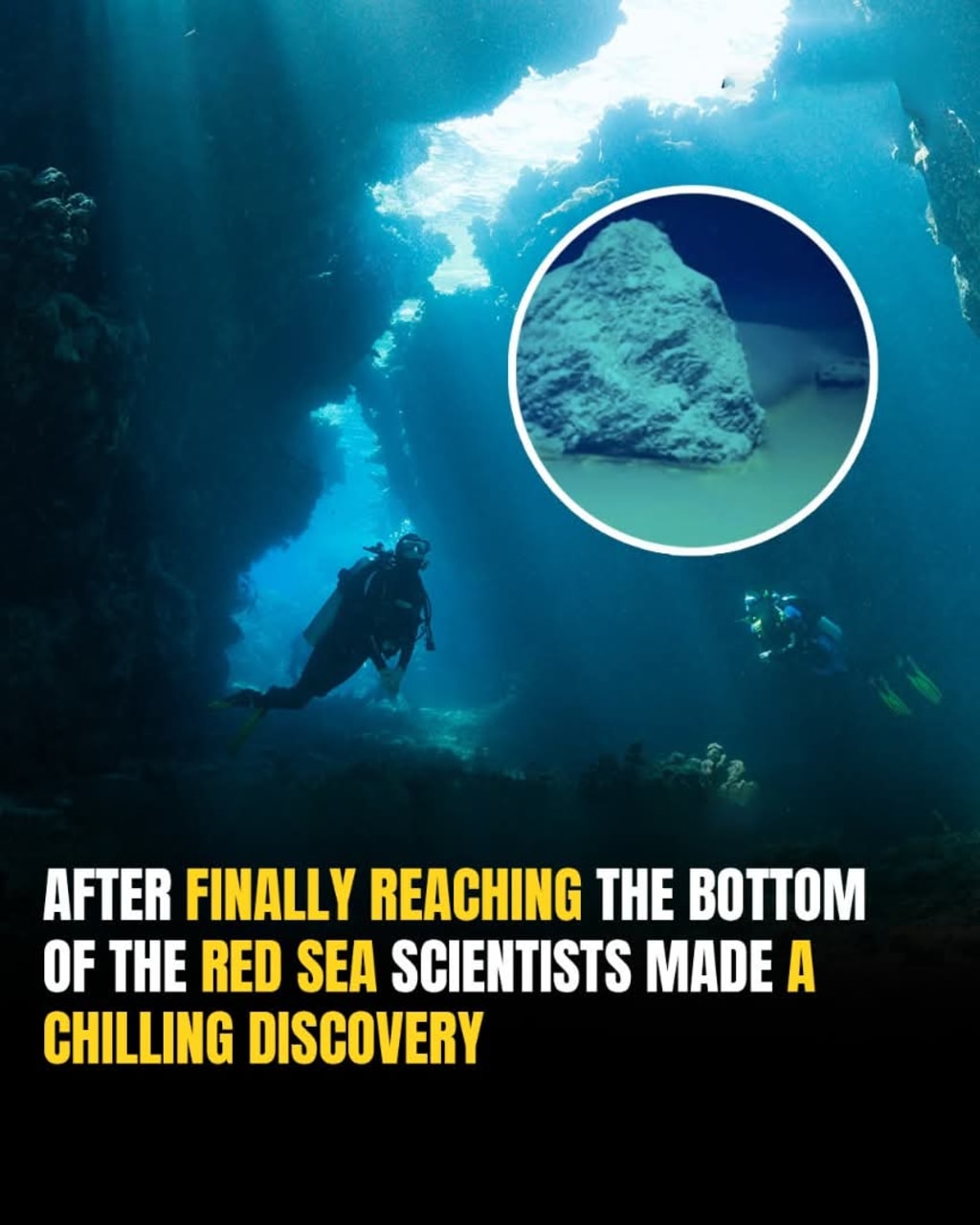
The Red Sea has long captivated scientists and adventurers alike. With its intense salinity, unique marine biodiversity, and biblical history, it’s a place that seems almost otherworldly. For decades, researchers have speculated about what might be hidden in its deepest depths — but reaching the sea’s bottom has always posed a major challenge due to extreme conditions, crushing pressure, and unexplored underwater terrain.
But in a recent breakthrough expedition, scientists finally descended into one of the deepest parts of the Red Sea — and what they discovered left even seasoned researchers stunned. It wasn’t just the strange topography or exotic marine life. It was something far more unsettling: a lifeless zone so hostile, so devoid of oxygen, and so toxic that it could instantly kill most known forms of life.
This is the story of the brine pools at the bottom of the Red Sea — a natural wonder and a scientific enigma, one that may hold secrets about the origins of life, death, and the very extremes of survival.
Descending Into the Abyss
Using advanced submersible drones and deep-sea robotics, the scientific team dove thousands of meters below the Red Sea’s shimmering surface. At these depths, sunlight disappears, temperatures drop, and water pressure becomes extreme. The goal: to explore the brine pools — deep pockets of water that are denser, saltier, and chemically distinct from the surrounding sea.
These brine pools are not just rare; they are biologically alien. They contain almost no oxygen, are loaded with toxic chemicals like hydrogen sulfide and methane, and reach salt concentrations over five times higher than regular seawater. In short, they are lethal — and eerily silent.
The Zone Where Life Ceases to Exist
What makes the Red Sea brine pools chilling is not only what scientists found there — but also what they didn’t. These pools are literal “dead zones.” Fish, crustaceans, and even microbes that typically thrive in extreme environments are either completely absent or exist in severely mutated forms. The toxic waters preserve carcasses in near-perfect condition because bacteria that usually cause decay cannot survive there.
Some of the creatures found near the edge of these pools had ventured too far and met a swift end, essentially mummified in place. This raised terrifying questions: How many animals — or even people — may have accidentally stumbled into these pools over centuries, lost forever in the depths?
Unraveling Ancient Secrets
In one part of the pool, scientists discovered perfectly preserved animal remains, including fish and crabs. But what really sent a shiver down their spines was the preservation of some species that had long vanished from other parts of the sea — as though the pool had frozen them in time.
Moreover, sediment cores collected from the area revealed chemical signatures that may hold records of climate shifts, massive floods, and even seismic activity dating back thousands of years. These hidden archives could help scientists reconstruct environmental events that shaped not just the Red Sea, but entire continents.
Potential for Life on Other Worlds
The chilling conditions of the Red Sea’s brine pools resemble those of extraterrestrial environments. With their extreme salinity, lack of oxygen, and toxic composition, these pools mimic the suspected conditions on moons like Europa or Enceladus — celestial bodies believed to have subsurface oceans.
If microbial life can be found here — and early signs suggest some unique, extremophile bacteria do live at the very edges — then life might also be possible in similar environments on other planets. That makes the Red Sea’s deadly zones not just terrifying, but potentially groundbreaking for astrobiology.
Why This Matters to Us
While the pools may seem distant and irrelevant to daily life, they remind us of nature’s power — and its fragility. They show us how much we still don’t know about our own planet. More importantly, they teach us about the balance between life and death, survival and extinction.
Scientists believe that by studying these brine pools, we can better understand disease-resistant microbes, toxic environments, and the biochemical roots of life itself. In the future, such knowledge could help us fight disease, clean up pollution, or even survive in extreme conditions.
A Final Word
The Red Sea’s brine pools are not just a scientific curiosity — they are a haunting reminder of how much mystery lies beneath the ocean’s surface. They offer no comfort, no color, no coral reefs — only a silent, deadly zone where even time seems to pause.
Yet within that darkness lies knowledge — and perhaps even the key to understanding where life begins, how it survives, and where it ultimately ends.
In a world obsessed with space, it turns out that some of the most mysterious frontiers are still here on Earth, hidden beneath the waves — waiting to be discovered.
About the Creator
Keep reading
More stories from DigitalAddi and writers in Journal and other communities.
The Woman Who Remembers Everything
In a world where most people struggle to recall what they had for breakfast last week, one woman has stunned scientists and the public alike with a claim that defies logic — she remembers everything. Not just the events of her childhood or key moments of her adult life, but every single second. And more astonishingly, she claims to remember her life even before birth.
By DigitalAddi7 months ago in Journal
How to Build AI Agents in 2026: Stop Coding Like It's 2024
Remember when we all thought pasting a prompt into ChatGPT was "prompt engineering"? Cute. It's 2026 now, and if your "AI" can't plan a vacation, book the flights, and argue with the airline about a refund, it's just a chatbot. Learning how to build AI agents isn't just a resume booster anymore; it's the only way to survive the "white-collar shockwave" experts warned us about.
By Sherry Walker5 days ago in Journal




Comments
There are no comments for this story
Be the first to respond and start the conversation.