
🎙️ “We’re Not Just Voices”: The Human Battle Against AI Dubbing
"We’re Not Just Voices": The Human Battle Against AI Dubbing

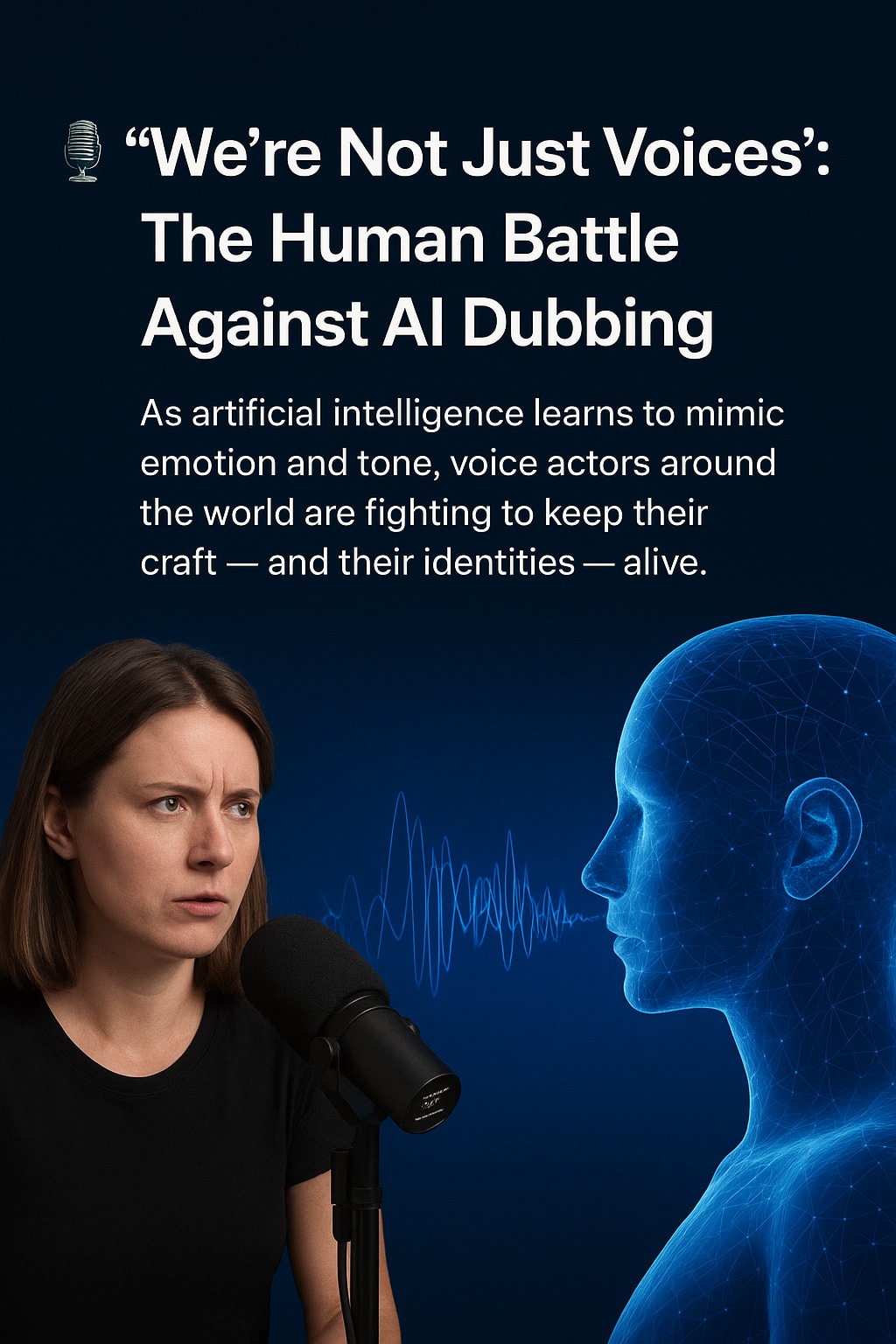
In a small sound booth in Madrid, Spanish voice actor Lara Jiménez takes a deep breath before her next line. The film is a French romantic comedy being dubbed into Spanish. She’s been working in the industry for over fifteen years — but now, for the first time, she’s competing with a machine.
Artificial intelligence can now replicate voices with astonishing precision. A single audio sample is enough for an algorithm to mimic pitch, accent, rhythm, and even emotion. Entire scenes can be dubbed in multiple languages without a human ever touching the microphone.
At first, the technology was marketed as a way to make localization faster and more affordable. But for professional voice actors, it’s starting to sound more like a threat.
“It’s not just about losing jobs,” Jiménez told reporters recently. “It’s about losing who we are. Our voices are our identity.”
🎧 The Rise of AI Dubbing
Over the past few years, startups such as DeepDub, ElevenLabs, and Papercup have introduced tools that allow studios to automatically translate and re-voice films, TV shows, and even video games.
The process is simple: an actor’s dialogue is analyzed, then “cloned” into a new language with machine learning. The AI keeps the same tone and delivery, but adjusts timing and mouth movements to match local speech patterns.
For streaming platforms like Netflix or Disney+, the benefits are clear — faster production and lower costs. A single film can now reach global audiences within days.
But for the actors whose voices are being cloned, the excitement quickly fades. Many fear they are being replaced or, worse, replicated without consent.
⚖️ The Legal and Ethical Grey Zone
Across Europe, voice-acting unions are calling for new laws that protect what they call vocal likeness rights. In France and Germany, guilds have urged regulators to include voice replication in upcoming AI legislation.
Why? Because many AI models are trained on existing performances — the very work that actors have already been paid for. If a system learns from an actor’s past recordings, and then generates a “new” version of that actor’s voice, who owns that output?
It’s a question the entertainment industry hasn’t fully answered. Some contracts now include “AI clauses,” where performers must sign away rights to their voice data. Others refuse to participate at all.
“If a machine copies your laugh, is it still yours?” one French voice actor asked during a recent union meeting. “Or is it now property of the algorithm?”
💔 Why Human Voices Still Matter
What makes this debate so powerful isn’t just the legal confusion — it’s the emotional one. Dubbing isn’t mechanical; it’s interpretive. When a Japanese actor re-voices an American character, they’re not only translating words. They’re translating emotion, rhythm, and culture.
AI can reproduce tone, but not intention. It can imitate emotion, but not understand it.
A skilled voice actor knows when to whisper a line differently because the character is nervous, or when to slightly pause to make a joke land better in another language. These are artistic decisions, not data points.
And that’s where the heart of the conversation lies: between efficiency and expression, between cost and creativity.
🔮 The Future of the Voice Industry
AI isn’t going away. Many insiders believe the future will be a hybrid model — where AI tools assist human performers, rather than replace them.
Some forward-thinking actors are even licensing their own “digital doubles,” allowing studios to use their AI voice under clear contractual terms and royalties. Others are exploring partnerships with ethical AI startups that emphasize consent and fair pay.
Still, the transition won’t be easy. Every technological revolution changes the creative industry, but few strike as personally as this one. After all, voices aren’t just instruments — they carry personality, memory, and humanity.
For now, the fight continues in studios and legal offices alike.
“Machines can learn how to sound human,” Jiménez says, “but they’ll never feel human.”
And that might be the one thing technology will never truly dub.
#AI #VoiceActing #Dubbing #CreativeRights #MediaIndustry #TechEthics #ArtificialIntelligence #DigitalVoices #FutureOfWork #HumanVsMachine
About the Creator
Shakil Sorkar
Welcome to my Vocal Media journal💖
If my content inspires, educates, or helps you in any way —
💖 Please consider leaving a tip to support my writing.
Every tip motivates me to keep researching, writing, sharing, valuable insights with you.
Keep reading
More stories from Shakil Sorkar and writers in Journal and other communities.
Elon Musk’s XOS Update: When Your Phone Starts Thinking for You
Elon Musk has done it again. Just when people thought X (formerly Twitter) couldn’t get more ambitious, Musk dropped the biggest surprise of the year: XOS, an operating system that transforms your phone into a fully integrated AI assistant — one that listens, learns, and acts, even when the screen is off.
By Shakil Sorkar4 months ago in Journal
Who is your "Person"?
It's important to recognize that you cannot go through life as easily on your own. My name is Elizabeth and I'm a survivor of child abuse and horrific trauma. Healing from trauma is not a quick fix and recognizing that it will take time, is part of the struggle.
By Elizabeth Woods4 days ago in Psyche


Comments
There are no comments for this story
Be the first to respond and start the conversation.