
Ustad Sabir Khan: A Life Shaped by Rhythm
The thirty third khalifa of the Farukhabad lineage

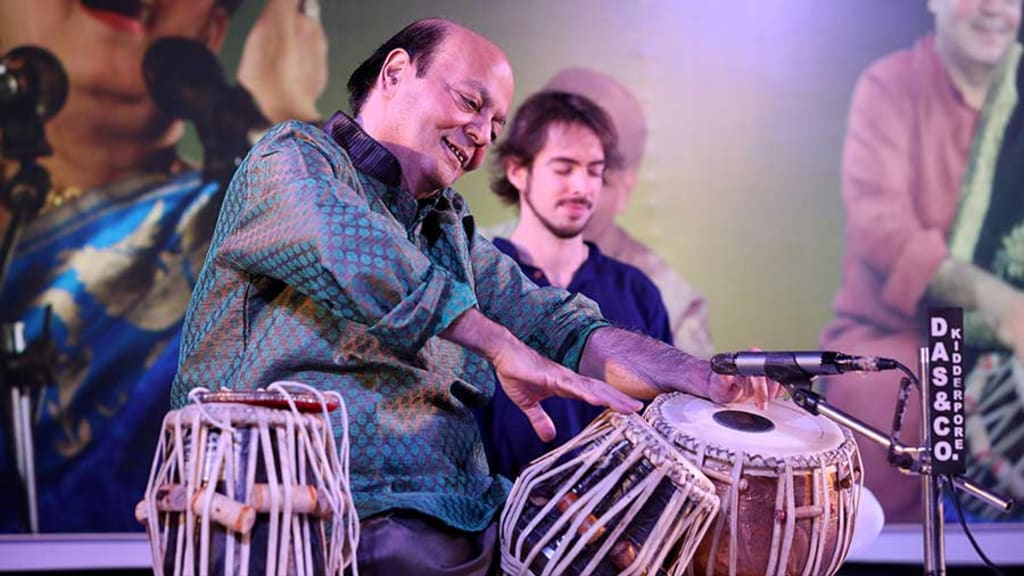
Born on 4 December 1959 in Rampur, Uttar Pradesh, Ustad Sabir Khan grew up in an environment where music was not merely a profession but an essential part of family identity. His household belonged to a lineage that had nurtured and sustained the tabla tradition for generations. Music was present in daily routines, in conversations, and in the cultural life that shaped his early years. His first exposure to the instrument came from his grandfather, the distinguished Ustad Masit Khan, whose discipline, rigour and clarity of teaching left a lasting mark on him. These formative lessons under Masit Khan provided his earliest foundation in rhythm, technique and musical sensitivity.
Following these initial years, Sabir Khan continued his training under his father, Ustad Karamatulla Khan, a highly respected exponent of the Farukhabad gharana. This gharana is known for its lyrical richness, subtlety of expression and balanced approach to both solo performance and accompaniment. Its legacy stretches back several generations, and its aesthetic values have been maintained through a continuous familial tradition. Within this lineage, Ustad Sabir Khan occupies a unique role: he is the 33rd and current khalifa of the Farukhabad gharana, entrusted with the responsibility of upholding and transmitting the tradition’s stylistic identity and interpretive depth.
Over the decades, Ustad Sabir Khan has come to be regarded as one of the leading tabla artists of his generation. He began performing professionally at a young age, demonstrating not only technical proficiency but also an instinctive ability to collaborate with senior artists. His skill as an accompanist soon drew the attention of many of the most respected figures in Hindustani classical music. He has performed with vocalists and instrumentalists alike, bringing a refined, responsive and nuanced approach to accompaniment. His playing has supported the music of Nisar Hussain Khan, Mallikarjun Mansur, Pandit Ravi Shankar, Ustad Bismillah Khan, and many others. His collaborations have continued with distinguished names including Ustad Rais Khan, Ustad Amjad Ali Khan, Pandit Hariprasad Chaurasia and Girija Devi. In each partnership, Sabir Khan’s sensitive command of rhythm and his ability to enhance a performance without overshadowing it has drawn consistent admiration.
Although deeply rooted in classical tradition, Ustad Sabir Khan has also ventured into broader musical territories. His work in film music spans multiple languages, demonstrating versatility and an openness to diverse forms of expression. He has composed for Hindi, Bengali and Tamil films such as Kaala Jal, Dhwani, Dhuratwa, Adavi Ramandu, Shankar Lal and Shruti. His compositions have also reached English-language cinema through the film Every Seventh Man is a Muslim. Beyond composition, he has contributed as a playback singer to notable films including Maqbool and Yatra. These projects reflect his willingness to adapt classical sensibilities to contemporary media while maintaining artistic integrity. Despite these varied engagements, his primary allegiance has always been to the tabla and to the classical tradition that shaped him.
His contribution to the art extends well beyond his performances. In Kolkata, Ustad Sabir Khan founded the Ustad Karamatulla Khan Music Society, an institution dedicated to the promotion, study and preservation of tabla. Through this organisation, he has trained numerous students, many of whom have gone on to establish themselves as performers in their own right. His recordings, released by major labels in India and internationally, continue to serve as valuable references for students and enthusiasts of Hindustani rhythm.
Throughout his career, Ustad Sabir Khan has been recognised by various cultural bodies for his contribution to Indian classical music. In 1976, he received the title Talmani from the Swami Haridas Sangeet Sammelan Samiti. He was later honoured as Aftab-e-Tabla at the Rampur Music Conference in 1990. This was followed by an award from Sur Singar Samsad, Mumbai, in 1991, and the Bharat Nirman Award in 2011. The Government of West Bengal has also acknowledged his contributions by producing a documentary film on his work, highlighting both his artistic achievements and his commitment to pedagogy.
In recognition of his long-standing dedication to the classical arts, and his role in sustaining the traditions of the Farukhabad gharana, Ustad Sabir Khan was presented with the Sangeet Natak Akademi Award for tabla. This honour stands as a testament to a lifetime devoted to musical excellence, cultural preservation and the continuing vitality of one of India’s most celebrated rhythmic traditions.
About the Creator
Aarohi Mehta
Aarohi is an independent journalist and art enthusiast who covers culture, creativity, and modern digital trends. She brings a fresh, expressive voice to her stories, blending clear reporting with a strong artistic perspective.
Keep reading
More stories from Aarohi Mehta and writers in Journal and other communities.
Ustad Shafqat Ali Khan: Carrying Forward a 400-Year Legacy of Classical Music
In the vast and intricate world of South Asian classical music, very few artists carry a lineage as deep or a reputation as distinguished as Ustad Shafqat Ali Khan, one of the finest contemporary exponents of the khayal tradition and an enduring representative of Pakistan’s historic Sham Chaurasi gharana. Born on June 17, 1972, Shafqat Ali Khan has spent more than four decades on stage, carrying forward a musical heritage that stretches back nearly four hundred years. His artistry, shaped by history yet alive with innovation, has made him a key figure in keeping classical music vibrant in the modern era.
By Aarohi Mehta4 months ago in Journal


Comments
There are no comments for this story
Be the first to respond and start the conversation.