
The Violet Shift That Changes the Experience of White Light
How a subtle move from 450nm to 405nm can transform visual comfort and biological response

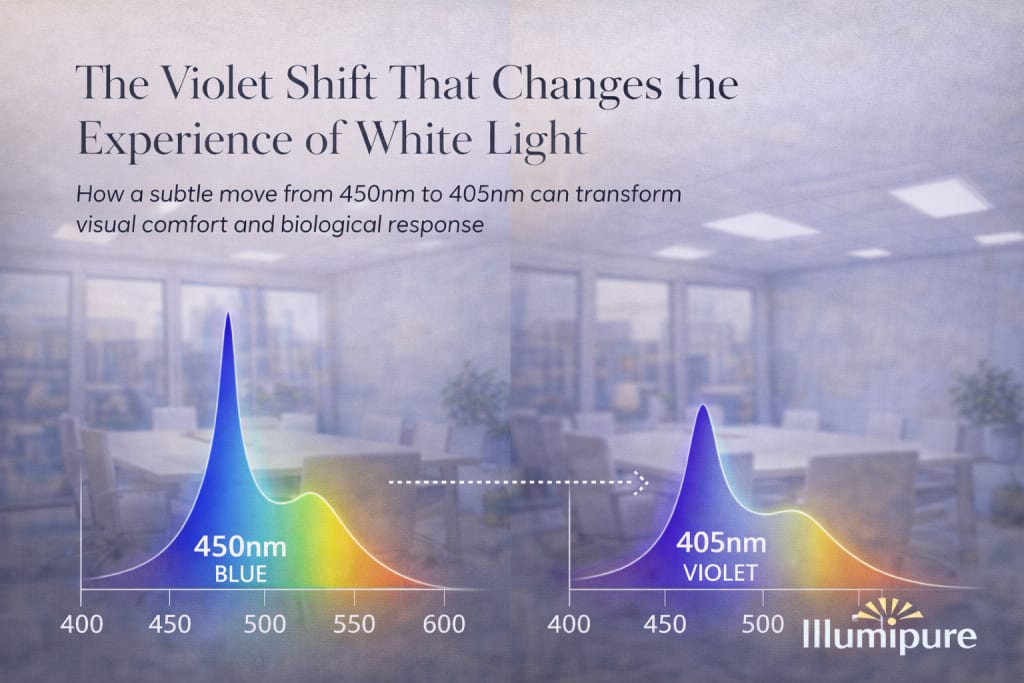
Most people think white light is simple.
If it looks white, it must be the same.
If it measures the same color temperature, it must feel the same.
But inside what appears to be identical white illumination, there can be a subtle but powerful difference — a shift in where energy is concentrated within the spectrum.
That shift can change not only how a room looks, but how it feels.
And in many cases, the difference comes down to moving from a strong 450nm blue peak to a lower 405nm violet region.
The Blue Foundation of Modern LEDs
Traditional white LEDs are built around a high-intensity blue diode centered near 450 nanometers. Phosphor coatings convert part of that blue energy into longer wavelengths, producing light that appears white.
It was a breakthrough for energy efficiency.
Bright. Low wattage. Long life.
But the spectral power distribution reveals a defining feature: a sharp spike at 450nm.
This spike falls within the high-energy visible (HEV) blue range, a region known for strong biological interaction with the retina and circadian system.
The room still looks white.
But the energy concentration tells a deeper story.
Why 450nm Feels Sharper
Short-wavelength blue light scatters more inside the eye than longer wavelengths. It refracts differently, increasing intraocular scatter and sometimes elevating perceived glare.
Even when brightness levels remain constant, a strong 450nm spike can make light feel:
Crisper.
Sharper.
More stimulating.
For short durations, that sharpness may enhance alertness.
Over extended exposure, however, the eye must work harder to stabilize incoming light. The brain must process a concentrated region of high-energy wavelengths continuously.
The result is often subtle:
Visual fatigue.
A sense of overstimulation.
Difficulty fully relaxing in the space.
It does not feel dramatic.
It feels accumulative.
What Happens When the Peak Shifts
Now imagine shifting the dominant energy from 450nm toward 405nm — a violet wavelength still within the visible spectrum, but lower in energy and positioned differently in relation to retinal sensitivity.
The room still appears white.
Brightness can remain high.
Color rendering can remain strong.
But the distribution of energy changes.
This shift reduces the intensity of the narrow high-energy blue spike while allowing light to remain visually clean and balanced.
The experience changes in ways that are often difficult to describe — but easy to feel.
The light feels steadier.
Less piercing.
More natural.
Your eyes do not tighten as quickly.
Your focus feels sustained rather than forced.
The Biological Layer
The retina contains specialized cells that respond strongly to short-wavelength blue light, especially in the region around 440–455nm.
These cells influence alertness, hormone regulation, and circadian rhythm.
When that region is heavily emphasized in artificial lighting, the body receives a strong daytime stimulation signal.
Shifting toward 405nm changes the nature of that stimulation.
It remains bright.
It remains effective.
But the biological emphasis softens.
Instead of concentrating energy where retinal sensitivity is highest, the spectrum becomes more distributed.
The nervous system perceives less abrupt stimulation.
The visual system requires less compensation.
Why the Difference Is Subtle but Meaningful
The violet shift does not make a room dimmer.
It does not dramatically change color temperature.
It does not remove the appearance of white light.
Instead, it changes the structure beneath the appearance.
And structure matters.
Two rooms can both be labeled 4000K.
Both can deliver the same lux levels.
Yet the room with a heavy 450nm spike may feel slightly sharper, more stimulating, even slightly fatiguing over time.
The room with a violet-shifted spectrum may feel calmer, more stable, and easier to occupy for long hours.
This is not about warmth versus coolness.
It is about spectral architecture.
Light as Engineering, Not Just Illumination
For decades, lighting design focused on two primary goals:
Efficiency.
Brightness.
But the future of lighting is expanding that focus.
Now the question becomes:
How does the light interact with human biology?
How does its spectral composition influence long-term exposure?
How does it support the eye, not just illuminate the desk?
A violet shift represents a move toward that broader understanding.
It recognizes that white light is not just a color.
It is a distribution of energy.
And where that energy sits matters.
The Experience of Balanced White
When the spectral peak shifts, the change is rarely dramatic.
You may not immediately say, “This light is different.”
Instead, you may notice what does not happen.
Your eyes do not strain as quickly.
Your head does not feel subtly tight by late afternoon.
Your body does not remain in a mild state of stimulation.
The room feels balanced.
White light still fills the space.
But the experience is smoother.
And that subtle smoothness accumulates across hours, days, and years of exposure.
White light is not a single thing.
It is a design decision.
And sometimes, the smallest shift — from blue toward violet — is enough to change how a space feels to the human body.
Not brighter.
Not dimmer.
Just better aligned with the way we see, process, and live under light.
About the Creator
illumipure
Sharing insights on indoor air quality, sustainable lighting, and healthier built environments. Here to help people understand the science behind cleaner indoor spaces.
Keep reading
More stories from illumipure and writers in Journal and other communities.
What Happens to Your Eyes Under a 450nm Spike
You don’t see the spike itself. You see white light. Clean. Neutral. Bright. But embedded inside much of modern LED lighting is a narrow concentration of energy centered around 450 nanometers — a region of high-energy visible blue light. It became standard not because it was biologically ideal, but because it was efficient.
By illumipurea day ago in Journal




Comments
There are no comments for this story
Be the first to respond and start the conversation.