
Uncovering the Mind: Alzheimer’s Disease Diagnostics Market Hits $15.57 Billion – Key Players Include Roche, Biogen, and Canon Medical Systems
Alzheimer’s has become one of the most common, severe, and fastest-growing neurological conditions in the world as the population ages rapidly across the globe.

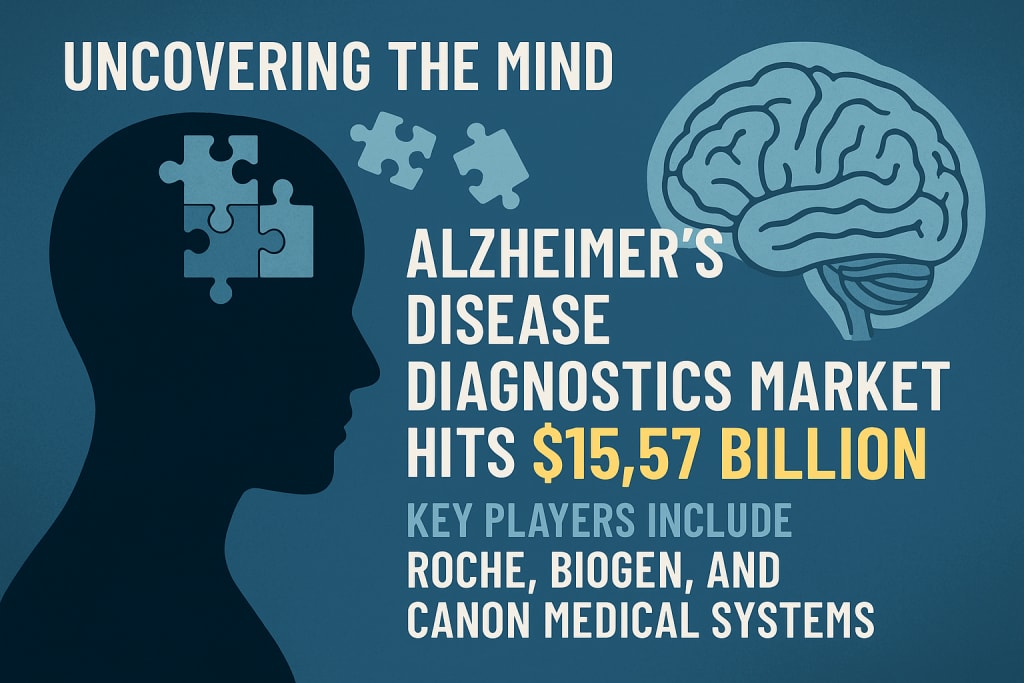
By 2030, the global market for Alzheimer’s disease diagnostics will reach valuation of $15.57 billion, propelled by a combination of medical innovation, early detection initiatives, and an increasing global burden of disease. Companies like Roche, Biogen, and Canon Medical Systems are at the forefront, driving advancements in diagnostic technologies that aim to detect the disease sooner, more accurately, and at lower cost.
The Critical Case for Earlier Diagnosis
Globally, over 55 million people are living with Alzheimer’s disease, with an expected jump to nearly 130 million by 2050. Diagnoses are usually made at moderate to late stages of disease progression, but the neurodegenerative processes often begin many years before a patient’s first symptoms. This presents a critical opportunity to identify patients earlier, when therapeutic interventions and lifestyle changes may be able to slow cognitive decline and improve overall patient outcomes.
An expanding pipeline of disease-modifying therapies and Alzheimer’s clinical trials are applying more pressure on the healthcare industry to develop more sensitive and quantitative methods of patient identification years earlier, and even before symptoms first appear. The combination of these trends is transforming the Alzheimer’s diagnostics space from a field focused on diagnosis of advanced disease, to one that is increasingly focused on prevention.
Get Sample Brochure at https://www.theresearchinsights.com/request_sample?id=68
Market Growth Drivers
Aging Global Population
Increased life expectancy has been accompanied by a rise in age-related neurological disorders. The growing demographic of people over age 65 is a primary driver of demand for Alzheimer’s disease screening solutions.
Rise of Biomarker-Based Diagnostics
Novel cerebrospinal fluid (CSF) biomarkers, such as amyloid beta and tau proteins, and emerging blood-based biomarkers are fueling innovation in diagnostic accuracy.
Advancements in Neuroimaging
PET scans, MRI, and AI-based brain imaging analysis software is allowing for earlier and more accurate diagnosis at structural and molecular levels.
Government and Research Funding
Major public-private government efforts to scale up dementia clinical research, such as the U.S. National Plan to Address Alzheimer’s Disease, are spurring research and clinical infrastructure.
Integration with AI and Digital Health Platforms
AI-based machine learning is being applied to speech, facial recognition, and mobile cognitive test apps for early-stage Alzheimer’s detection, making diagnostics more scalable and accessible.
Market Leaders in Alzheimer’s Disease Diagnostics
Roche
Roche is a prominent player in the space, offering a suite of molecular diagnostics including the Elecsys® beta-Amyloid (1-42) and Total Tau CSF immunoassays for the earlier identification of Alzheimer’s biomarkers.
Biogen
Biogen, maker of the highly controversial Aduhelm Alzheimer’s treatment, is a major Alzheimer’s research company that is investing more resources into their own diagnostics and digital biomarkers to round out an integrated diagnostic-treatment pipeline.
Canon Medical Systems
Canon Medical Systems offers PET and MRI solutions with high resolution 3D and 4D brain imaging. Canon has also developed AI-based diagnostic support software, and neuroimaging can be useful for earlier detection.
Other companies include:
GE Healthcare and Siemens Healthineers – MRI and PET/CT imaging solutions
C2N Diagnostics – Blood-based Alzheimer’s testing, developer of PrecivityAD™ blood test for early detection
Eli Lilly – Investing in biomarker R&D, and imaging partnerships for their drug development efforts
Regional Market Shares
North America represents the largest share of the global market, buoyed by a well-established healthcare infrastructure, a large and ongoing number of clinical trials, and public awareness and interest.
Europe follows close behind with high numbers of active research networks and the presence of dementia screening reimbursement frameworks.
Asia-Pacific is one of the fastest-growing regions, led by Japan and China with large aging populations and increased access to diagnostics.
Challenges Within the Diagnostic Journey
The market for Alzheimer’s disease diagnostics has seen robust growth over recent years, but there are still a number of important barriers to overcome:
Cost and Accessibility: Advanced neuroimaging and CSF biomarker testing is very expensive and remains largely inaccessible in low- and middle-income countries.
Lack of Standardization: No unified diagnostic criteria have been established, and few blood-based or imaging tests have been cross-validated, making it difficult to interpret or compare results from clinic to clinic or region to region.
Patient Stigma, Shame and Fear: Patients may avoid getting tested for long enough that early-stage diagnostic technologies become less useful and relevant for their condition.
Precision, Integration & Accessibility: The Alzheimer’s diagnostics market in the future is likely to see benefits from these trends
Blood-Based Biomarkers
Blood-based tests like the PrecivityAD™ test from C2N Diagnostics are less invasive and more scalable than traditional CSF testing.
AI-Driven Platforms
AI and machine learning are being applied to early-stage Alzheimer’s detection through analysis of speech patterns, mobile memory tests, and brain scans.
Point-of-Care / At-Home Screening Tools
Consumer-facing risk-screening tools and point-of-care tools for primary care clinics may enable earlier and more widespread screening.
Conclusion
At $15.57 billion, the Alzheimer’s disease diagnostics market has reached a critical inflection point in its development, as early, precise, and accessible diagnosis is becoming a primary focus. As pharmaceutical research and therapeutic interventions continue to evolve and improve, the efforts of companies like Roche, Biogen, and Canon Medical Systems have been shining a light not just into the shadowy recesses of the human mind, but also into the window of a better future for patients.
About the Creator
Silvie Karson
Passionate storyteller exploring the world of trends. With a background in digital marketing, I craft compelling narratives that inform and inspire. Whether diving into deep-dive features, growth analysis, or trend analysis.
Keep reading
More stories from Silvie Karson and writers in Journal and other communities.
The Rise of Veterinary 3D Printing: A $196.2 Million Market Revolutionizing Animal Healthcare – Led by 3D Systems, Formlabs, and Materialise
Amid the ongoing tech revolution in the veterinary industry, one area has already gone mainstream while also showing strong growth potential: 3D printing. Veterinary 3D printing has shifted from a novelty and moved into the fast lane, with a global veterinary 3D printing market that could expand to $196.2 million by 2030, driven by technological advances, increased demand for personalized treatments, and a new frontier in animal healthcare.
By Silvie Karson7 months ago in Journal
How to Build AI Agents in 2026: Stop Coding Like It's 2024
Remember when we all thought pasting a prompt into ChatGPT was "prompt engineering"? Cute. It's 2026 now, and if your "AI" can't plan a vacation, book the flights, and argue with the airline about a refund, it's just a chatbot. Learning how to build AI agents isn't just a resume booster anymore; it's the only way to survive the "white-collar shockwave" experts warned us about.
By Sherry Walker6 days ago in Journal




Comments
There are no comments for this story
Be the first to respond and start the conversation.