
The Rise of Veterinary 3D Printing: A $196.2 Million Market Revolutionizing Animal Healthcare – Led by 3D Systems, Formlabs, and Materialise
Veterinary 3D printing is here to stay and is making a difference.

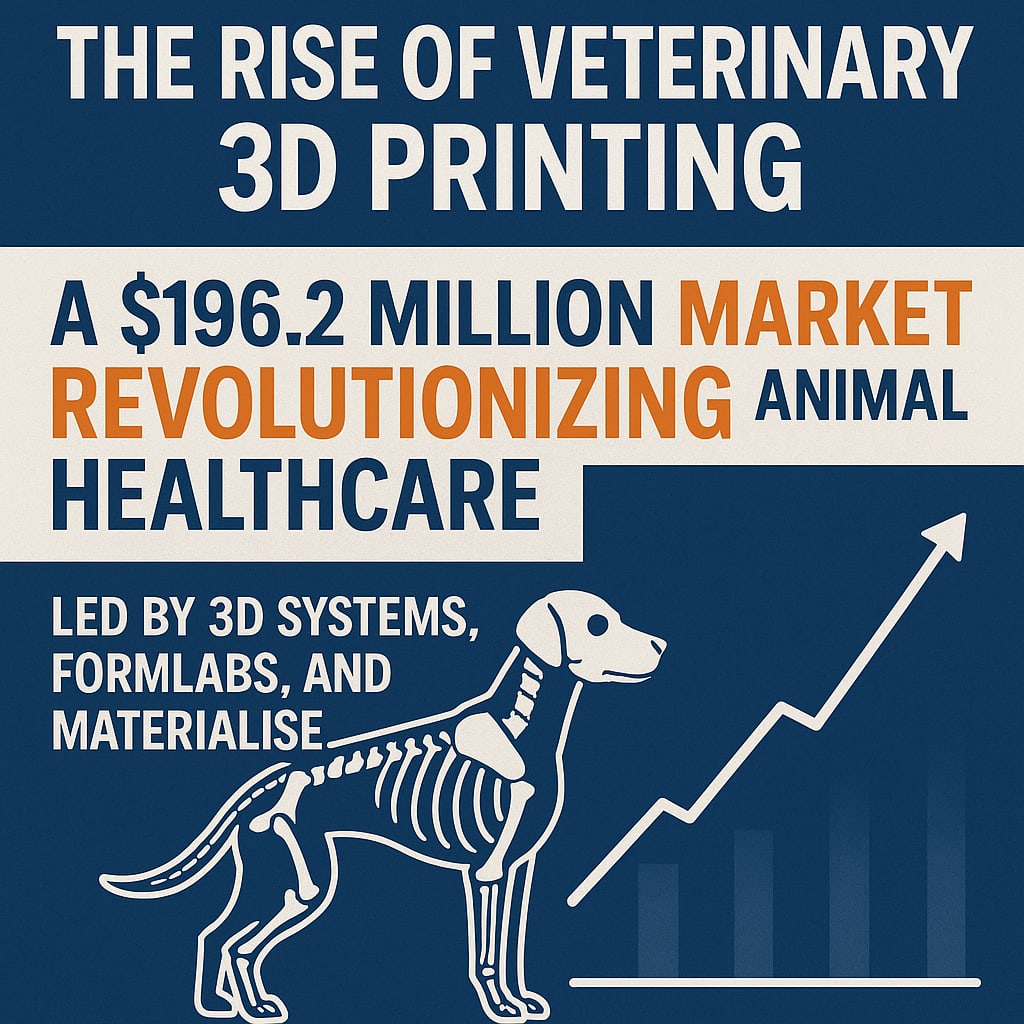
Amid the ongoing tech revolution in the veterinary industry, one area has already gone mainstream while also showing strong growth potential: 3D printing. Veterinary 3D printing has shifted from a novelty and moved into the fast lane, with a global veterinary 3D printing market that could expand to $196.2 million by 2030, driven by technological advances, increased demand for personalized treatments, and a new frontier in animal healthcare.
Now, more than ever, industry-leading 3D printing companies such as 3D Systems, Formlabs, and Materialise are making their mark, providing veterinarians with advanced tools and techniques for improved diagnostics, treatment, and surgical applications.
Veterinary 3D Printing Market Overview
3D printing, or additive manufacturing, is the process of fabricating objects in a layered manner using digital files and specialized hardware. Models are constructed from bottom to top through computer-guided extrusion of materials, allowing the creation of highly precise, customized, and intricate structures that are difficult or impossible to make by traditional methods.
In the veterinary space, the technology is finding many applications and products that make procedures easier, more affordable, and tailored to the individual needs of animals of all sizes, species, and conditions.
From orthopedic surgery to prosthetics, dental care to trauma reconstruction, veterinarians are using 3D printing to transform their treatment process and help more animals in need. Veterinary 3D printing also has use cases for the better training of new veterinarians and veterinary students.
Veterinary 3D printers are used to print patient-specific anatomical models from CT or MRI imaging, surgical guides, planning tools, and patient-specific implants. The insights provided by these models allow clinicians to increase diagnostic and treatment accuracy, streamline their surgical planning, and even rehearse complex operations in advance, decreasing operating time and stress on animals during procedures.
In orthopedics, for example, the ability to produce fully customized bone implants for patients has dramatically improved recovery from trauma or congenital joint or bone issues, and continues to find new applications in animal trauma care, joint reconstruction, and more across companion animals, livestock, and exotic species.
Get Sample PDF Copy at https://www.theresearchinsights.com/request_sample?id=67
Veterinary 3D Printing Market Drivers: Precision, Personalization & Pet Care Boom
As the number of people who consider their pets as family members (instead of property or livestock) continues to grow, so does their willingness to spend money on premium pet care, with an emphasis on personalization and results.
The spending in the U.S. pet industry, for example, is estimated to have crossed the $143 billion mark for the first time in 2023, with advanced veterinary services (i.e. diagnostic and treatment modalities that go beyond the standard care level) set to capture an increasing share.
In addition, a new generation of owners is also willing to pay for premium, personalized products and services such as those enabled by 3D printing.
Factors driving the adoption of veterinary 3D printing include:
Increase in pet ownership & spending: Pets are being treated more and more like members of the family, with owners seeking the best care and highest quality life for their animals. The need for customized implants, prosthetics, etc. can be higher in companion animals.
Demand for customized implants & prosthetics: 3D printing enables fully customized implants, reducing risks and increasing the chance of successful healing. Custom prosthetics are also seeing increased demand for pets and livestock with congenital defects, injuries, or amputations.
Veterinary education & surgical planning: Veterinary schools and teaching hospitals are utilizing 3D-printed models for training new veterinarians and veterinary students.
Efficiency & cost-savings: Faster turn-times and fewer resources are wasted.
Top Applications in the Veterinary 3D Printing Market
- Orthopedic implants and surgical guides
- Prosthetics for amputated limbs and deformities
- Dental implants and surgical planning tools
- Skull, jaw, and spine reconstruction models
- Pre-surgical models for complex tumor removals
- Tissue scaffolds for regenerative procedures (still in early R&D phase)
Veterinary 3D Printing Market Leaders and Innovations
Veterinary 3D printing has been embraced by most of the top manufacturers in the industry to some degree.
3D Systems, for example, has been at the forefront of the space for some time, producing high-resolution printers and bio-compatible materials for veterinary orthopedics and dental procedures.
Formlabs is known for its user-friendly desktop 3D printers, which have found a home in many veterinary clinics. These machines are often used for printing anatomical models and surgical guides, and Formlabs’ resins are known for their balance of precision and affordability.
Materialise is another key player that specializes in creating patient-specific implants and pre-surgical planning services, based on the medical imaging data of the patient. Materialise has developed veterinary-specific software platforms that make it easier to turn the scans into printable files with the needed clinical precision.
Other players in the space include Stratasys, Ultimaker, Voxeljet, and more, each carving their own space in terms of price competitiveness and innovation in biocompatible materials.
Regional Outlook
North America is the current leader in the global veterinary 3D printing market, thanks to high spending on pet care, the presence of an advanced veterinary infrastructure, and the maturity of the regional 3D printing ecosystem.
Europe is another region where the industry is expected to grow in coming years, in line with investments in veterinary hospitals and technology.
Asia-Pacific is also an emerging region, with Australia, Japan, and South Korea serving as centers of activity, both in the companion animal and livestock sectors.
Veterinary 3D Printing Market Challenges and Future Opportunities
Adoption of the technology in the veterinary space, however, is not without challenges, including the relatively high set-up costs of printers, training required for the practitioners to operate them, and regulations around medical-grade 3D printing for animals.
Future developments such as innovations in bio-compatible printing materials, cloud-based design software and platforms, and integration of AI and machine learning for better imaging and model generation have the potential to overcome these barriers and even open up new opportunities for applications like bioprinting for veterinary regenerative medicine in the future.
Conclusion
A once-future concept that has now become a reality is transforming how animals are treated, from the family pet to farm animals. Veterinary 3D printing helps with faster diagnostics, improved surgical outcomes, and more personalized treatment. In a market that will continue to grow and mature, established leaders like 3D Systems, Formlabs, and Materialise are at the cutting edge of development, with their contributions to the industry being seen, literally, layer by layer.
About the Creator
Silvie Karson
Passionate storyteller exploring the world of trends. With a background in digital marketing, I craft compelling narratives that inform and inspire. Whether diving into deep-dive features, growth analysis, or trend analysis.
Keep reading
More stories from Silvie Karson and writers in Journal and other communities.
Dopamine Agonist Market Grows to $1.83 Billion Amid Rising Parkinson’s Cases – Led by Pfizer, Novartis, and Teva Pharmaceuticals | The Research Insights
The global dopamine agonist market is anticipated to grow to 1.83 billion by 2030 with the rapid increase in Parkinson’s cases and an expanding focus on neurological care worldwide. Dopamine agonists drugs or therapies work to mimic the neurotransmitter dopamine in the brain. The medications are now used to manage restless legs syndrome, Parkinson’s disease, hyperprolactinemia, and pituitary prolactin-secreting tumors. Key manufacturers, such as Pfizer, Novartis, and Teva Pharmaceuticals, are currently focusing on R&D and modernizing distribution to improve product accessibility and therapy outcomes for patients globally.
By Silvie Karson7 months ago in Journal
The goals I did not achieve
Every writing goal I made for the year is a wash. It has been this way for a while, but I think it's important to be open about my failures and the reality of how life can get in the way. This is especially true considering the several times I have posted on Vocal about my writing goals, how I was changing my approach, and where I was hoping to be for the upcoming year. I will probably do that again in a couple months, but for now, it is time to acknowledge where I am today.
By Kay Husnick24 days ago in Journal




Comments
There are no comments for this story
Be the first to respond and start the conversation.