
UI for AI Agents: What’s Working in 2026
Designing UI for AI agents in 2026 requires new approaches. This article explores what’s working today, from agentic interfaces and trust design to practical GenUI patterns.

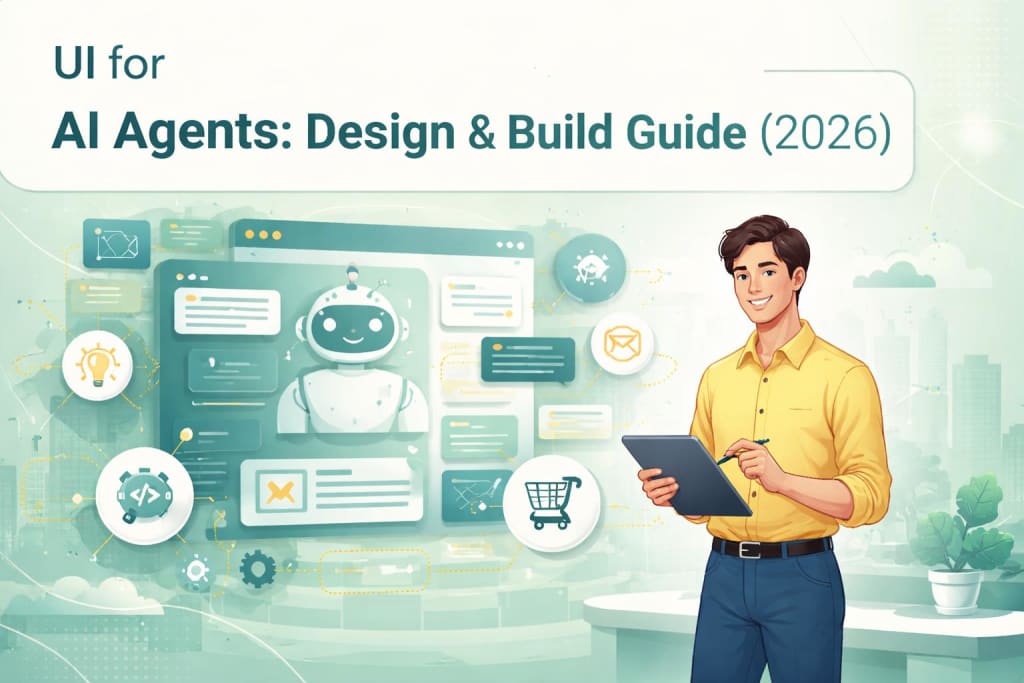
You reckon designing for AI agents is just slapping a chat window on your app? Mate, we're way past that now.
2026 hit different. The whole UI game flipped when AI agents stopped being glorified chatbots and became actual autonomous teammates. I've spent the past few months neck-deep in agentic design work, and let me tell you, the old playbooks? Completely useless.
Thing is, when you're building UI for AI agents, you're not designing for humans anymore. Well, you are, but you're also designing for systems that think, decide, and act on their own. Wild, right?
The Big Shift Nobody Saw Coming
Here's what's mental about 2026. According to research from UX Tigers, this is the year we finally moved from Conversational UI to Delegative UI. That's proper fancy talk for saying we stopped asking AI questions and started giving it actual jobs to do.
Chris Hay from IBM nailed it when he said during a recent podcast, "We're seeing the rise of what I call the 'super agent.' In 2026, I see agent control planes and multi-agent dashboards becoming real."
And he's spot on. I'm seeing it everywhere. The interfaces that work now? They're the ones treating AI like a coworker, not a search bar.
What Makes Agent Interfaces Actually Work
Let me break down what's working in the real world, not just in some designer's Figma fever dream.
Trust Is Everything (And It's Fragile as Hell)
Users don't trust black boxes. Period. Research from Codewave shows trust is the primary challenge when designing agentic AI interfaces. Makes sense, yeah? If something's making decisions for you, you better know why.
The interfaces crushing it right now show their work. They've got visible thought logs, plain-English explanations, and—this is crucial—easy undo buttons. Because when your AI agent accidentally books you a flight to Sydney instead of Sussex, you need that sorted quick smart.
Generative UI Is Here (Finally)
Jakob Nielsen predicted this ages ago, but 2026 is when it actually landed. Generative UI means the interface itself gets created on the fly based on what you're trying to do.
So instead of clicking through seventeen menus to dispute a charge, the AI predicts your intent and generates a custom interface with just what you need. According to UX Tigers research, this works because latency for code generation has dropped to milliseconds. Fast enough that it feels instant.
Proper game-changer, that.
The Multi-Agent Dashboard Revolution
Single agents are old news. What's working now is orchestrated teams of specialized agents. MachineLearningMastery reported a staggering 1,445% surge in multi-agent system inquiries from Q1 2024 to Q2 2025.
Here's the thing though. Managing multiple agents needs a different kind of interface. You can't just have five chat windows open. Teams working with app development company california figured this out early on, building unified dashboards where you assign tasks to different agents but monitor everything from one place.
Smart approach, that.
What Designers Are Getting Wrong
I've seen heaps of teams faceplant this year. Here's what's not working.
Hiding the AI's reasoning. Users hate mysterious decisions. If your agent does something unexpected and doesn't explain itself, trust vanishes faster than my motivation on a Monday morning.
Making undo too complicated. When an agent screws up (and they will), fixing it should take one click. Two max. Anything more and users feel trapped. Codewave research shows this is where most interfaces fail.
Treating intent like it's simple. Users express goals, not tasks. "Book me a flight" could mean fifty different things depending on context. The interfaces that work lean into this ambiguity instead of fighting it.
The Future's Weird (In a Good Way)
Designer Tejj wrote something that stuck with me: "In 2026, designers stand between humans and increasingly autonomous systems. They translate messy intent into safe action."
That's exactly it. We're not pixel pushers anymore. We're building trust frameworks, designing for systems that learn, and figuring out how to keep humans in control of increasingly autonomous tech.
The global UX services market getting projected to jump from USD 4.68 billion in 2024 to USD 54.93 billion by 2032 tells you everything. According to Motiongility research, this growth isn't just about more designers. It's about fundamentally different work.
What's Coming Next
The agentic AI market itself? Going from $7.8 billion now to over $52 billion by 2030, per MachineLearningMastery data. And Gartner reckons 40% of enterprise applications will have embedded AI agents by the end of this year.
That means most of us will be designing agent interfaces whether we planned to or not.
Here's what I'm watching for the rest of 2026:
Explainable AI becoming standard. Not a nice-to-have. Every action needs a clear explanation in human language.
Zero UI experiments. Voice and gesture interactions replacing screens for certain tasks. Weird but inevitable.
Agent personality customization. Users want their AI teammates to feel familiar. Some companies are already letting you adjust how formal or casual your agent sounds.
Getting It Right
If you're building UI for AI agents right now, here's what actually matters.
Make reasoning visible. Users need to see why the agent chose option A over option B. Build it into the interface from day one.
Design for failure. Your agent will mess up. Make recovery effortless, not optional.
Start small. Don't try to build a super agent on day one. Pick one task, nail that, then expand.
Test with real humans in messy situations. Lab testing won't cut it. You need to see how people react when things go sideways.
The Bottom Line
Designing UI for AI agents in 2026 feels less like traditional UX work and more like building trust systems for autonomous teammates. The interfaces winning right now prioritize transparency, make undo easy, and treat user intent as the messy, complicated thing it actually is.
We're not designing screens anymore. We're designing relationships between humans and systems that can think for themselves.
Bit weird when you put it like that. But also bloody exciting.
The old rules don't apply. Static interfaces are done. One-size-fits-all is finished. The UI that works now? It adapts, explains itself, and knows when to shut up and let the agent do its thing.
Welcome to 2026. Things just got interesting.
About the Creator
Keep reading
More stories from Sherry Walker and writers in Journal and other communities.
Pakistan’s Mineral Exports Could Hit $6–8 Billion Annually With Value Addition: Ahsan Iqbal
ISLAMABAD — Pakistan’s mineral sector holds immense promise, and with a strategic shift toward value addition, the country could see its mineral exports surge to between $6 billion and $8 billion per year by the end of the decade, Federal Minister for Planning and Development Ahsan Iqbal said on Wednesday. Speaking at the Pakistan–China Mineral Cooperation Forum in Islamabad, Iqbal outlined a vision for transforming Pakistan’s historically under‑utilised mineral wealth into a linchpin of export‑led growth.
By Salaar Jamalia day ago in Journal



Comments
There are no comments for this story
Be the first to respond and start the conversation.