
Trump vs. Marjorie Taylor Greene
When the MAGA House Starts to Crack

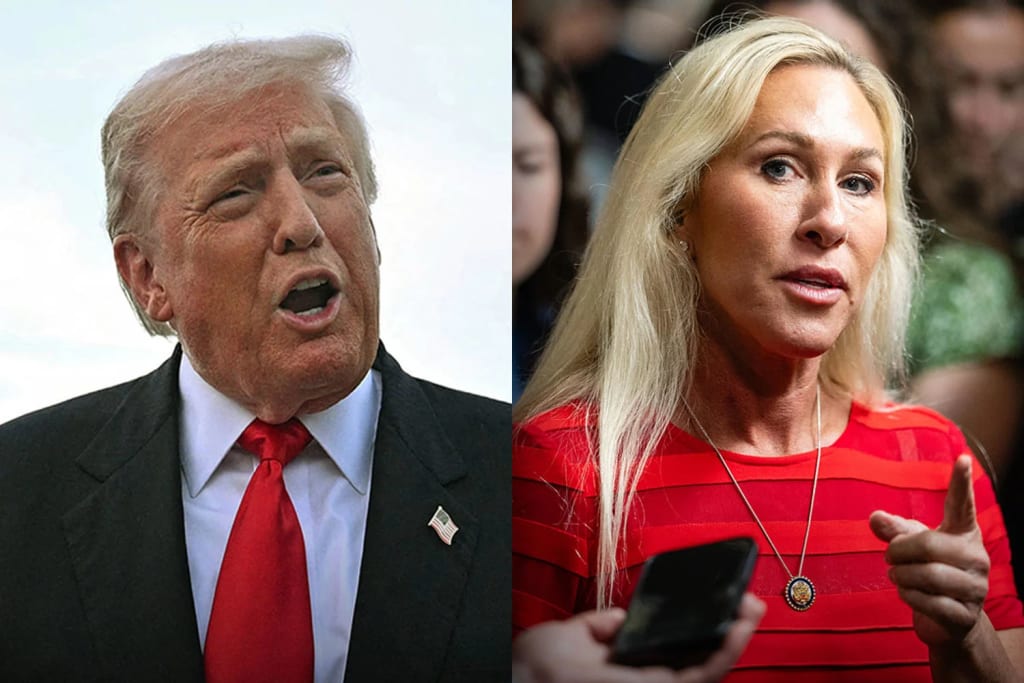
In American politics, where alliances are forged in the heat of passion and broken in the cold light of ambition, a new rift has emerged in the once ironclad walls of MAGA unity. On Monday, November 10, 2025, former President Donald Trump fired a warning shot — not at the Democrats, not at the media, but at one of his most vocal loyalists: Rep. Marjorie Taylor Greene (R-Ga.).
“She’s lost her way,” Trump said, almost with the weariness of a teacher disappointed in a star pupil.
For a man whose political empire was built on unshakable loyalty, this was no small remark.
So what happened between the MAGA general and one of his fiercest foot soldiers? Let’s break it down — not just as a political feud, but as a sign of shifting tides in the populist right that has defined American politics for the past decade.
The Rift: A Family Argument in Public
The setting was as symbolic as it was political — the Oval Office. Trump, now back in power during his second term, stood before reporters when he dropped his comment about Greene. His tone wasn’t fiery. It was reflective, even slightly melancholic.
“I don’t know what happened to Marjorie,” he said. “She’s a nice woman, but I don’t know what happened. She’s lost her way, I think.”
In the world of Trumpian rhetoric, those words hit harder than a thousand tweets. To say someone “lost their way” is to question their loyalty — the ultimate sin in the MAGA movement.
But Greene, never one to back down, hit back swiftly.
“I haven’t lost my way,” she declared. “I’m 100% America First and only!”
Her retort was vintage Greene — brash, unapologetic, and fiery.
And just like that, a fissure opened up between two titans of the modern conservative base.
The Spark: Foreign Policy and “America First” Identity
At the heart of their clash is a debate as old as politics itself: Should America lead the world, or mind its own house first?
Greene had taken to X (formerly Twitter) earlier that day to criticize the White House for hosting a bilateral meeting with Syrian President Ahmad al-Sharaa, a controversial figure and former jihadist turned political leader. The meeting was expected to focus on strengthening a U.S.-led coalition against the Islamic State.
“I pray the persecution ends, not only in Syria, but all around the world,” Greene wrote. “However, I would really like to see nonstop meetings at the WH on domestic policy, not foreign policy and foreign country’s leaders.”
Her message was clear: America should fix itself before fixing the world.
But Trump, a man who once built his campaign on the “America First” slogan, now views the presidency through a broader, more global lens.
“I have to view the presidency as a worldwide situation, not locally,” he told reporters. “We could have a world that’s on fire, where wars come to our shores very easily if you had a bad president.”
For Trump, global engagement isn’t betrayal — it’s insurance.
For Greene, it’s distraction.
And in that tension lies the soul of the MAGA divide.
When “America First” Starts to Mean Different Things
What does “America First” mean in 2025?
That’s the question tearing through conservative circles like a quiet storm.
For Trump, the phrase has evolved. During his first presidency, it meant renegotiating trade deals, closing borders, and reducing foreign entanglements. But in his second term, “America First” seems to mean using global influence to protect American interests abroad — a pragmatic nationalism rather than isolationism.
Greene, however, is holding onto the ideological purity that launched her into Congress: a grassroots populism that distrusts the global stage entirely.
She’s the voice of small-town America — the voter who sees foreign aid as a betrayal, international diplomacy as elitist theater, and domestic struggle as the only battlefield that matters.
That’s why she lashed out not just at Trump’s meeting with al-Sharaa, but at what she sees as a shift in focus away from the kitchen-table issues that got Trump elected twice.
“She’s Now Catering to the Other Side”
Trump didn’t mince words in his follow-up comments either.
“She’s now catering to the other side,” he said, with a hint of disbelief. “You know, it’s easy to say, ‘Oh, don’t worry about the world,’ but the world is turning out to be our biggest customer. The world was on fire, and we could have been in that fire very easily.”
That statement wasn’t just defensive — it was strategic. Trump was reasserting himself as a global power player, subtly contrasting his worldview against Greene’s provincialism.
In his mind, America’s prosperity isn’t isolated — it’s linked to trade, alliances, and influence.
Greene’s Pushback: Populism Reborn
Greene’s criticism of Trump didn’t end with foreign policy. She’s also taken aim at the Republican establishment — including her own party — for its handling of the ongoing government shutdown that began on October 1.
Appearing on ABC’s “The View”, she didn’t hold back:
“It’s an embarrassment that the Republican-controlled House was not in session more than a month after the federal government shut down.”
She also told NBC News that while she gives Trump “some credit” on fighting inflation, her constituents are still “really struggling.”
That’s a bold statement for a Republican from deep-red Georgia — and an even bolder one when aimed at Trump himself.
A recent NBC News national poll supports her sentiment: roughly two-thirds of registered voters believe Trump hasn’t fulfilled campaign promises tied to the economy and cost of living.
Greene’s populist message — “Washington isn’t listening” — is resonating again, even if it’s at Trump’s expense.
The Global President vs. The Grassroots Fighter
Trump’s second term has been defined by travel and diplomacy. He’s already visited 14 countries, compared to just 15 U.S. states in the same period. His weeklong trip to Asia even coincided with the fourth week of the government shutdown — a move that Greene and her allies viewed as tone-deaf.
But from Trump’s perspective, the trips are victories. He boasts of renewed soybean purchases from China and $350 billion in U.S. investments pledged by South Korea.
To him, those aren’t just foreign deals — they’re proof that “America First” can coexist with global leadership.
To Greene, they’re distractions from rising prices, mortgage pressure, and disillusioned workers in her district.
Political Theater or Genuine Rift?
Let’s not forget: both Trump and Greene are masters of performance. They understand the power of spectacle.
For Trump, every feud is a stage. For Greene, every clash is a rallying cry.
So, is this feud real — or just a political recalibration?
Some insiders believe it’s both. Greene’s criticism could be a calculated move to reclaim her image as a “true outsider” while Trump’s rebuke is meant to reassert his dominance over the movement he created.
But either way, it’s a public family argument that’s too loud to ignore.
The Symbolism: MAGA’s Growing Pains
In many ways, this feud is about the evolution of populism.
The MAGA movement, once united under Trump’s gravitational pull, is now facing an identity crisis.
Do they remain fiercely nationalist and insular, or adapt to the complex realities of global politics?
Greene represents the purists — the movement’s emotional core.
Trump represents the pragmatists — the dealmakers trying to scale “America First” into global dominance.
It’s the same tension that fractured movements before them — from the Tea Party to the Occupy Wall Street left. Passion breeds division as easily as unity.
The Verdict: Lost Her Way or Found Her Voice?
When Trump says, “She’s lost her way,” what he might really mean is that she’s no longer walking his path.
And when Greene insists she’s “100% America First,” what she might mean is that Trump isn’t anymore.
Politics, after all, is about direction. And in this case, two people who once walked side by side now seem to be heading down the same road — just in opposite directions.
The Bigger Picture: What This Means for 2026 and Beyond
The Trump-Greene clash could be a preview of the Republican Party’s next identity battle.
If Trump remains the face of MAGA, Greene could become the conscience — the voice reminding voters of what “America First” originally meant before it got rebranded for international optics.
With midterms on the horizon and the 2028 presidential field quietly forming, these ideological differences could shape not just headlines — but the entire trajectory of American conservatism.
The Teacher and the Apprentice
In mythology, the hero’s journey often ends with the student challenging the master.
From Luke Skywalker to Tony Stark’s protégés — rebellion is how legacies evolve.
Perhaps that’s what’s happening here.
Greene isn’t abandoning Trumpism — she’s redefining it.
And Trump, ever the strategist, knows that every movement needs both a visionary and a disruptor.
Maybe, just maybe, this isn’t the end of their alliance — just the beginning of a new chapter in the story of American populism.
About the Creator
Omasanjuwa Ogharandukun
I'm a passionate writer & blogger crafting inspiring stories from everyday life. Through vivid words and thoughtful insights, I spark conversations and ignite change—one post at a time.
Keep reading
More stories from Omasanjuwa Ogharandukun and writers in Journal and other communities.
Flight cuts underway after FAA orders reduction due to government shutdown
The Sky’s Been Shrinking on Us Imagine arriving at an airport, feeling the familiar hum of jet engines and boarding announcements—but instead of the usual crowd, the gates are quieter. More empty seats. Fewer planes taxiing. That palpable sense of something’s off? It’s real.
By Omasanjuwa Ogharandukun2 months ago in Journal
The Last Game of the Season
I didn’t go for the win. I went because it was the last game. The gym was packed—folding chairs lined the walls, parents stood in the back, and the buzz of nervous energy hung thick in the air. Two rival high schools, decades of history, one championship on the line. But I wasn’t there for the trophy. I was there for my nephew, who’d spent all season riding the bench.
By KAMRAN AHMAD5 days ago in Journal



Comments
There are no comments for this story
Be the first to respond and start the conversation.