
Trump Administration Announces Next Phase of Gaza Peace Plan
A Simple Explanation of What Phase Two Means for Gaza, Palestine, and the Region

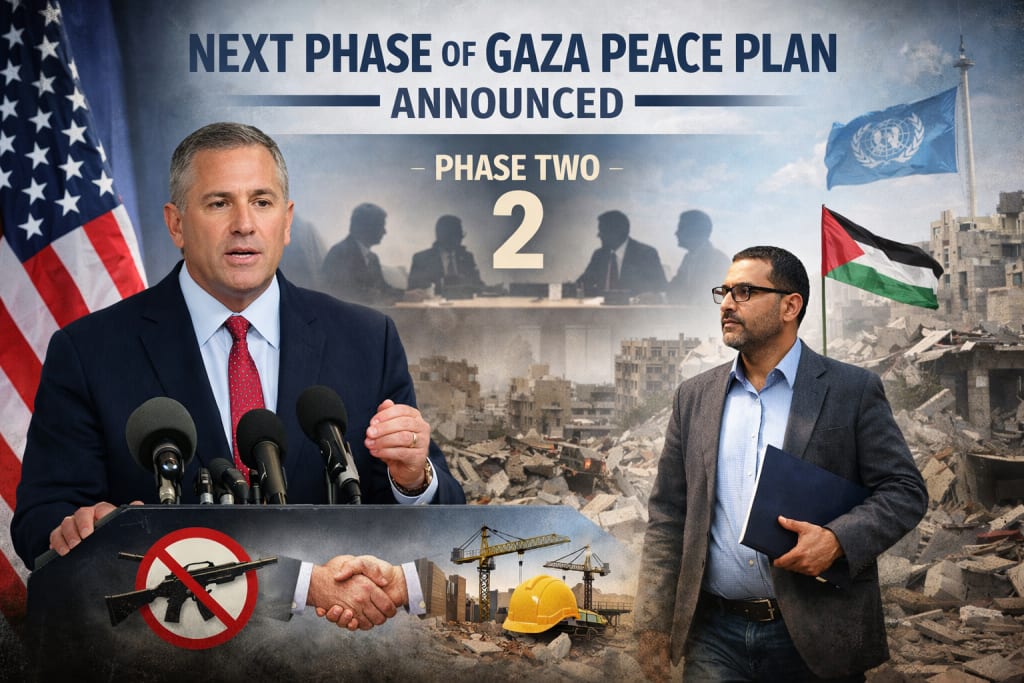
The Trump administration has announced the next phase of its Gaza peace plan, marking a new step in efforts to bring stability to a region that has faced months of conflict, destruction, and humanitarian suffering. This second phase, often called “Phase Two,” focuses on post-war governance, security, and rebuilding Gaza after intense fighting between Israel and Hamas.
This article explains the announcement in clear and simple English, following a neutral and informative approach, so readers can easily understand what is happening and why it matters.
Background: Why a Gaza Peace Plan Is Needed
Gaza has been at the center of a devastating conflict that has caused massive loss of life, destruction of homes, and a severe humanitarian crisis. Millions of people have struggled with shortages of food, clean water, medical supplies, and electricity. International pressure has grown on all sides to find a solution that can stop the violence and create long-term stability.
In response, the Trump administration introduced a multi-stage peace plan. The first phase mainly focused on reducing fighting, reaching ceasefire agreements, and securing the release of hostages. While progress was made in some areas, the situation remained fragile. This led to the announcement of the second phase, which aims to address what comes after the fighting slows down.
What Is Phase Two About?
Phase Two of the Gaza peace plan is centered on governance and security. According to U.S. officials, this stage is designed to answer an important question: who will run Gaza after the war
The plan proposes the creation of a temporary governing body made up of Palestinian technocrats. Technocrats are professionals such as economists, engineers, doctors, and administrators who are chosen for their skills rather than their political affiliations. The idea is to form a non-political administration that can focus on rebuilding Gaza, restoring basic services, and maintaining order.
This temporary government would handle daily affairs, including healthcare, education, infrastructure repair, and humanitarian coordination. It is meant to be a transitional solution until a more permanent political arrangement can be agreed upon.
The Role of Hamas
One of the most sensitive parts of Phase Two involves Hamas, the group that has controlled Gaza for many years. The Trump administration has made it clear that Hamas must meet specific conditions for the plan to move forward.
These conditions include the full release of remaining hostages and compliance with ceasefire agreements. There is also strong emphasis on demilitarization, meaning Hamas would be expected to give up its weapons and military control in Gaza.
U.S. officials have warned that failure to meet these conditions could lead to serious consequences. This reflects Washington’s position that lasting peace is not possible if armed groups continue to control Gaza through force.
International and Regional Involvement
Phase Two is not only about U.S. policy. The plan includes coordination with international partners, regional countries, and humanitarian organizations. The United States has suggested the possibility of an international oversight mechanism to help supervise governance and reconstruction efforts in Gaza.
Such international involvement is seen as important to ensure transparency, security, and proper use of reconstruction funds. Rebuilding Gaza will require billions of dollars and long-term commitment, making global cooperation essential.
Neighboring countries and key regional actors are also closely watching the plan. Stability in Gaza affects the wider Middle East, and many governments are concerned about the risk of renewed violence if the transition is not handled carefully.
Reaction from the Palestinian Authority
The Palestinian Authority (PA), which governs parts of the West Bank, has welcomed the announcement of Phase Two. PA officials have expressed support for a technocratic administration in Gaza, seeing it as a possible step toward Palestinian unity and reconstruction.
However, challenges remain. The relationship between the Palestinian Authority and Hamas has been tense for years, and rebuilding trust between different Palestinian factions will not be easy. Still, the PA’s positive response suggests some openness to dialogue and cooperation.
Challenges and Concerns
Despite the announcement, many experts caution that Phase Two will be difficult to implement. Security conditions in Gaza remain unstable, and there is deep mistrust among the parties involved. Ordinary civilians, who have suffered the most, are unsure whether political plans will truly improve their daily lives.
Another concern is legitimacy. Some Palestinians may question who has the right to govern Gaza and whether a temporary administration can truly represent the people. Without public support, even a well-designed plan may struggle to succeed.
Humanitarian groups also stress that immediate needs must not be ignored. While political and security arrangements are discussed, people in Gaza still need food, shelter, medical care, and clean water.
Why This Announcement Matters
The announcement of Phase Two signals that the Trump administration is looking beyond short-term ceasefires and toward long-term solutions. It shows an attempt to address governance, security, and reconstruction together rather than separately.
Whether the plan succeeds or fails will depend on many factors, including cooperation from local actors, support from the international community, and real improvements in the lives of Gaza’s civilians.
Conclusion
The next phase of the Gaza peace plan represents a critical moment for the region. By focusing on transitional governance and rebuilding, the Trump administration aims to create a foundation for stability after months of conflict. However, serious challenges remain, and the path forward is uncertain.
For the people of Gaza, the hope is simple: peace, safety, and a chance to rebuild their lives. Whether Phase Two can deliver on these hopes will become clear in the months ahead.
About the Creator
sehzeen fatima
Sehzeeen Fatima is a writer with a Master’s in Science who shares inspiring stories about sports, life, and people. She writes in simple, clear language to connect with readers and spark meaningful thought.
Keep reading
More stories from sehzeen fatima and writers in Journal and other communities.
Canadian Prime Minister Visits China After Nearly a Decade of Tense Relations
After almost ten years of difficult relations, the Canadian Prime Minister has traveled to China in a move that could mark a turning point for both countries. The visit is the first official trip to China by a Canadian prime minister in nearly a decade and comes after years of political tension, trade disputes, and broken trust.
By sehzeen fatima4 days ago in Journal
TanStack Form vs React Hook Form in 2026
Choosing a form library in 2026 is a major decision. It is no longer just about reducing re-renders in the browser. We are now deeper into the era of Server Components. We must handle localized state hydration and strict type safety. Your choice defines how your application architecture will scale. TanStack Form and React Hook Form (RHF) have both evolved. They have changed significantly over the last two years. However, they still serve different philosophies of state management. One focuses on uncontrolled speed within the React ecosystem. The other prioritizes type-safe logic that works across different frameworks.
By Del Rosario5 days ago in Journal
Wild Card Weekend Recap: What Happens Now?
I think I figured out why I love Wild Card Weekend so much. It's because it's the first playoff anything of the calendar year. The NFL season starts in the fall, and once upon a time, the champion was crowned either on or slightly before New Year's. The evolution of the NFL schedule has resulted in the playoffs starting just into the New Year, and currently, the final week of the season falls on the first weekend of the New Year, with Wild Card Weekend coming a week after that. So yes, chronologically, the NFL's Wild Card Weekend serves as the first playoff anything of the calendar year.
By Clyde E. Dawkins4 days ago in Unbalanced



Comments
There are no comments for this story
Be the first to respond and start the conversation.