
Tragedy at Hong Kong International Airport: Cargo Plane Plunges into the Sea After Runway Accident
Tragedy at Hong Kong International Airport: Cargo Plane Plunges into the Sea After Runway Accident
Tragedy at Hong Kong International Airport: Cargo Plane Plunges into the Sea After Runway Accident
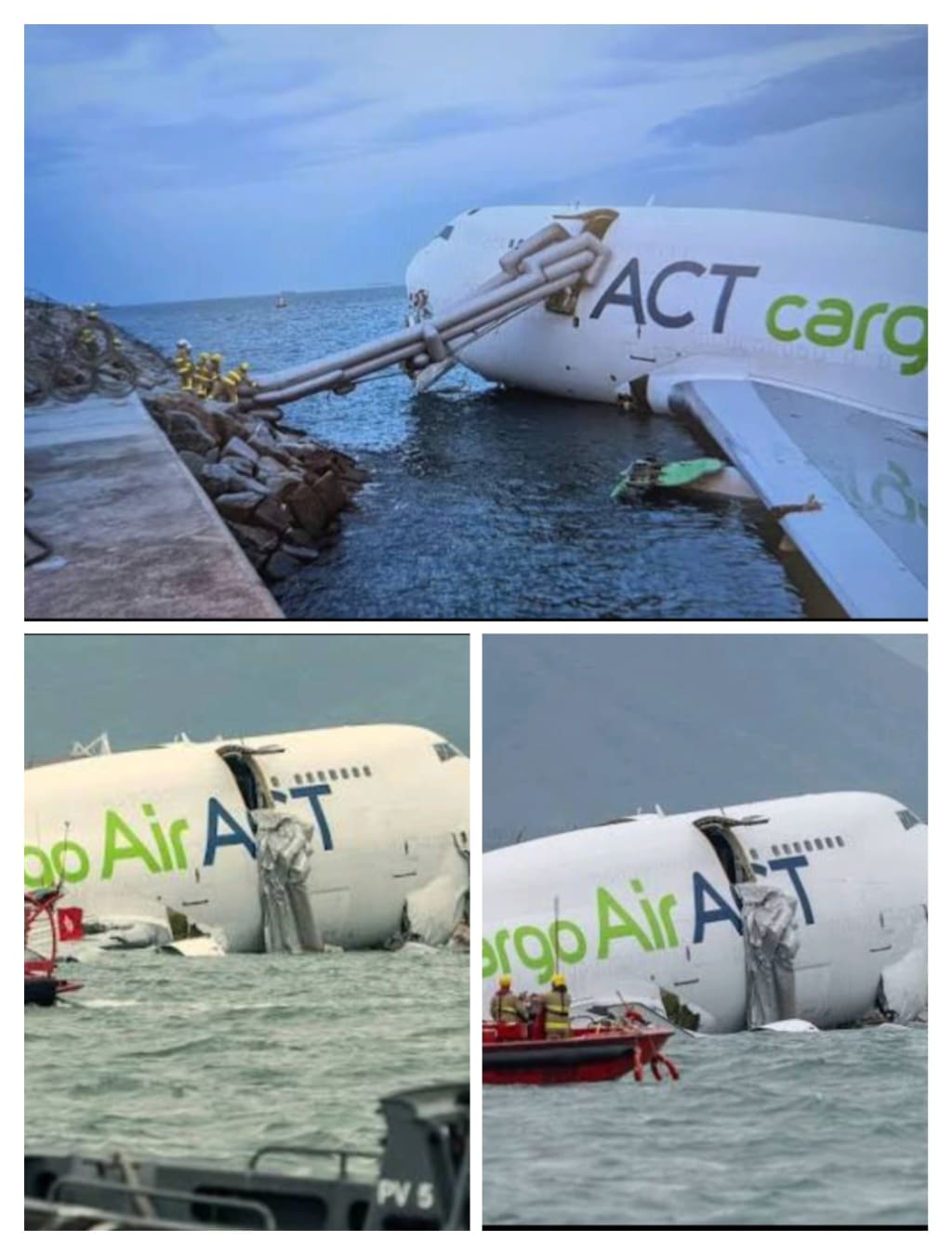
In the early hours of October 20, 2025, Hong Kong woke to shocking news: a cargo aircraft had skidded off the runway at Hong Kong International Airport and plunged into the sea. The accident, involving a Boeing 747-400 freighter operated by ACT Airlines on behalf of Emirates SkyCargo, resulted in the deaths of two airport security personnel and raised serious questions about runway safety, airport operations, and mechanical reliability.
A Routine Landing Turns into Disaster
According to reports, the aircraft — operating as Flight EK9788 — was returning from Dubai to Hong Kong with no cargo on board. At around 3:50 a.m. local time, the plane was attempting to land on the north runway of Hong Kong International Airport. Weather conditions were reportedly stable, with good visibility and no significant wind shear or rain that could have compromised the landing.
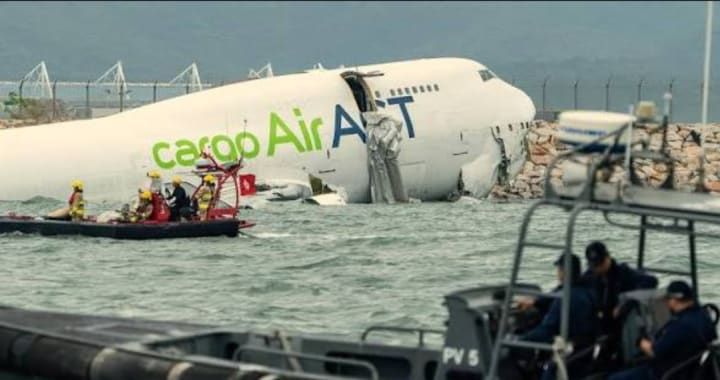
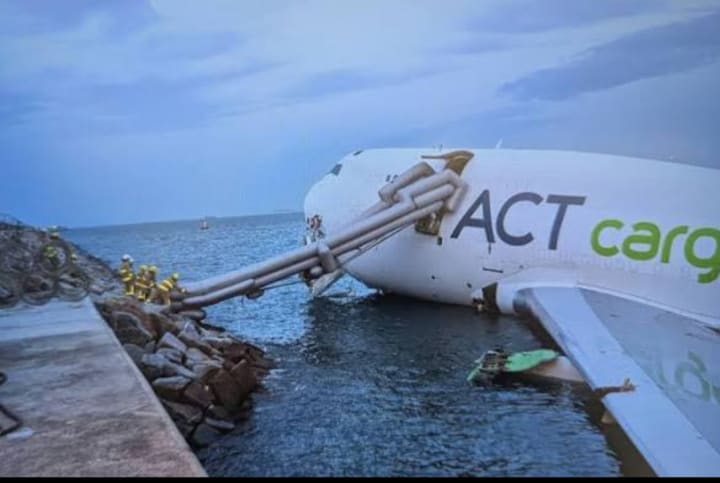
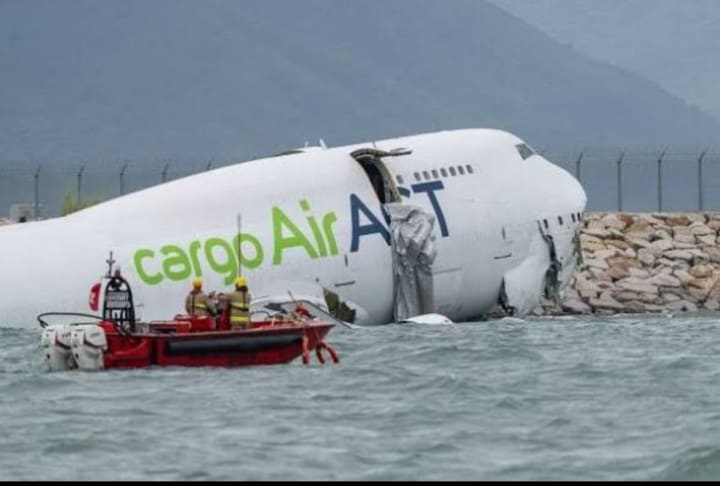
However, moments after touchdown, the aircraft began to veer uncontrollably to the left, skidding off the runway and breaching the perimeter barrier. In a tragic sequence of events, the massive freighter struck a security patrol vehicle parked just outside the runway fence before plunging nose-first into the adjacent seawall. The impact was violent enough to break the plane into two major sections — the forward fuselage partially submerged in the water, and the tail section resting near the seawall.
Immediate Response and Rescue Efforts
Emergency response units were dispatched within minutes. Airport fire crews, marine rescue teams, and ambulances rushed to the site. Four crew members aboard the Boeing 747 — all Turkish nationals — were miraculously rescued from the wreckage. They were treated for minor injuries and shock but survived the crash.
Tragically, the two occupants of the security vehicle were not as fortunate. One was declared dead at the scene, while the other succumbed to injuries later in hospital. Their deaths marked the first fatalities related to an aircraft incident at Hong Kong International Airport in years, sending waves of grief across the aviation community and among airport staff.
A Rare and Disturbing Incident
Hong Kong International Airport, one of the world’s busiest and most advanced aviation hubs, has maintained an exceptional safety record since opening in 1998. Runway incidents of this magnitude are exceedingly rare. The fact that a 400-ton cargo jet could slide off the runway and end up in the water has sparked intense debate about what exactly went wrong.
Initial statements from the Hong Kong Civil Aviation Department (CAD) confirmed that weather conditions were normal and that the patrol vehicle was legally stationed outside the runway perimeter, not within the restricted zone. This immediately ruled out unauthorized ground presence as the cause of the crash.
Investigators are now focusing on multiple possible factors: mechanical malfunction in the aircraft’s braking or steering systems, pilot error during rollout, or an issue with runway friction or lighting. The Air Accident Investigation Authority (AAIA) of Hong Kong has launched a formal inquiry, with support from the U.S. National Transportation Safety Board (NTSB) and Boeing engineers, who are providing technical expertise.
The Aircraft’s Background and Age
The ill-fated aircraft was more than 32 years old, originally built as a passenger jet before being converted into a freighter in the early 2000s. While aging planes are not uncommon in the cargo industry, older airframes require rigorous maintenance and inspection. Preliminary records indicate the plane had undergone its last major inspection in 2024, passing all standard airworthiness checks.
Aviation analysts note that mechanical failures are more likely in older aircraft, especially in braking and hydraulic systems that face immense stress during landings. The absence of a distress call before the accident has raised further speculation that the event unfolded too rapidly for the crew to respond.
Impact on Airport Operations
Following the crash, Hong Kong International Airport temporarily closed its north runway, diverting all traffic to the two remaining operational runways. Cargo operations experienced mild delays, but passenger flights continued with minimal disruption. Recovery teams worked for over 48 hours to stabilize the wreckage and prevent fuel leakage into surrounding waters, while divers searched the submerged fuselage for the flight data and cockpit voice recorders.
The airport authority announced that the north runway would remain under restricted use until full debris removal and safety verification were complete. The closure served as a stark reminder of the fragility of air transport safety, even at one of the world’s most modern facilities.
A Wake-Up Call for Aviation Safety
The Hong Kong cargo plane crash has reignited discussions about aviation risk management, especially for freighter operations that often involve older aircraft and overnight flights. Experts argue that this tragedy underscores the importance of upgrading aging fleets, reinforcing runway barriers, and reviewing airport safety protocols — particularly near coastal boundaries.
Families of the deceased security officers have received condolences from both the Hong Kong government and Emirates Airlines. In a statement, Emirates expressed “deep sorrow” for the loss of life and pledged full cooperation with the ongoing investigation.
While the final investigation report may take months to complete, one thing is certain: the crash has left a lasting mark on Hong Kong’s aviation history. It serves as a sobering reminder that even in an age of cutting-edge technology and precise air traffic control, the margin for error in aviation remains perilously this
About the Creator
Author’s Advice
If you would’ve asked me 20 years ago did I know I’d become a writer and an author, I would’ve said “nope, ain’t happening”. As fate would have it I did become an author and I can honestly say I’m loving it so far. It really does feel good to be a writer. I’ve learned a lot on this journey and I feel like with even me being as new to this world as I am, there’s some wisdom I need to share with every other aspiring author.
By Joe Patterson5 days ago in Journal




Comments
There are no comments for this story
Be the first to respond and start the conversation.