
Beyond the Screen: Why Gen Z is Choosing "Analog America" in 2026
Why is Gen Z ditching smartphones for "Analog America"? Discover the 2026 trend of analog bags, film cameras, and "grandma hobbies" to cure digital burnout.
Beyond the Screen: Why Gen Z is Choosing "Analog America" in 2026
The blue light didn't feel like a glow anymore; it felt like a cage.
Maya sat in her dimly lit apartment in Seattle, her thumb hovering over an infinite scroll of AI-generated "slop" and hyper-targeted ads. It was 11:42 PM on a Tuesday in 2026. She had 47 unread DMs, a calendar full of virtual meetings, and a crushing sense that she hadn't touched anything real in weeks. With a sudden, visceral shudder, she did something she hadn't done since middle school. She powered down her phone, slid it into a kitchen drawer, and picked up a heavy, ink-stained fountain pen.
Maya isn't alone. She is part of "Analog America," a massive cultural correction led by Gen Z—the very generation born into the digital womb.
The Great Disconnect: Why 2026 is the Year of Analog Living
After a decade of digital acceleration that culminated in the "ambient chaos" of 2025, the pendulum has officially swung back. Recent data reveals that 63% of Gen Z now intentionally embrace screen-free habits for their mental well-being. This isn’t a rejection of progress; it is a survival strategy against digital burnout and the psychological strain of a hyper-automated world.
As AI began to generate our emails, our art, and even our casual conversations, a profound hunger for the "human-made" emerged. In 2026, imperfection has become the ultimate luxury.
The Rise of the #AnalogBag
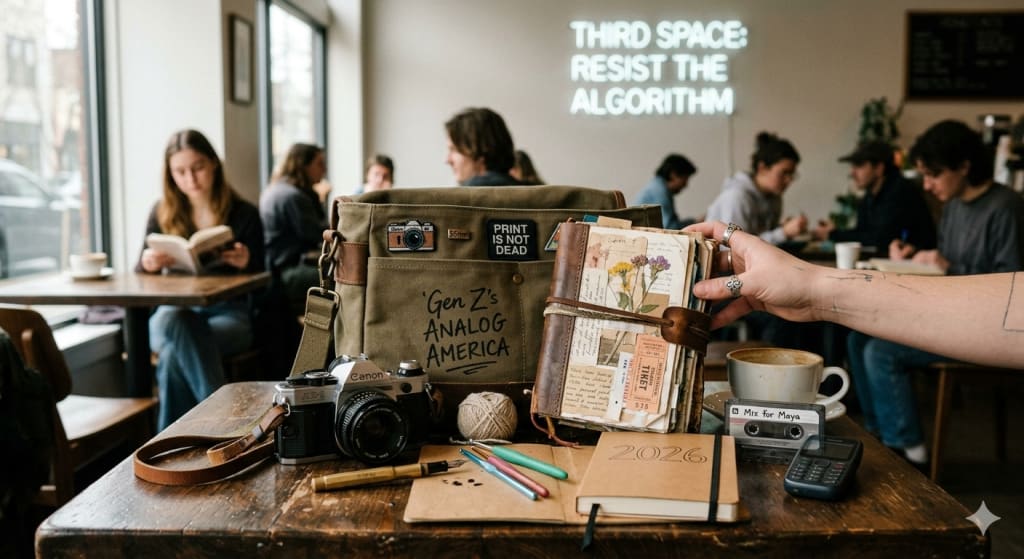
If you walk into a park in New York or a library in Singapore this year, you’ll see the movement’s most visible symbol: the Analog Bag.
Popularized on TikTok and Instagram (ironically, the very platforms people are trying to escape), the Analog Bag is a curated "offline survival kit." Instead of a tablet or an e-reader, these bags are packed with tactile boredom-busters designed to keep the "primal urge" to scroll at bay:
Junk Journals: Bound books filled with ticket stubs, pressed leaves, and physical sketches.
Tactile Hobbies: Mini knitting kits, crochet hooks, and even travel-sized Lego sets.
Physical Media: Paperbacks that smell of old paper and newsstands.
Friction-Maxxing Tools: High-quality stationery and fountain pens that require a slow, deliberate hand.
Why "Friction" is the New Status Symbol
For years, tech companies competed to remove "friction"—making everything one-click, instant, and invisible. But in 2026, Gen Z is realizing that friction is where the memory lives. Using a film camera forces you to wait for the development; you can't see the photo instantly, so you stay in the moment. Placing a vinyl record on a turntable requires you to listen to the album in full, without a "next" button. This "delayed gratification" is a hard-reset for a dopamine system fried by 15-second video loops.
Digital Compartmentalization: AI for Work, Analog for Life
The "Analog America" movement doesn't mean Gen Z is moving to the woods and burning their routers. Instead, they are practicing digital compartmentalization.
Studies show that while nearly 80% of Gen Z professionals use AI to survive their workdays, they are drawing a hard line at 5:00 PM. They use ChatGPT to handle emails and research, but they use a paper planner to organize their dreams. The phone is a tool for the office; the notebook is the sanctuary for the soul.
The "Dumb Phone" Resurgence
One of the most radical shifts in 2026 is the mainstreaming of the "dumb phone." Once a fringe experiment, basic feature phones with no social apps have become a status symbol of discipline. Carrying a flip phone signals that you are "important enough" to be unreachable and "mindful enough" to exist without a digital pacifier. It is the ultimate flex of the 2026 creator class.
From Doomscrolling to "Analog Wellness"
The shift toward Analog America is more than just an aesthetic—it’s a revolution of the nervous system. Experts are calling it "Analog Wellness." The Digital Fatigue Era (2010–2024) The Analog America Era (2026)
Dopamine Loops: Instant likes and infinite scrolling.
Mindful Engagement: Puzzles, gardening, and hand-crafting.
Algorithmic Music: Spotify "Daily Mixes."
Tactile Music: Vinyl records and cassette tapes.
Virtual Presence: Group chats and Zoom hangouts.
Third Spaces: In-person book clubs and run clubs.
Perfect Imagery: AI-filtered, high-def photos.
Authentic Imperfection: Grainy 35mm film photography.
Reclaiming the "Third Space"
Perhaps the most beautiful part of this trend is the revival of the Third Space. Tired of "swipe fatigue" on dating apps, young adults are flocking to physical communities. Board game cafes, pottery workshops, and "no phone" silent reading circles are the new nightlife. Local markets are seeing a surge as people reject "10-minute delivery" apps in favor of the sensory experience of choosing their own groceries and chatting with a neighbor.
Conclusion: The Smartest Move is a Dumber Phone
Maya’s story didn't end with her staring at a blank page. As she wrote with her fountain pen, she noticed the way the ink pooled on the paper, the way her hand cramped slightly—the physical reality of creation. She felt a sense of focus she hadn't experienced in years.
The "Analog America" movement of 2026 is proof that we are reaching a breaking point with "more is better." By choosing objects they can touch and experiences that cannot be shared with a heart icon, Gen Z is reclaiming their humanity. They are proving that in an age of artificial intelligence, the most advanced technology is still the human connection to the physical world.
As we move deeper into 2026, the question is no longer how to stay connected. It’s how to stay real.
About the Creator
Mr Fihsak
NEVER GIVE UP
Author’s Advice
If you would’ve asked me 20 years ago did I know I’d become a writer and an author, I would’ve said “nope, ain’t happening”. As fate would have it I did become an author and I can honestly say I’m loving it so far. It really does feel good to be a writer. I’ve learned a lot on this journey and I feel like with even me being as new to this world as I am, there’s some wisdom I need to share with every other aspiring author.
By Joe Patterson3 days ago in Journal
A Transparent Look at Vocal Challenges and Top Stories
Almost three years ago, we shared a resource article that served as a place for people to suggest new challenge prompts. We thought it would be a good idea to refresh that thread, and take the opportunity to answer a few common questions about top stories, how challenges are judged and how submissions are reviewed.
By Vocal Curation Team2 days ago in Resources




Comments
There are no comments for this story
Be the first to respond and start the conversation.