
Traditional vs Smart Toys: Who Is Winning the Battle for the Europe Toys Market?
The value depends entirely on your specific goals: skill acquisition often favors smart toys, while longevity and creativity favor traditional options.

The battle between nostalgic wooden blocks and AI-powered robots is heating up. As the Europe toys market evolves, parents face a difficult choice: should they embrace the future with Traditional vs Smart Toys, or stick to the classics? This isn't just about fun; it is about child development, privacy, and economic value. According to recent data from the IMARC Group, the European market reached a massive USD 27.82 billion in 2024, proving that the appetite for play is stronger than ever.
However, the dynamics are shifting. While technology pervades every aspect of our lives, a counter-movement towards sustainability and "digital detox" is gaining momentum. This article explores who is truly winning this commercial and cultural tug-of-war.
How Big is the Europe Toys Market Currently?
The European toy industry is a financial titan, valued at USD 27.82 billion as of 2024. Furthermore, analysts expect this figure to grow significantly over the next decade.
Specifically, the IMARC Group forecasts the market will reach USD 48.22 billion by 2033. This represents a steady Compound Annual Growth Rate (CAGR) of 5.7% between 2025 and 2033. Several key factors drive this impressive growth. First, the explosion of e-commerce platforms has made international niche brands accessible to parents in Germany, France, and the UK. Second, there is a rising demand for specialized toys catering to children with special needs. Finally, the industry sees a massive push toward green packaging, as European consumers increasingly reject single-use plastics.
Why Are Smart Toys Surging in Popularity Across Europe?
Smart toys are surging because they bridge the gap between entertainment and essential future skills, such as coding and problem-solving.
Modern parents often fear their children will fall behind in a tech-centric world. Consequently, manufacturers have flooded the market with STEM toys (Science, Technology, Engineering, and Math). These devices, ranging from app-controlled LEGO sets to programmable robots, promise to turn screen time into learning time. The smart toys vs traditional toys debate often leans toward "smart" when educational outcomes are the priority. Additionally, market data suggests that the "connected toy" segment is growing faster than the general market average of 5.7%. This rapid acceleration confirms that digital integration is not a fad; rather, it is a fundamental shift in how children interact with the world.
Can Traditional Toys Survive the Digital Age?
Yes, traditional toys are not just surviving; they are thriving due to widespread "digital fatigue" and a booming sustainability trend.
While screens are ubiquitous, experts and parents alike are recognizing the value of tactile, battery-free play. A study by the University of Toledo suggests that fewer, simpler toys actually lead to deeper, more creative play sessions. This concept, known as "Deep Play," heavily favors traditional items like wooden blocks, dolls, and puzzles. Moreover, the sustainable toy trends in Europe create a significant advantage for traditional manufacturers. Wood, organic cotton, and recycled materials appeal to eco-conscious buyers in a way that plastic, circuit-heavy smart devices cannot. Therefore, the "old school" toy market is securing its future by positioning itself as the ethical, healthy alternative to digital noise.
Smart vs Traditional Toys: Which Offers Better Value?
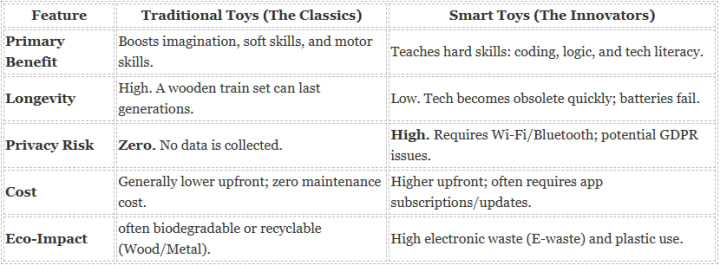
The value depends entirely on your specific goals: skill acquisition often favors smart toys, while longevity and creativity favor traditional options.
To help you evaluate the Europe toys market landscape, we have compared these two categories across five critical metrics.
Is Data Privacy Killing the Smart Toy Trend in Europe?
Data privacy concerns act as a major speed bump, preventing smart toys from completely dominating the sector.
European regulators enforce the strictest data protection laws in the world (GDPR). Consequently, parents are increasingly wary of "Internet of Things" (IoT) devices entering the playroom. In previous years, German regulators even banned specific smart dolls and watches, classifying them as "espionage devices" because they could record conversations without consent. GDPR compliant smart toys are now a mandatory requirement, not a luxury feature. If a manufacturer fails to guarantee data safety, European parents will swiftly return to offline alternatives. Thus, trust is the currency of the future market.
Who Is the Real Winner of the European Market?
The real winner is a hybrid model that combines the volume of traditional play with the innovation of smart technology.
Currently, traditional toys still hold the crown for volume and trust. The IMARC Group data indicates a robust 5.7% growth, much of which comes from standard play items. However, smart toys win on potential and educational value. The market is not deleting the past to write the future; instead, it is expanding to accommodate both. Ultimately, the successful toy companies of 2033 will be those that can offer high-tech learning tools while respecting the European demand for privacy and sustainability.
About the Creator
Joey Moore
I'm Joey Moore, a seasoned Research Analyst with 5+ years of experience in market research. Expert in data analysis, strategic planning, and industry insights. Proven track record in delivering actionable reports.
Keep reading
More stories from Joey Moore and writers in Journal and other communities.
Generic Drugs in Germany: New Opportunities in Germany Pharmaceutical Market
Germany has long been hailed as the "Pharmacy of the World," a historic powerhouse of chemical engineering and medical innovation. Today, however, the spotlight is shifting. While groundbreaking research continues in Berlin and Munich, the real engine driving the sector is pragmatism. The rise of generic drugs in Germany represents a pivotal shift in how Europe's largest economy manages healthcare for its aging population.
By Joey Moorea day ago in Journal
~ Fired ~
— Ai Intrusion ~ Are you Next ~ Is Ai Evolution after your job? — Few workplaces haven't been affected. Ai is in supermarkets, at doctors' offices, and even monitoring farms. I just can't think of anything this machine is not getting into, can you? For instance: Education ~ Law and Tech jobs will one day have a major influence or be taken over by these inanimate machines, with accuracy and vigor. From mechanics' diagnoses to a wide variety of everyday jobs, including fast food workers, with this input having the ability to cut their unnecessary work hours. I'm certain all of us have been touched by this with our short stories and colorful headings, have you? Even comments are very questionable 'Non-Robot' insertions.
By Jay Kantor5 days ago in Journal
Trouble at the Tea Leafing Café
The rain had started right around the time that Annie was buttering her second thick slice of homemade toast for breakfast, and hadn’t paused since. Not that anyone could tell. The windows of the café were fogged over, and with every seat filled with happy customers munching on fresh baked pastries or steaming bowls of the delicious soup of the day, it was hardly surprising. Annie looked around the room, finally taking a moment to breathe after the lunch time rush. Her old life already felt like a bad memory, a part of her history, always, but just that. History.
By Hannah Moore7 days ago in Fiction




Comments
There are no comments for this story
Be the first to respond and start the conversation.