
Generic Drugs in Germany: New Opportunities in Germany Pharmaceutical Market
Why is the German government pushing so hard for generics? The answer lies in the financial sustainability of the GKV (Gesetzliche Krankenversicherung) - the Statutory Health Insurance system that covers 90% of the population.

Germany has long been hailed as the "Pharmacy of the World," a historic powerhouse of chemical engineering and medical innovation. Today, however, the spotlight is shifting. While groundbreaking research continues in Berlin and Munich, the real engine driving the sector is pragmatism. The rise of generic drugs in Germany represents a pivotal shift in how Europe's largest economy manages healthcare for its aging population.
For investors and pharmaceutical stakeholders, this is not just a trend; it is a structural necessity. As healthcare costs rise, the Germany pharmaceutical market is opening new doors for cost-effective solutions. But where exactly are these opportunities, and what do the numbers say about the next decade?
In this analysis, we explore the market's trajectory using the latest 2025 data, dissect the regulatory landscape (AMNOG), and identify where the smart money is moving.
How Big is the Opportunity in the Germany Pharmaceutical Market?
To understand the potential, we must look at the hard data. The market is robust, stable, and growing. According to the latest market research from the IMARC Group, the German pharmaceutical market size reached USD 68.9 billion in 2025.
This figure positions Germany as the undisputed heavyweight of the European healthcare sector. However, the future trajectory is what demands attention. The market is forecast to surge to USD 120.8 Billion by 2034, exhibiting a solid Compound Annual Growth Rate (CAGR) of 6.44% during the 2026-2034 period.
Why is this significant? A 6.44% growth rate in a "mature" Western economy is rare. It indicates that the market is being driven by powerful, unstoppable forces:
- Demographics: Germany has one of the oldest populations in the world.
- Chronic Disease: An aging population correlates directly with higher consumption of daily maintenance medications (hypertension, diabetes, cholesterol) - the sweet spot for generics.
Why Are Generic Drugs Becoming the Backbone of German Healthcare?
Why is the German government pushing so hard for generics? The answer lies in the financial sustainability of the GKV (Gesetzliche Krankenversicherung) - the Statutory Health Insurance system that covers 90% of the population.
The Volume vs. Value Equation Studies and market reports indicate a fascinating disparity:
- Volume: Generic drugs now account for approximately 76% to 80% of all prescriptions dispensed in Germany.
- Cost: Despite this massive volume, generics consume a much smaller fraction of the total pharmaceutical budget compared to patented drugs.
The "Aut idem" Rule To keep the healthcare system solvent, German pharmacists are often mandated by the "Aut idem" (or "the same") rule. This requires them to substitute a prescribed brand-name drug with a cheaper generic equivalent unless the doctor explicitly forbids it. This regulatory mechanism guarantees a massive, built-in demand for generic manufacturers.
What Role Does the "AMNOG" Regulation Play in Market Growth?
Foreign investors often stumble over the acronym AMNOG (Arzneimittelmarktneuordnungsgesetz). Simply put, this is the Pharmaceutical Market Restructuring Act, introduced in 2011. It fundamentally changed the game.
The Mechanism Under AMNOG, every new drug launching in Germany must undergo an "Early Benefit Assessment" by the Federal Joint Committee (G-BA).
- If a new drug proves it offers added benefit over existing therapies, it can negotiate a premium price.
- If it offers no added benefit, it is reimbursed at the price of the comparable generic comparator (the "reference price").
The Opportunity for Generics: This rigorous system actually favors the generic drugs market. Since generics are bioequivalent to established effective treatments, they bypass the high hurdles of benefit assessment. They enter the market as the "safe," reimbursement-friendly option that insurers love.
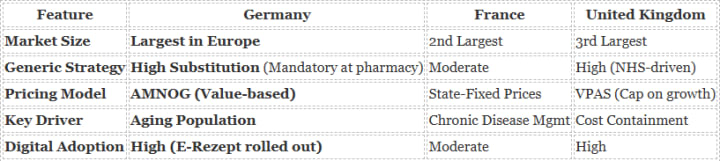
Germany vs. The Rest of Europe: How Does the Market Compare?
Germany is not just another European market; it is the anchor. Its regulatory decisions often influence the rest of the EU.
Comparison Table: Germany vs. Key European Peers
Where Are the Hidden Niches? (Biosimilars & Specialty Generics)
The "New Opportunities" mentioned in the title are not found in manufacturing simple ibuprofen or aspirin - markets that are saturated and race-to-the-bottom on price. The real growth lies in Biosimilars and Specialty Generics.
1. The Biosimilar Boom: As patents expire on complex biologic drugs (used for cancer, rheumatoid arthritis, and Crohn's disease), Germany has become a world leader in biosimilar uptake.
Expert Insight: German oncologists are pragmatic. Data shows they are willing to switch patients to biosimilars faster than their counterparts in the US, driven by quota targets set by physician associations (KVs).
2. Specialty Generics: These are generics that are difficult to manufacture, such as complex injectables, inhalers, or transdermal patches. Because the barrier to entry is higher, there are fewer competitors, allowing for healthier profit margins than standard oral solids.
What Challenges Must New Entrants Navigate?
Entering the German market is lucrative but not an open road without speed bumps. The market is highly regulated and price-sensitive.
The Tender System (Rabattverträge): Germany operates on a unique system of rebate contracts. Health insurers (like AOK or Barmer) put out tenders for specific drugs (e.g., "We need 5 million packs of Metformin").
- The Risk: It is a "winner-takes-all" or "winner-takes-most" scenario. If a manufacturer wins the tender, they get exclusive access to that insurer's patients for two years. If they lose, they are effectively locked out.
Supply Chain Resilience: Recently, Germany has faced shortages of basic drugs like pediatric fever syrups and antibiotics. In response, the government passed the ALBVVG (Drug Supply Bottleneck Combatting Act).
- The Opportunity: This law allows for slightly higher pricing for drugs manufactured in Europe, aiming to diversify the supply chain away from reliance solely on Asia. This creates a new competitive advantage for European-based generic manufacturers.
What is the Impact of Digital Health (E-Rezept)?
Germany is currently undergoing a massive digital transformation with the nationwide rollout of the E-Rezept (Electronic Prescription).
- Efficiency: Patients no longer need paper slips; prescriptions are sent directly to their app or health card.
- Market Impact: This reduces friction in the pharmacy. It also opens the door for online pharmacies (Versandapotheken) to gain market share, which typically have even higher generic substitution rates than physical pharmacies.
Conclusion
The Germany pharmaceutical market is evolving. The 6.44% CAGR forecast by IMARC Group reflects a healthcare system that is hungry for efficiency and sustainability.
For pharmaceutical companies, the "Golden Ticket" is no longer just discovering a blockbuster molecule; it is mastering the art of the generic supply chain and navigating the AMNOG landscape. As the "Silver Economy" expands, the demand for affordable, high-quality generic drugs will only intensify. Germany remains the most challenging, yet most rewarding, pharmaceutical battleground in Europe.
Data Sources:
- IMARC Group: Germany Pharmaceutical Market Size, Forecast 2034
- Federal Institute for Drugs and Medical Devices (BfArM): AMNOG Procedures
- German Medicines Manufacturers Association (BAH): Generic Market Statistics
About the Creator
Joey Moore
I'm Joey Moore, a seasoned Research Analyst with 5+ years of experience in market research. Expert in data analysis, strategic planning, and industry insights. Proven track record in delivering actionable reports.
Keep reading
More stories from Joey Moore and writers in Journal and other communities.
Will Mild Hybrids Survive the EV Revolution? Impact on Europe Mild Hybrid Vehicles Market Growth
The headlines are dominated by the electric vehicle (EV) revolution. Governments are setting bans on combustion engines, and Tesla sales figures are scrutinized like stock tickers. In this noise, a quiet revolution is happening under the hood of millions of European cars. The Europe mild hybrid vehicles market is not dying; it is evolving into the automotive industry's most critical survival tool.
By Joey Moorea day ago in Journal
~ Fired ~
— Ai Intrusion ~ Are you Next ~ Is Ai Evolution after your job? — Few workplaces haven't been affected. Ai is in supermarkets, at doctors' offices, and even monitoring farms. I just can't think of anything this machine is not getting into, can you? For instance: Education ~ Law and Tech jobs will one day have a major influence or be taken over by these inanimate machines, with accuracy and vigor. From mechanics' diagnoses to a wide variety of everyday jobs, including fast food workers, with this input having the ability to cut their unnecessary work hours. I'm certain all of us have been touched by this with our short stories and colorful headings, have you? Even comments are very questionable 'Non-Robot' insertions.
By Jay Kantor5 days ago in Journal
Local Burnley Experience & Shopping Days
Burnley has a way of surprising people who only know its industrial past. It is a town where rugged hills meet busy high streets. You can spend a morning hiking up to a wind-powered musical sculpture and the afternoon hunting for designer bargains. For those looking to spruce up their outdoor space, finding a quality garden centre in Burnley offers a great starting point for a day of exploration. The local scene is a mix of traditional grit and modern charm. It feels authentic and unpretentious. If you want a day out that combines fresh air with retail therapy, this corner of Lancashire delivers.
By Lisa Smith5 days ago in Journal
Off the Book
It ended like every other stupid idea. Badly, and alone. I’m researching digital confession ethics, he said. A tech ethicist. He gestured at floating data I couldn’t see then pulled out a physical notebook. Actual paper, fountain pen. He held it up like he was showing me scripture.
By Nicky Frankly7 days ago in Fiction




Comments
There are no comments for this story
Be the first to respond and start the conversation.