
Top Doubts About Florida’s Notice to Owner (NTO): FAQs, Pitfalls, and Tips
Protecting Your Payment Rights in Florida Construction Projects


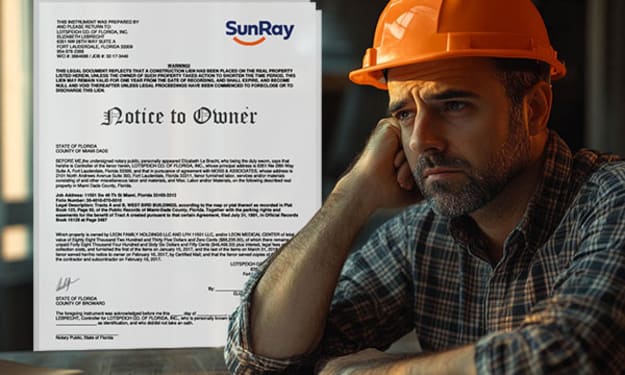
If you work in Florida’s construction industry, whether as a contractor, subcontractor, or supplier, you have probably heard of the Notice to Owner (NTO). This legal document is critical for protecting your lien rights and ensuring you get paid for your work.
Unfortunately, mistakes and misunderstandings about Florida NTO requirements are common, and they can cost you your ability to file a mechanics lien or make a payment bond claim. This guide answers the most frequently asked questions about the Florida NTO process, outlines common pitfalls, and shares practical tips to help you stay compliant.
What Is a Florida Notice to Owner (NTO), and Who Needs to Send It?
The NTO is a formal notice that subcontractors, material suppliers, and certain other construction professionals must send to the property owner when they are not working under a direct contract with that owner.
An NTO is required on most private construction projects and many public projects in Florida. Sending it preserves your right to:
- File a construction lien
- Make a claim against a payment bond if unpaid
Who must send an NTO in Florida?
- Subcontractors
- Material suppliers
- Some contractors (if they are not contracted directly with the owner)
What Is the Florida NTO Deadline?
Florida law gives you 45 days from your first furnishing of labor, services, or materials to send the NTO.
- The clock starts when you actually begin work or supply materials, not when you sign the contract or send an invoice.
- Missing the 45-day NTO deadline, even by one day, can completely forfeit your lien rights.
What Information Must Be on a Valid NTO?
Florida statutes require complete and accurate information on your NTO, including:
- Your business name and address
- Property owner’s name and address
- Property description and address
- Name of the party who hired you
- Brief description of labor, services, or materials provided
Even small errors, such as a misspelled name or incorrect address, can invalidate the NTO.
Who Should Receive the NTO in Florida?
- The NTO must be sent to:
- The property owner
- The general contractor
- The surety company, if there is a payment bond (public projects)
Check the Notice of Commencement (NOC), a public document posted at the job site, to confirm correct names and addresses.
How Do You Deliver a Florida NTO?
The NTO must be sent by:
- Certified mail with return receipt requested, or
- A method that provides legal proof of delivery such as hand delivery
Email or standard mail usually does not meet Florida’s statutory requirements.
What Happens If the NTO Has Mistakes?
If you find an error before the 45-day deadline, correct it immediately by sending an amended NTO.
If you discover the error after the deadline, consult a Florida construction attorney. Some minor errors may be overlooked, but major mistakes could cost you your lien rights.
Will Sending an NTO Harm Client Relationships?
No. Sending notice to owner Florida is standard business practice. It is not a sign of mistrust. Most contractors, property owners, and developers expect it as part of the payment protection process.
NTO vs. Notice to Contractor (NTC)
- NTO: Sent to the property owner to notify them of your involvement.
- NTC: Sometimes required for notifying the general contractor, depending on your role in the project.
Common Florida NTO Mistakes
- Sending the NTO after the 45-day deadline
- Addressing it to the wrong party
- Missing required information
- Not keeping proof of delivery
- Best Practices for Florida NTO Compliance
- Track the date you first furnished labor or materials
- Double-check project details against the Notice of Commencement
- Send by certified mail and keep the receipt
- Make NTO filing part of your standard project process
Key Takeaway
Florida’s NTO rules are strict, but with proper tracking, accurate information, and timely delivery, you can protect your right to payment. If you are unsure about your situation, seek advice from a Florida construction law professional.
Following these steps will help ensure your work and your business get the payment they deserve.
About the Creator
Raviteja Gottipati
An accomplished SEO Team Lead with 12 years of experience, specializing in content strategy and optimization. Skilled in creating engaging content across diverse industries including lifestyle, construction, real estate, and sports.
Keep reading
More stories from Raviteja Gottipati and writers in Journal and other communities.
Preliminary Notice Requirements Guide in Florida Construction
Receiving payment for a construction project in Florida frequently depends on whether you submit the correct notices punctually. A key document in this process is the Preliminary Notice, often referred to in Florida as the Notice to Owner (NTO).
By Raviteja Gottipati4 months ago in Journal
I Stopped Chasing Motivation and Focused on Systems.
Motivation feels good. It also fades fast. You wake up inspired one day and stuck the next. I learned this the hard way. I waited for the right mood before I worked. Progress stayed slow. Results stayed random. Everything changed when I stopped chasing motivation and built systems instead.
By Wilson Igbasi5 days ago in Journal
Smart phones, Humans and Aliens.
WARNING. I will be tapping into one of your favorite creative tensions: The absurdity of humans worshipping their glowing rectangles as if they were tiny oracles. There’s something deliciously poetic about that contradiction, and it lends itself beautifully to an instructive proviso.
By Novel Allen5 days ago in Poets


Comments
There are no comments for this story
Be the first to respond and start the conversation.