
Preliminary Notice Requirements Guide in Florida Construction
Preliminary Notice Requirements

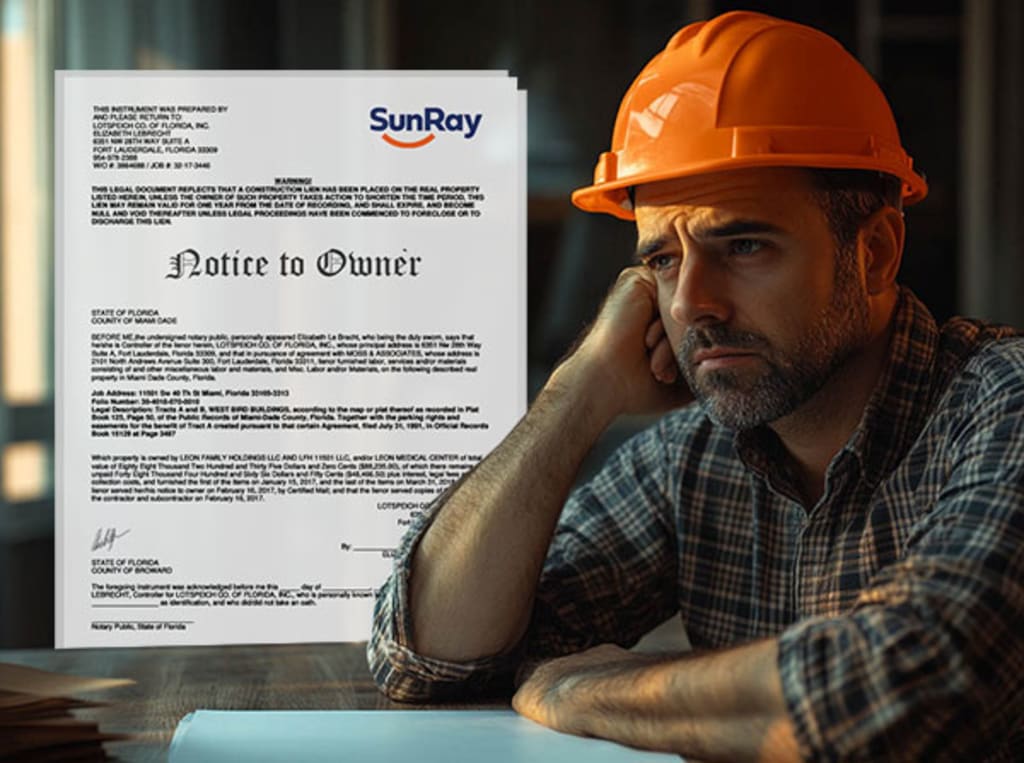
Receiving payment for a construction project in Florida frequently depends on whether you submit the correct notices punctually. A key document in this process is the Preliminary Notice, often referred to in Florida as the Notice to Owner (NTO).
Issuing a Preliminary Notice is not merely a best practice; it’s a legal obligation for many contractors, subcontractors, and suppliers aiming to maintain their lien rights. Overlooking this step might result in the inability to file a lien and ensure payment.
Article Introduction
This guide outlines the key aspects of preliminary notice regulations in Florida construction and how SunRay can assist you in streamlining the process.
What Is a Preliminary Notice (Notice to Owner) in Florida?
A Preliminary Notice is a written communication dispatched to the property owner, general contractor, and occasionally others engaged in the project, informing them that you are supplying labor, services, or materials.
In Florida, this document is referred to as a Notice to Owner (NTO). It guarantees that the property owner is aware of who is involved in the project and enables them to safeguard against duplicate payments. Most crucially, it protects your right to place a lien if any payment problems occur.
Who Is Required to Send a Florida Preliminary Notice?
Under Florida law, you must send an NTO if you are not in direct contract with the property owner, including:
- Subcontractors
- Material suppliers
- Equipment lessors
- Laborers (in some cases)
General contractors (directly contracted with the owner) are not required to send an NTO because they already have a direct relationship with the owner.
Florida Preliminary Notice Deadline (45-Day Rule)
Timing is essential. Florida law mandates that the NTO must be sent within 45 days after the initial provision of labor, materials, or services to the project. Sending it promptly, preferably as soon as you begin working, is recommended. Failing to meet the 45-day deadline results in the forfeiture of your lien rights.
How to Send a Preliminary Notice in Florida
Florida laws outline the procedure for delivering a Preliminary Notice. Permitted approaches include:
- Certified or registered mail with return receipt requested
- Actual delivery with a signed receipt
- Overnight delivery services that provide tracking and proof of receipt
- Always keep proof of delivery as it is essential if you need to file a lien later.
Required Information in a Florida Notice to Owner
A valid NTO must include:
- Your business name, address, and contact information
- A description of the property and the owner’s name
- The type of labor, services, or materials you are providing
- The name of the hiring party (contractor or subcontractor)
Even small errors in the property description or recipient details can invalidate your notice. Accuracy is key.
Consequences of Not Sending a Notice to Owner
If you fail to send a timely and proper NTO:
- You lose your lien rights in Florida.
- You may have no legal leverage to enforce payment.
- Your chances of collecting unpaid invoices drop significantly.
Common Misconceptions About Florida NTOs
- “Sending a notice will upset the owner.”
False. NTOs are standard in Florida construction and expected by most owners.
- “I don’t need one if I trust my contractor.”
Wrong. Even trusted contractors can face financial issues that affect your payment.
- “Small projects don’t require it.”
Incorrect. Florida’s lien law applies regardless of project size.
Benefits of Using SunRay for Florida Notices to Owner
Manually tracking deadlines and handling paperwork can lead to costly mistakes. SunRay simplifies the process by allowing you to:
- Prepare and send a Florida NTO in just minutes
- Ensure compliance with built-in accuracy checks
- Track deadlines and delivery automatically
- Protect your lien rights with confidence
With SunRay, you never have to worry about missing a step that could cost you payment.
Florida Notice to Owner FAQs
1. Is a Preliminary Notice the same as a Notice to Owner in Florida?
Yes. In Florida, the Preliminary Notice is called a Notice to Owner (NTO).
2. When should I send the Florida Notice to Owner?
As early as possible, but no later than 45 days after first furnishing labor, materials, or services.
3. Can I send a Florida NTO online?
Yes. Platforms like SunRay allow you to prepare and send an NTO electronically while staying fully compliant.
4. Do material suppliers need to send a Notice to Owner?
Yes. Suppliers must send an NTO to protect their lien rights, even if they only deliver materials.
5. What if the property owner refuses delivery of the NTO?
If you sent it properly (via certified mail, tracked delivery, etc.), the refusal does not invalidate your notice.
About the Creator
Raviteja Gottipati
An accomplished SEO Team Lead with 12 years of experience, specializing in content strategy and optimization. Skilled in creating engaging content across diverse industries including lifestyle, construction, real estate, and sports.
Keep reading
More stories from Raviteja Gottipati and writers in Journal and other communities.
Essential Pre-Construction Due Diligence Steps Every Stakeholder Should Know
Before breaking ground on any construction project, one of the most important steps is pre-construction due diligence. This process helps owners, contractors, investors, and other stakeholders evaluate risks, confirm feasibility, and ensure the project has the right foundation — not just structurally, but legally and financially as well.
By Raviteja Gottipati5 months ago in Journal
eCommerce Development vs Shopify Development Services: Key Differences
When businesses decide to sell online, one of the first major decisions they face is how to build their digital storefront. Some choose a fully customized approach, while others opt for a ready-to-use platform that promises speed and simplicity. This is where the comparison between eCommerce Development and Shopify development services becomes important.
By Jane Smithabout 4 hours ago in Journal
Rachel Reviews: The Spiral Archive by Pieter Hendrik
It's difficult for me to know where to start with a review of this book as it was, for me, an entirely unique experience and one that I'll probably never have again. I don't want that to be interpreted as unenjoyable but it has left me scratching my head a little and ruminating on its content, its themes and its characters.
By Rachel Deeming3 days ago in BookClub


Comments
There are no comments for this story
Be the first to respond and start the conversation.